A job interview is not only a test of your experience. It is also a test of your clarity, confidence, professionalism, and fit for the role. Career guidance from Harvard shows that employers look at your qualifications, motivation, communication, professionalism, and overall fit with the organization, while CareerOneStop and LinkedIn emphasize preparation, practice, and thoughtful storytelling as major advantages in the interview room.
That is why the best way to crack any job interview is not to memorize a few answers and hope for the best. It is to prepare in a way that helps you speak naturally, show your value clearly, and stay calm when the conversation becomes unpredictable. When you understand the role, study the company, practice your stories, and prepare your questions in advance, you give yourself a much stronger chance of making a great impression.
Table of Contents
1. Understand What Interviewers Actually Want
Before you prepare your answers, it helps to understand what the interviewer is trying to learn. Harvard career guidance explains that interviewers want to know whether you can do the job, whether you fit the culture and values of the organization, whether you are truly interested in the role, and whether you can communicate your contribution clearly. In simple terms, they are asking one big question: Why should we hire you?
This means your preparation should not focus only on sounding smart. It should focus on showing three things very clearly:
- You understand the job
- You can solve real problems
- You will work well with the team and the company culture
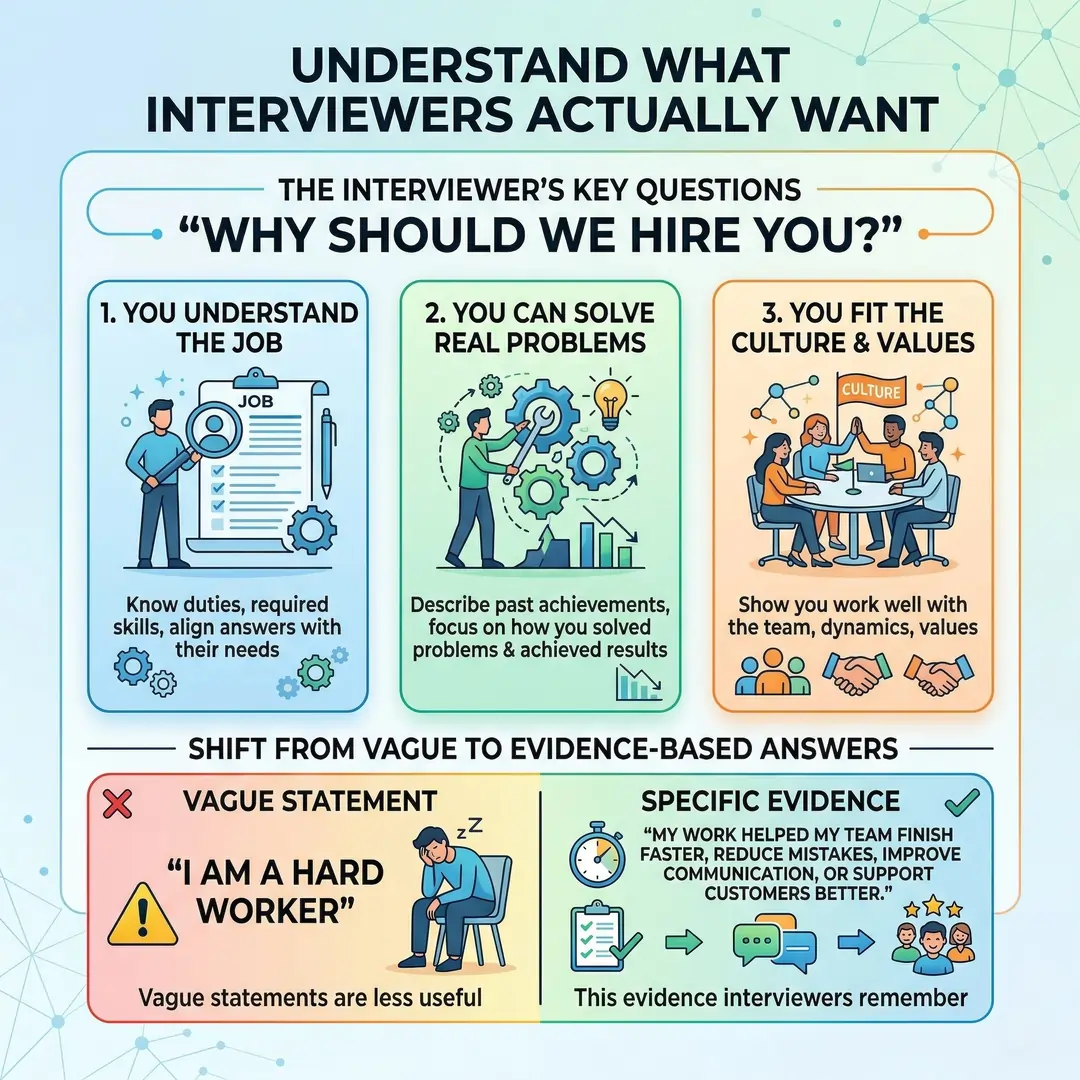
When you think this way, your answers become more useful. Instead of giving vague statements like “I am a hard worker,” you can explain how your work helped a team finish faster, reduce mistakes, improve communication, or support customers better. That is the kind of evidence interviewers remember.
2. Research the Company, Role, and Industry Thoroughly
One of the strongest interview preparation tips is to do deep research before the interview. Harvard advises candidates to study the job description, the employer’s website, printed materials, company updates, social media, and industry news so they can connect their experience with the role more clearly. CareerOneStop also recommends researching the employer and job before the interview and reviewing common interview questions ahead of time.
Good research helps you answer questions more smartly. You will know what the company does, what kind of work it values, and which problems it may need help solving. That allows you to speak in a way that feels relevant rather than generic.
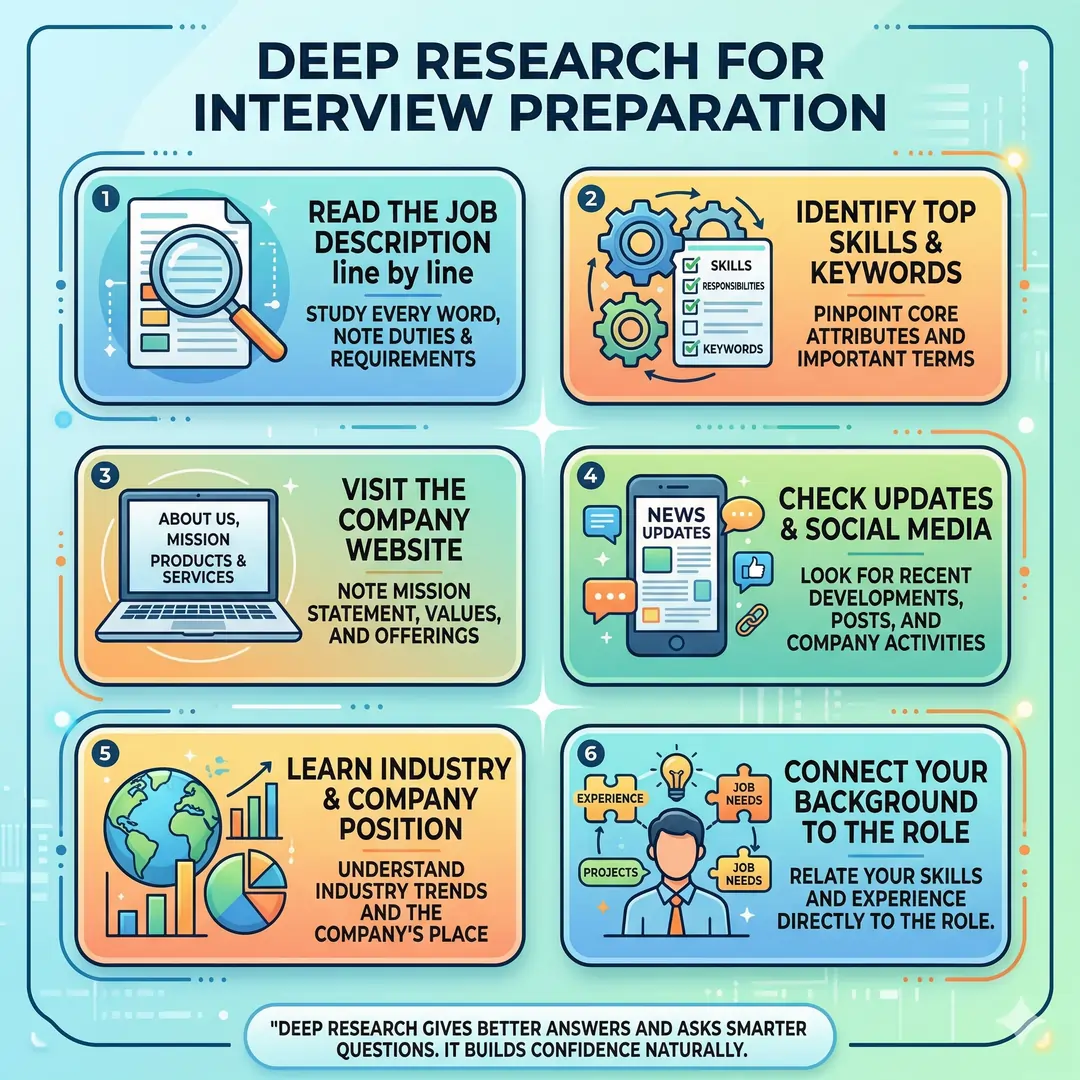
Here is a simple research checklist you can use:
- Read the job description line by line
- Identify the top skills, responsibilities, and keywords
- Visit the company website and note its mission, products, and services
- Check recent company updates, news, and social media posts
- Learn basic facts about the industry and the company’s position in it
- Think about how your background connects to the role
A useful thought to keep in mind is this. Research is not about impressing the interviewer with facts. It is about helping you give better answers and ask smarter questions. When you know the company well, your confidence grows naturally.
3. Match Your Resume to the Job You Are Interviewing For
Harvard career guidance recommends that you be ready to discuss everything on your resume in relation to the needs of the employer and the specific role. In other words, the interview is not the place to recite your resume line by line. It is the place to explain why your experience matters for this job.
A lot of candidates make the mistake of talking too generally. They say what they did, but not why it matters. Strong candidates connect the dots. They explain the situation, the challenge, the action, and the result. That makes their background easier to understand and much more memorable.
You can prepare by making a simple match chart before the interview:
| Job requirement | Your matching experience | Proof you can share |
|---|---|---|
| Communication | Led team meetings and client updates | Example of solving confusion or improving coordination |
| Problem-solving | Fixed a recurring process issue | Results such as less delay, fewer errors, or better output |
| Teamwork | Worked across departments | Example of collaboration under pressure |
| Organization | Managed deadlines and priorities | Example of handling multiple tasks successfully |
| Initiative | Started a useful improvement | Example of a small process change that saved time |
This kind of preparation helps you avoid hesitation. When a question comes up, you already know which experience to use.
4. Practice Common Interview Questions Until Your Answers Feel Natural
CareerOneStop advises candidates to review common interview questions and practice answering them out loud or with someone else. Harvard also recommends mock interviews and practice tools, while LinkedIn suggests preparing speaking points instead of scripting every word. The goal is to sound ready, not robotic.
Some common questions include:
- Tell me about yourself
- Why do you want this job?
- What are your strengths?
- What is your weakness?
- Tell me about a challenge you handled
- Where do you see yourself in five years?
- Why should we hire you?
The best way to practice is not to memorize a speech. It is to build a clear structure. For each important question, prepare a few bullet points that cover the main idea, one example, and one result. LinkedIn specifically recommends bullet point preparation rather than word-for-word scripting because it keeps you flexible and authentic.
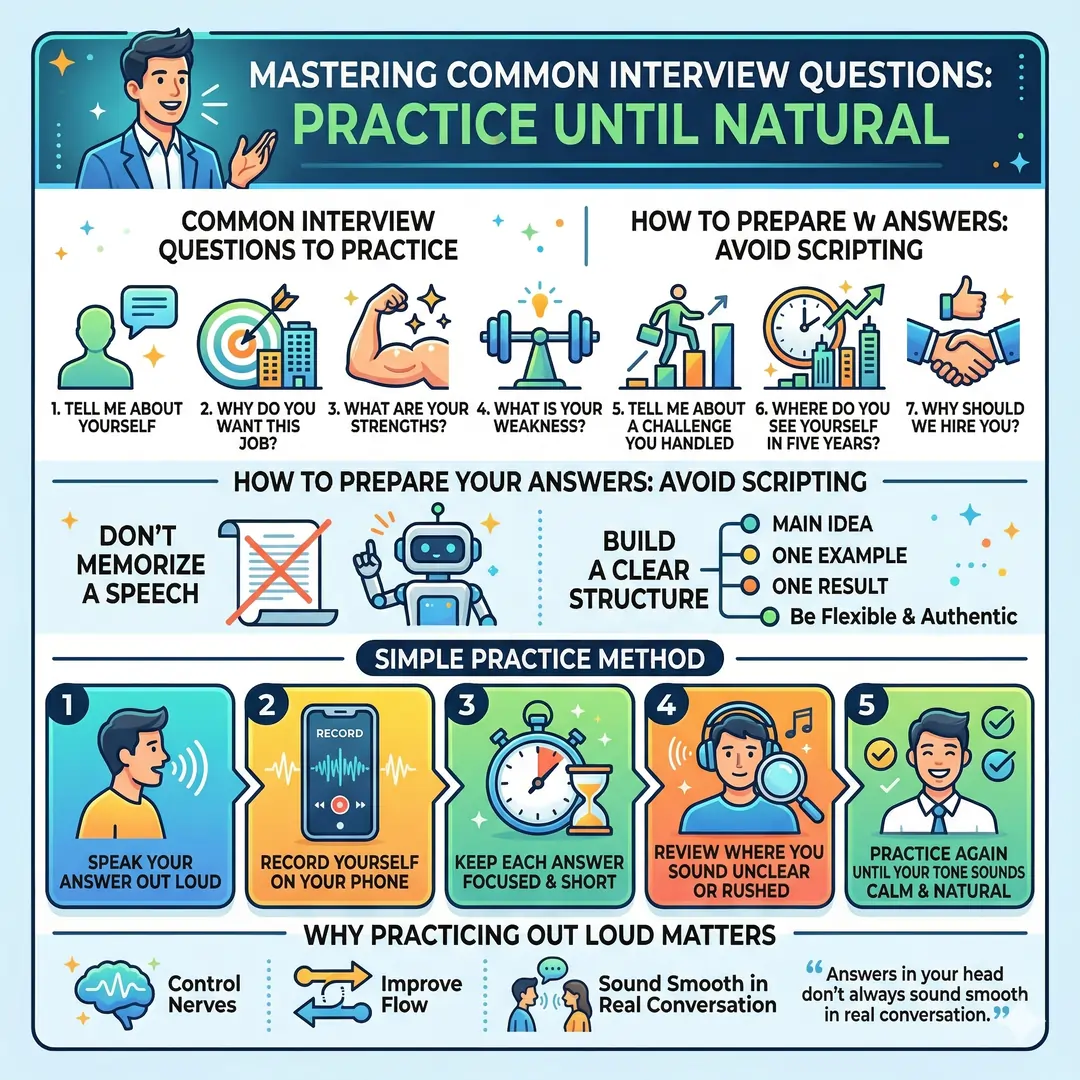
A simple practice method
- Speak your answer out loud
- Record yourself on your phone
- Keep each answer focused and short
- Review where you sound unclear or rushed
- Practice again until your tone sounds calm and natural
Practicing out loud matters because an answer that sounds good in your head may not sound smooth in a real conversation. Rehearsal helps you control nerves and improve your flow.
5. Use the STAR Method for Behavioral Questions
Behavioral interview questions ask about how you handled past situations. Harvard Law School explains that employers use these questions to understand your past performance and predict future performance. It also recommends the STAR method, which stands for Situation, Task, Action, and Result.
This method is one of the most powerful tools in job interview preparation because it keeps your answer organized and specific. It helps you avoid rambling while still showing real experience.
How the STAR method works
- Situation: Set the context briefly
- Task: Explain what needs to be done
- Action: Describe the steps you took
- Result: Share the outcome and what you learned
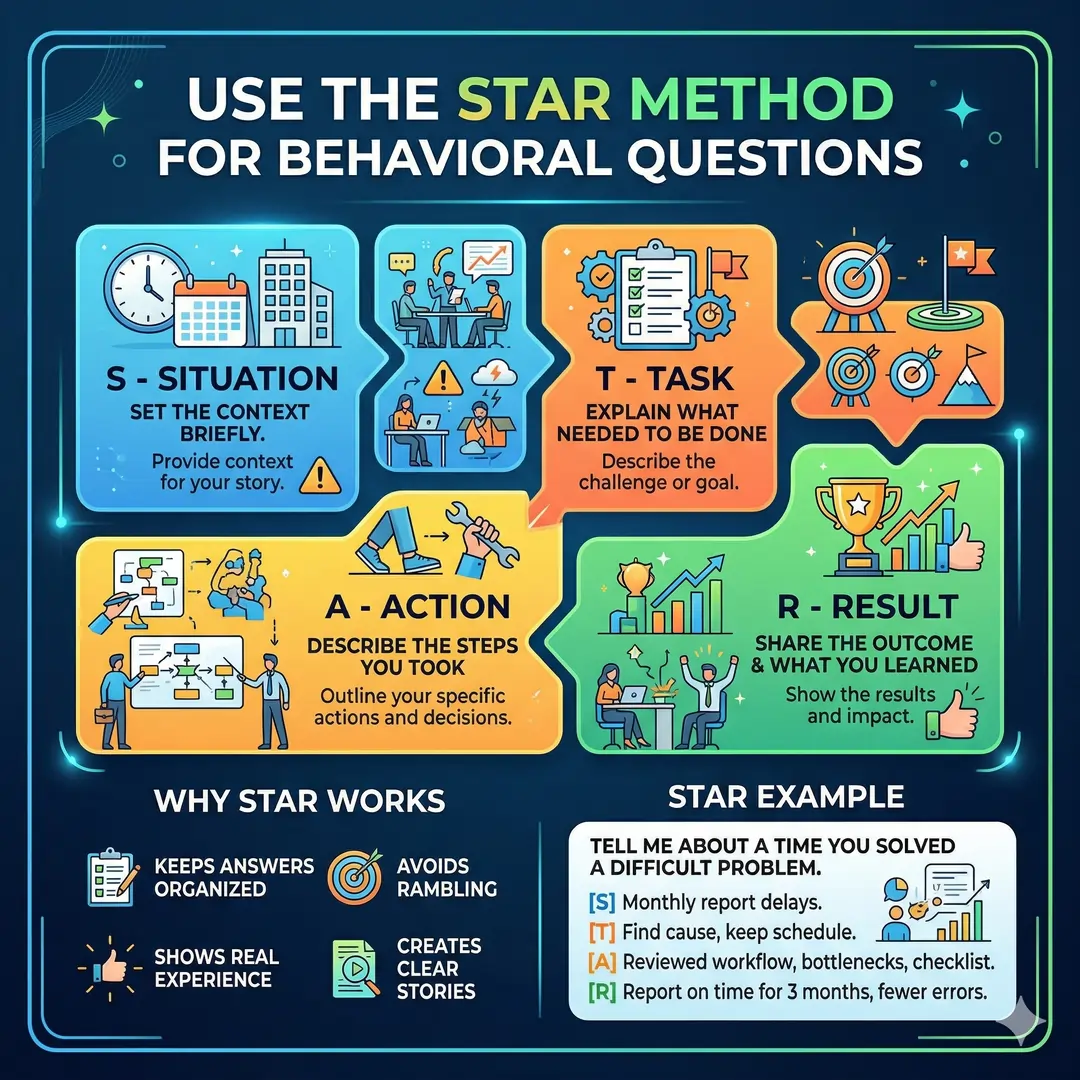
Example
Question: Tell me about a time you solved a difficult problem.
Answer using STAR:
- Situation: My team had a recurring delay in monthly reporting.
- Task: I needed to find the cause and help the team stay on schedule.
- Action: I reviewed the workflow, identified repeated bottlenecks, and created a clearer checklist.
- Result: The report went out on time for the next three months, and the team spent less time correcting errors.
You do not need to make your story dramatic. You only need to make it clear, relevant, and honest. The strongest answers usually sound simple because they are easy to follow.
6. Build a Strong Personal Pitch
One question appears in almost every interview, Tell me about yourself. LinkedIn notes that interviewers do not want a full life story or a resume recap. They want a concise, relevant answer that tells them why you are the right person for this role.
A strong personal pitch usually has three parts:
- Who you are professionally
- What have you done that is relevant
- Why does this role fit your goals now
Example structure
“I am a customer support professional with experience handling client queries, resolving service issues, and improving communication between teams. In my last role, I helped reduce response time by organizing the ticket flow more efficiently. I am now looking for a role where I can use those skills to support customers in a more structured and growth-focused environment.”
That kind of answer is direct, confident, and useful. It gives the interviewer a quick summary while leaving room for follow-up questions.
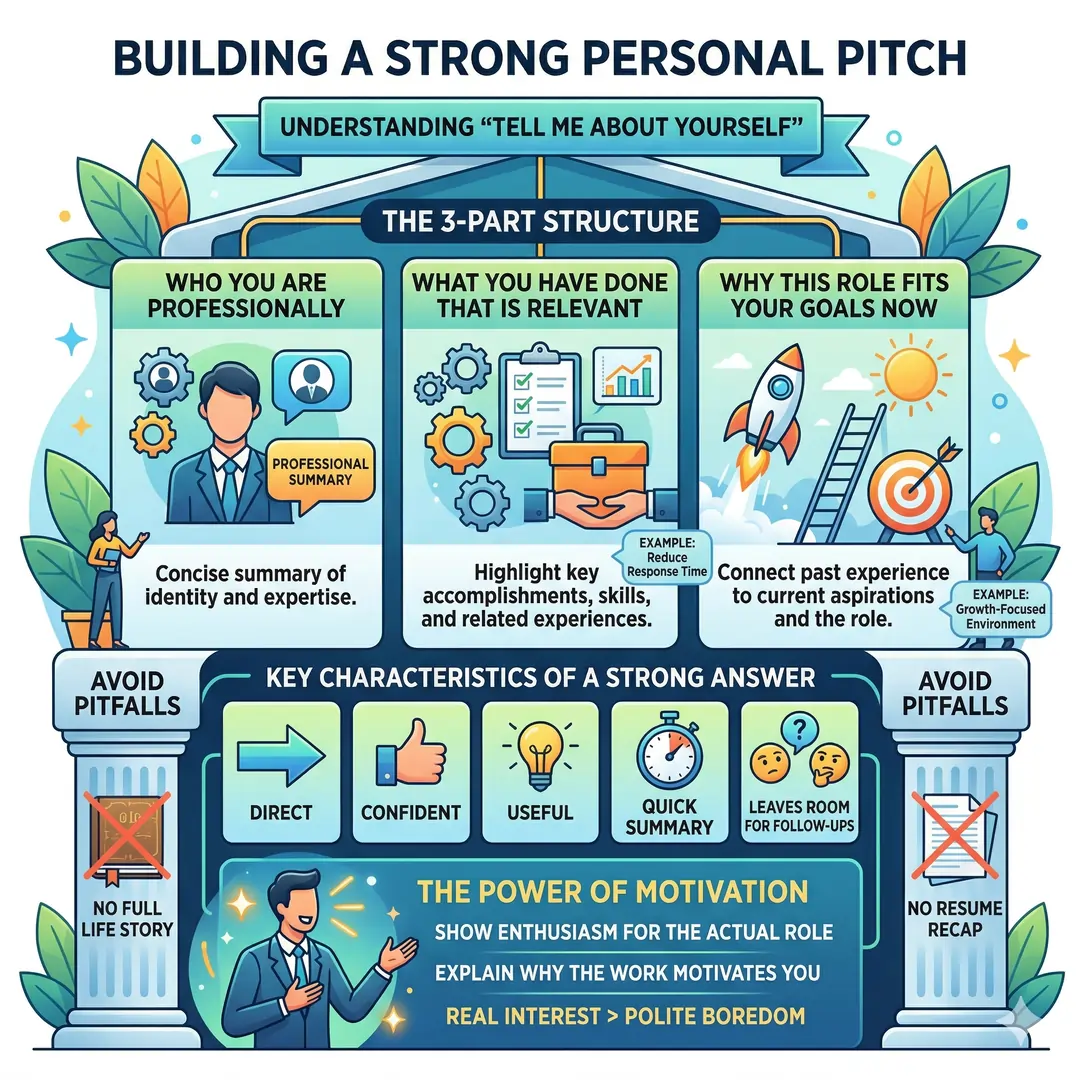
LinkedIn also suggests showing enthusiasm for the actual role, not just the company name. Employers want to sense real interest, not polite boredom. When you explain why the work itself motivates you, your answer becomes more convincing.
7. Learn How to Sell Your Strengths Without Sounding Arrogant
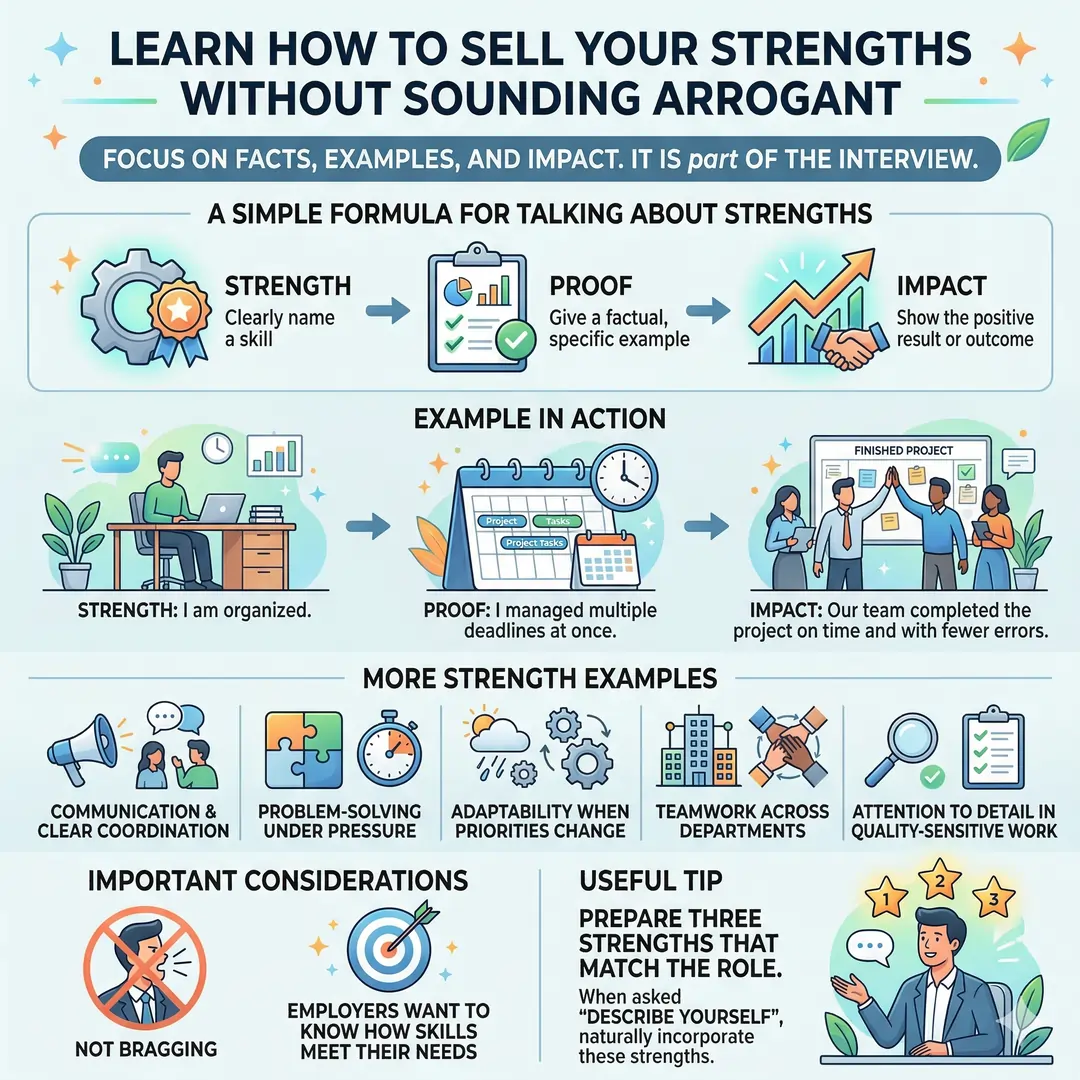
Talking about your strengths is not bragging. It is part of the interview. LinkedIn recommends sharing your strengths clearly and backing them up with facts, examples, and feedback from others. Harvard also stresses that employers want to know how your skills can meet their needs.
A simple way to talk about strengths is to use this formula:
Strength + proof + impact
For example:
- Strength: I am organized
- Proof: I managed multiple deadlines at once
- Impact: Our team completed the project on time and with fewer errors
More strength examples
- Communication and clear coordination
- Problem-solving under pressure
- Adaptability when priorities change
- Teamwork across departments
- Attention to detail in quality-sensitive work
A useful tip is to prepare three strengths that match the role. If the interviewer asks you to describe yourself, you can naturally bring in those strengths instead of trying to invent them on the spot.
8. Prepare Smart Questions to Ask the Interviewer
An interview is not only for the employer to evaluate you. It is also your chance to evaluate the employer. Harvard says interviews help you see whether the role aligns with your interests, skills, values, and goals, while CareerOneStop recommends making a list of questions to ask during the interview.
Asking thoughtful questions shows interest, maturity, and preparation. It also helps you understand whether this job is really the right fit for you.
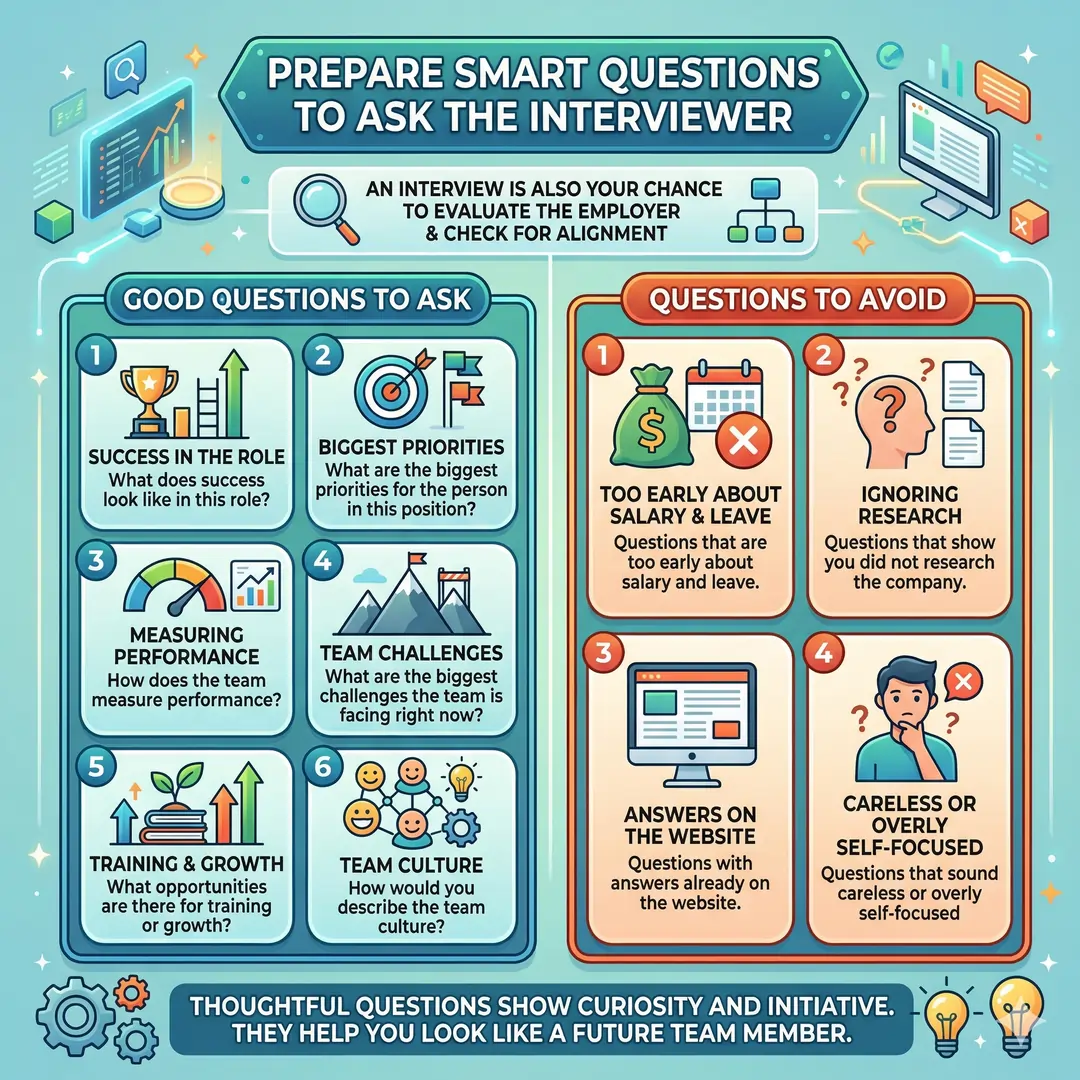
Good questions to ask
- What does success look like in this role?
- What are the biggest priorities for the person in this position?
- How does the team measure performance?
- What are the biggest challenges the team is facing right now?
- What opportunities are there for training or growth?
- How would you describe the team culture?
Questions to avoid
- Questions that are too early about salary and leave
- Questions that show you did not research the company
- Questions with answers already on the website
- Questions that sound careless or overly self-focused
The best questions show curiosity and initiative. They help you look like someone who is already thinking like a future team member.
9. Focus on Body Language, Eye Contact, and Professional Presence
Interview success is not only about words. Harvard notes that a professional appearance matters, and LinkedIn highlights the importance of a strong first impression. Eye contact, a calm voice, and a confident posture all help shape that impression.
Here are some practical reminders:
- Sit upright but relaxed
- Make natural eye contact
- Smile when appropriate
- Avoid fidgeting too much
- Speak clearly and steadily
- Listen carefully before answering
Your clothing also matters. Harvard advises candidates to dress appropriately and, when possible, dress one level more formally than the usual workplace style. CareerOneStop also emphasizes dressing professionally for interviews.
Simple rule for dressing
Choose clothing that is clean, neat, comfortable, and suitable for the industry. The goal is not to look flashy. The goal is to look polished and respectful.
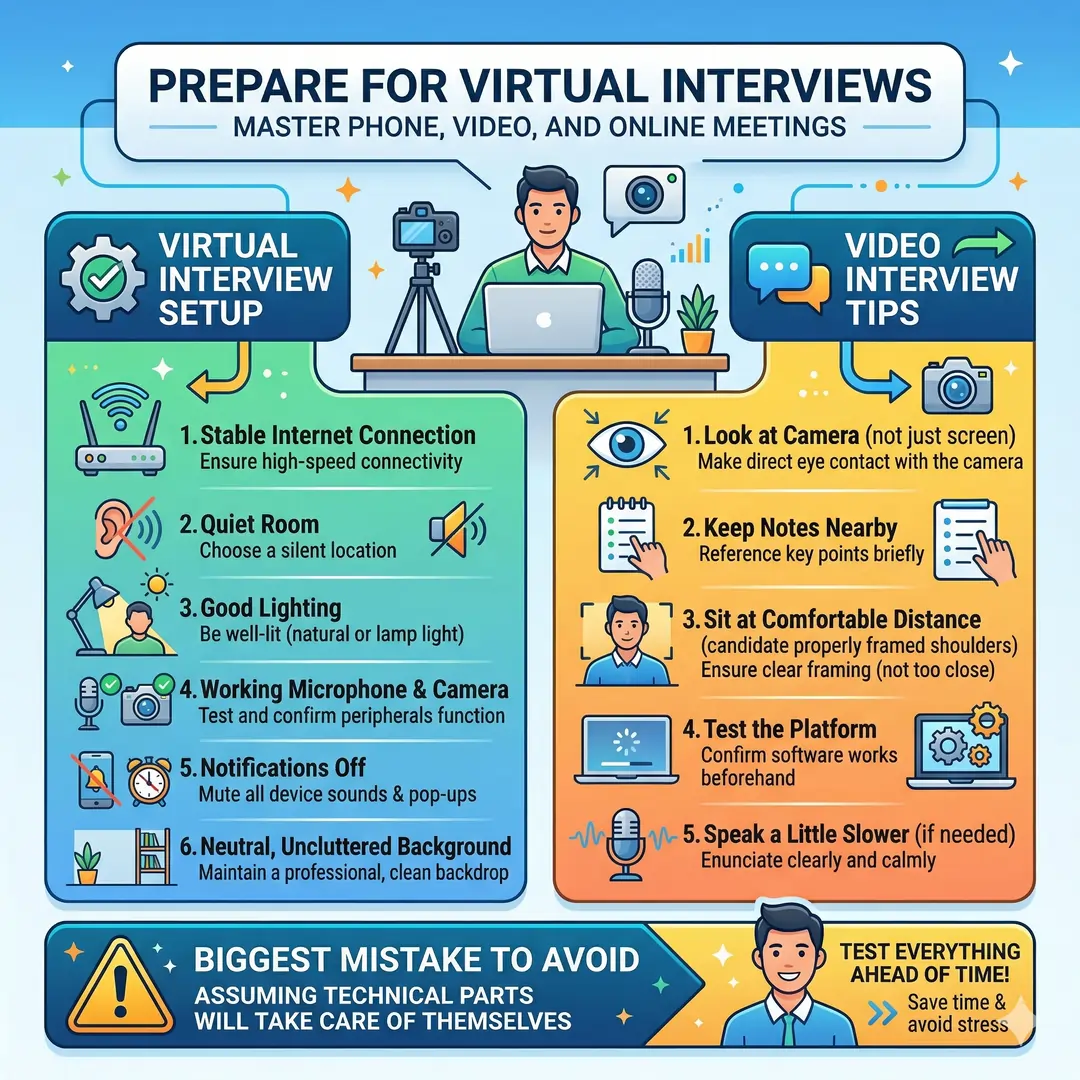
10. Prepare for Phone, Video, and Online Interviews
Many interviews happen online now, so you should prepare for video calls just as carefully as in-person meetings. CareerOneStop says video interview candidates should practice in mock interviews and test their equipment ahead of time. LinkedIn also discusses setup, attire, and finishing strong in remote interviews.
A strong virtual interview setup includes:
- A stable internet connection
- A quiet room
- Good lighting
- A working microphone and camera
- Notifications turned off
- A neutral, uncluttered background
Video interview tips
- Look at the camera sometimes, not only the screen
- Keep notes nearby, but do not read from them
- Sit at a comfortable distance from the camera
- Test the platform before the interview starts
- Speak a little more slowly than usual if needed
The biggest mistake in virtual interviews is assuming the technical part will take care of itself. A few minutes of testing can save you from stress later.
11. Arrive Early and Start Strong
CareerOneStop recommends planning your schedule so you arrive 10 to 15 minutes early for an in-person interview. That gives you time to settle in, breathe, and begin the conversation calmly instead of being rushed and flustered.
For online interviews, the same principle applies in a different form. Log in early, open your documents, and make sure everything works before the meeting begins. That shows respect and preparedness.
Starting strong matters because first impressions often shape the tone of the full interview. LinkedIn advises candidates to plan their first impression carefully and answer the opening questions directly rather than drifting into a long resume summary.
12. Tell Short, Clear Stories Instead of Long Monologues
LinkedIn recommends using stories with a beginning, middle, and end. A good answer should include just enough context, the action you took, and the outcome. It also suggests keeping stories under two minutes, using I instead of we where appropriate, and making the response feel like the start of a conversation rather than a speech.
This is a very practical interview skill. Many candidates lose the interviewer because they talk too much without direction. A focused story is easier to follow and shows that you can communicate clearly under pressure.
A good story should answer these questions
- What was the situation?
- What did you need to do?
- What did you personally do?
- What was the result?
- What did you learn?
13. Practice Mock Interviews Whenever Possible
Mock interviews are one of the most useful preparation tools. Harvard promotes mock interview support, and CareerOneStop says candidates can practice with a friend, a free interview practice website, or a local American Job Center.
Mock interviews help you notice problems that are hard to see on your own. For example:
- You may speak too fast
- You may repeat yourself too much
- You may forget to mention the results
- You may sound unsure on common questions
- You may not realize your posture is closed off
Even one practice session can make a major difference. The more realistic the practice, the more comfortable you will feel in the real interview.
14. Send a Thoughtful Thank-You Note
CareerOneStop recommends sending a thank-you email or letter after the interview and trying to send it within 24 hours. That small step helps you show professionalism and continued interest.
A good thank-you note should include:
- Appreciation for the interviewer’s time
- A brief reminder of your interest
- One short point that reinforces your fit
- A polite closing
Simple example
“Thank you for speaking with me today about the marketing coordinator role. I enjoyed learning more about your team’s goals and the work ahead. Our conversation made me even more interested in the opportunity, and I believe my background in campaign coordination and content planning would allow me to contribute quickly. Thank you again for your time and consideration.”
A well-written follow-up can leave a final positive impression, especially if several candidates are similar in qualifications.
15. Common Interview Mistakes to Avoid
Even strong candidates sometimes lose opportunities because of simple mistakes. The good news is that most of these are easy to prevent with preparation. Harvard and CareerOneStop both emphasize readiness, professionalism, and clear communication as key parts of interview success.
Mistakes that hurt many candidates
- Arriving late or logging in late
- Speaking without understanding the role
- Giving memorized, unnatural answers
- Talking too much without a clear point
- Not asking any questions
- Failing to research the company
- Dressing inappropriately
- Forgetting to send a thank-you note
The best way to avoid these problems is to prepare early and treat the interview like an important professional meeting, not a casual chat.
16. Interview Preparation Timeline Table
| When to prepare | What to do | Why it matters | Practical example |
|---|---|---|---|
| 7 to 5 days before | Research the company, the role, and the industry | Helps you answer with context and relevance | Read the company website, recent news, and the job description |
| 5 to 3 days before | Match your resume to the job and create story examples | Helps you show fit with real evidence | Prepare 3 stories using the STAR method |
| 3 to 2 days before | Practice common questions out loud | Improves fluency and confidence | Record your answer to Tell me about yourself |
| 1 day before | Prepare outfit, documents, directions, and questions | Reduces stress on interview day | Print your resume and note 5 smart questions |
| Interview day | Arrive early, stay calm, and listen carefully | Creates a strong first impression | Enter 10 to 15 minutes early or log in early for virtual calls |
| After the interview | Send a thank-you note within 24 hours | Shows professionalism and continued interest | Write a short note that mentions one key topic from the conversation |
17. Common Interview Question Strategy Table
| Question type | What the interviewer wants | Best answer style | Example approach |
|---|---|---|---|
| Tell me about yourself | A clear professional summary | Short, relevant, role-focused | Present past, present, future in 30 to 60 seconds |
| Why do you want this job? | Your motivation and fit | Connect your goals to the role | Explain why the work interests you and how it matches your skills |
| What are your strengths? | Evidence of value | Strength plus proof plus result | “I am detail-oriented, and that helped me reduce errors in reporting.” |
| What is your weakness? | Self-awareness and growth | Honest, controlled, improving | Mention a real but manageable weakness and how you are improving it |
| Tell me about a challenge | Problem-solving ability | Use STAR | Explain the issue, your action, and the result |
| Where do you see yourself in five years? | Stability and ambition | Show realistic growth | Describe developing skills and contributing more deeply |
| Why should we hire you? | Your strongest value proposition | Tie your background to the employer’s needs | Show how your skills solve their problems |
| Do you have questions for us? | Interest and preparation | Ask thoughtful questions | Ask about success, team goals, and next steps |
18. A Simple Final Preparation Checklist
Before your interview, make sure you can confidently check off these items:
- You know the company and the role well
- You can explain your resume clearly
- You have 3 to 5 strong stories ready
- You have practiced common questions out loud
- You know your top strengths
- You have smart questions to ask
- You have prepared your clothes, documents, and setup
- You know how to send a thank-you note afterward
This checklist is simple, but it covers the areas that matter most. It supports clarity, confidence, and professionalism, which are exactly the qualities employers are hoping to see.
Final Thoughts
The best interview preparation is not about sounding perfect. It is about being prepared, clear, and believable. Harvard career resources, CareerOneStop guidance, and LinkedIn’s interview advice all point to the same core idea. Candidates do best when they research carefully, practice speaking points, use strong examples, show enthusiasm, and follow up professionally.
If you remember only one thing from this article, remember this. A great interview is built before the interview begins. The more time you spend preparing your stories, your questions, your research, and your mindset, the easier it becomes to speak naturally and make a strong impression when it matters most.
Also, Read these Articles in Detail
- Top Interview Questions and Answers Guide
- Interview Questions and Answers for Freshers and Experienced Candidates
- Common Interview Questions and Best Answers for Job Seekers
- “Tell me about yourself” Interview Answer Examples and Tips
- Strengths and Weaknesses Interview Questions and Sample Answers
- Behavioral Interview Questions and Answers Using the STAR Method
- How to Answer “Why Should We Hire You” in a Job Interview
- How to Answer “Why Do You Want This Job?” with Examples
- Situational Interview Questions and Answers for Better Preparation
- Phone Interview Questions and Answers for Job Seekers
Article References And Citations
- Harvard Career Services – Interview Preparation Guide
https://careerservices.fas.harvard.edu/channels/prepare-for-an-interview/ - Harvard Extension School – Interviewing Guide PDF
https://cdn-careerservices.fas.harvard.edu/wp-content/uploads/sites/161/2024/08/2024-HES-interviewing-edited-1.pdf - Harvard Law School – STAR Method for Interviews
https://hls.harvard.edu/bernard-koteen-office-of-public-interest-advising/opia-job-search-toolkit/interview-questions/ - CareerOneStop – Interview Tips
https://www.careeronestop.org/JobSearch/Interview/interview-tips.aspx - CareerOneStop – Common Interview Questions
https://www.careeronestop.org/JobSearch/Interview/common-interview-questions.aspx - CareerOneStop – Interview Preparation Guide
https://www.careeronestop.org/JobSearch/Interview/get-ready.aspx - CareerOneStop – Types of Interviews
https://www.careeronestop.org/JobSearch/Interview/types-of-interviews.aspx - CareerOneStop – Virtual Interview Tips
https://www.careeronestop.org/JobSearch/Interview/virtual-interviews.aspx - CareerOneStop – Interview Follow-Up Guide
https://www.careeronestop.org/JobSearch/Interview/interview-and-negotiate.aspx - LinkedIn Learning – Interview Skills Guide
https://www.linkedin.com/business/learning/blog/job-seeking-tips/6-interview-skills-that-will-get-you-hired-2023 - LinkedIn Learning – Video Interview Preparation
https://www.linkedin.com/business/learning/blog/job-seeking-tips/video-job-interview-preparation-tips-resources
Frequently Asked Questions
FAQ 1. What is the best way to prepare for a job interview?
The best way to prepare for a job interview is to combine research, practice, and self-confidence. You should begin by studying the job description carefully so you understand the main responsibilities, required skills, and expectations for the role. After that, learn about the company, its products or services, its values, and the kind of work it does. This gives you a strong base for answering questions in a way that feels relevant and professional.
It is also important to prepare your own stories and examples before the interview. Think about situations where you solved problems, worked in a team, showed leadership, handled pressure, or achieved results. When you connect your experience to the needs of the role, your answers become much stronger. Good interview preparation is not about memorizing lines. It is about knowing your strengths well enough to speak clearly and naturally when the interviewer asks questions.
FAQ 2. Why is company research so important before an interview?
Company research matters because it helps you understand what the employer is looking for and how you can fit into that picture. When you know the company’s mission, culture, recent updates, and business goals, you can answer questions with more confidence and relevance. This often makes a much better impression than giving general answers that could apply to any job.
Research also helps you ask better questions at the end of the interview. Instead of asking something basic that could have been found on the company website, you can ask thoughtful questions about team goals, challenges, growth opportunities, or success in the role. That shows the interviewer that you are serious, prepared, and genuinely interested in the opportunity. A well-researched candidate usually sounds more focused and professional.
FAQ 3. How should I answer the question, “Tell me about yourself”?
A strong answer to “Tell me about yourself” should be short, clear, and focused on your professional background. The best structure is to talk about who you are now, what experience you have, and why this job is a good next step for you. This question is not the time to share your full life story. It is your chance to give a polished introduction that helps the interviewer understand your value quickly.
For example, you can mention your current role, your strongest skills, and one or two achievements that connect to the job you want. Then finish by explaining why you are interested in the position. This keeps your answer natural and easy to follow. A well-prepared response to this question can set the tone for the rest of the interview and make you seem confident from the very beginning.
FAQ 4. What is the STAR method, and why is it useful in interviews?
The STAR method is a simple way to answer behavioral interview questions. It stands for Situation, Task, Action, and Result. This method helps you tell a clear story about something you did in the past. Instead of giving a messy or incomplete answer, you explain what happened, what needed to be done, what you did, and what result followed. This makes your answer easy to understand and much more convincing.
The STAR method is especially useful when interviewers ask about challenges, teamwork, leadership, conflict, problem-solving, or achievements. It helps you stay organized and avoid rambling. It also shows that you can think clearly and explain your actions in a professional way. If you prepare a few STAR examples in advance, you will be ready for many common interview questions without feeling nervous or unprepared.
FAQ 5. How can I talk about my strengths without sounding arrogant?
The key to talking about your strengths is to stay honest, specific, and humble. Instead of simply saying, “I am the best,” you should explain a real strength and support it with an example. For example, you can say that you are organized, detail-oriented, adaptable, or good at communication, then briefly show how that strength helped you in a real situation. This makes your answer believable and professional.
It also helps to connect your strengths to the job you are applying for. If the role needs teamwork, talk about how well you collaborate with others. If it needs accuracy, explain how your attention to detail helped reduce errors or improve quality. This approach makes you sound confident without sounding braggy. Interviewers usually appreciate candidates who can speak about their strengths in a calm, mature, and factual way.
FAQ 6. What are the most common mistakes people make in job interviews?
One of the most common mistakes is not preparing enough. Many candidates walk into an interview without fully understanding the company, the role, or the kind of questions they might be asked. This often leads to vague answers, nervous pauses, and weak examples. Another common mistake is speaking too much without a clear point. A long answer is not always a strong answer. What matters most is clarity, relevance, and confidence.
Other mistakes include arriving late, dressing inappropriately, avoiding eye contact, forgetting to ask questions, or failing to send a thank-you note after the interview. Some candidates also memorize answers so heavily that they sound unnatural. The best way to avoid these problems is to prepare early, practice out loud, and focus on being professional and genuine. A calm, thoughtful interview style usually leaves a better impression than a rushed or overly rehearsed one.
FAQ 7. How can I improve my body language during an interview?
Good body language can make a big difference in how an interviewer sees you. Sit up straight, maintain natural eye contact, and avoid movements that make you look nervous, such as tapping your feet or playing with your hands. A calm posture and a relaxed face can help you appear more confident and more comfortable. Even small things like a polite smile and a steady voice can improve the way you are perceived.
You should also pay attention to how you listen. Good body language is not only about speaking well. It is also about showing that you are engaged. Nod when appropriate, look interested, and give the interviewer your full attention. In a video interview, make sure your camera, lighting, and background are professional. When your body language supports your words, you come across as more polished and trustworthy.
FAQ 8. How should I prepare for a video interview?
A video interview should be treated with the same seriousness as an in-person interview. Start by testing your camera, microphone, and internet connection before the interview day. Make sure your background looks clean and professional, and choose a quiet space where you will not be interrupted. Good lighting is also important because it helps the interviewer see you clearly and creates a better overall impression.
You should also dress professionally, just as you would for a face-to-face interview. Keep your resume, notes, and job description nearby, but do not read from them word for word. It is best to look at the camera from time to time so the interviewer feels that you are engaged. A video interview may feel different at first, but with the right preparation, it can feel smooth, natural, and comfortable.
FAQ 9. What kind of questions should I ask the interviewer at the end?
At the end of an interview, it is a good idea to ask questions that show interest, curiosity, and preparation. Good questions might include asking what success looks like in the role, what the team is currently working on, what challenges the team faces, or how the company supports professional growth. These kinds of questions show that you are already thinking like someone who may join the team.
You should avoid asking questions that sound careless or show that you did no research. For example, do not ask something that is clearly explained in the job description or on the company website. Also, avoid focusing too early on salary, leave, or benefits unless the interviewer brings them up. Strong questions make the conversation more meaningful and help you decide whether the job is the right fit for you.
FAQ 10. Why is follow-up after the interview so important?
Following up after an interview is important because it shows professionalism, courtesy, and continued interest in the job. A short thank-you note or email can leave a strong final impression. It reminds the interviewer that you appreciated their time and that you are still enthusiastic about the role. This small step can matter more than many candidates realize.
A good follow-up message should be brief, polite, and specific. Thank the interviewer for the conversation, mention one point that stood out to you, and restate your interest in the position. You do not need to write a long message. Even a simple note sent within 24 hours can help you stand out positively. In many cases, this is one of the easiest ways to show maturity and strong communication skills after the interview has ended.
