One of the most common interview questions is also one of the most important. When an interviewer asks, “Why do you want this job?” they are not just making small talk. They are trying to understand your motivation, your fit, your interest in the company, and your ability to explain the value you can bring. Harvard Career Services explains that interviews are used to assess your qualifications, your fit with the organization, how clearly you explain your contribution, and how well your reasons for applying make sense. Berkeley and UNC also note that employers use interviews to judge whether you can do the job, whether you will do the job, and whether you will fit in with the organization.
That is why a strong answer should never sound lazy, generic, or overly focused on what you want from the company. The best response shows that you understand the role, you have researched the organization, and you can connect your skills and goals to what the employer needs. Stanford describes interviewing as a search for alignment, where skills matter, but motivations and values matter too. Harvard Business Review similarly advises candidates to focus on a specific match between their interests, the role, and the employer’s goals.
Table of Contents
Why employers ask this question
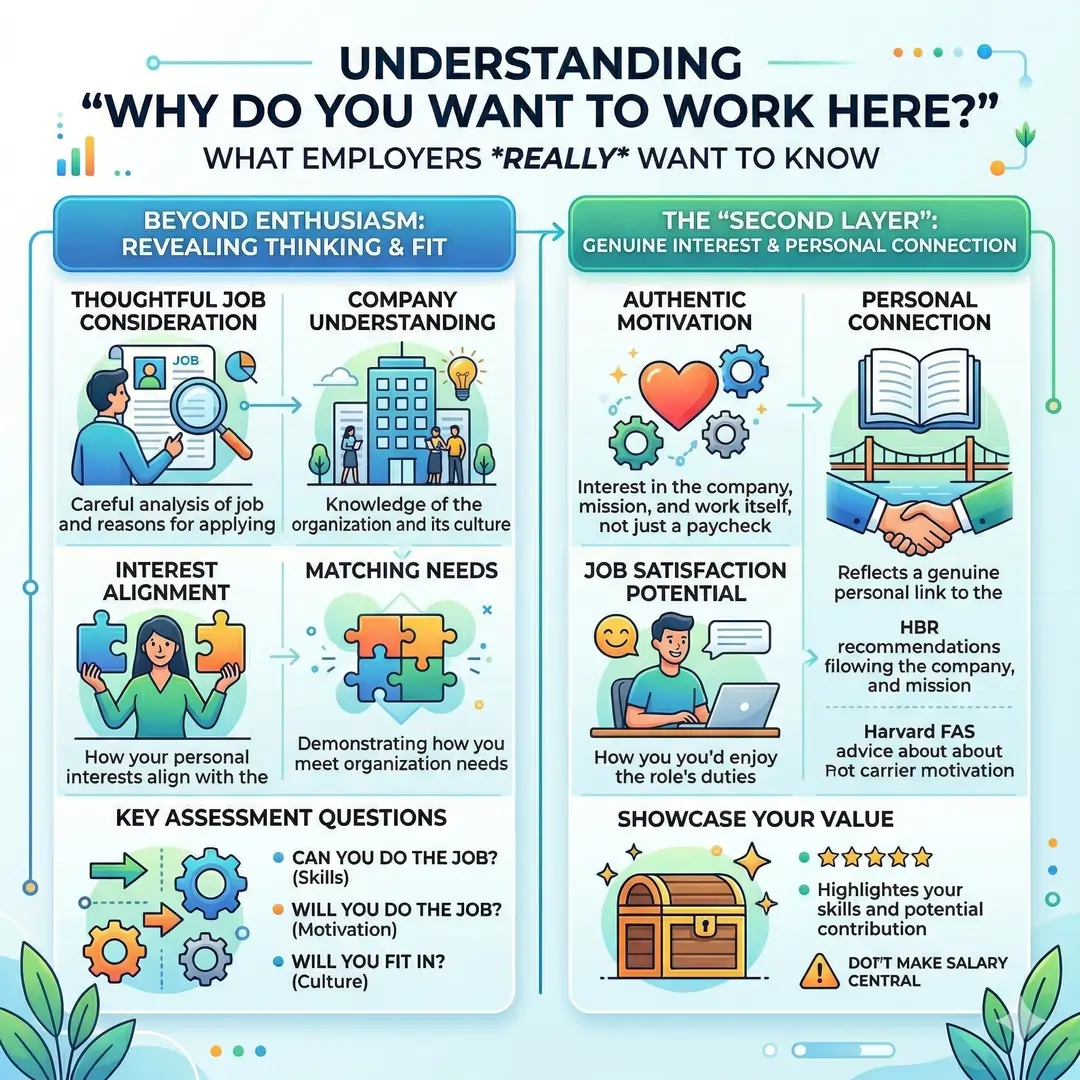
This question is designed to reveal more than enthusiasm. Employers want to know whether you have thought carefully about the job, whether you understand the company, and whether your interests line up with the work itself. Harvard FAS notes that interviewers assess how well you considered your reasons for applying and how clearly you express your potential contribution. UNC says employers want evidence that you can do the job, will do the job, and will fit in with the organization. Berkeley adds that interviews also let employers see how your skills, experience, and personality match their needs.
- Also, Read this Article in Detail
There is also a second layer to this question. The interviewer wants to hear whether you are genuinely interested in the company, the mission, and the work itself, not just a paycheck or any available opening. Harvard Business Review recommends that your answer should reflect a personal connection to the employer and an explanation of why you would enjoy the role’s responsibilities. Harvard also warns that, when discussing career motivation, it is smarter to emphasize the value and skill set you bring rather than making salary the center of the conversation.
The best structure for your answer
A clear answer is usually built from three parts:
- A specific reason you want this company
- A specific reason you want this role
- A specific reason you are a strong fit for the role
That structure works because it connects research, motivation, and value. UNC recommends researching the employer, the role, and the company’s mission, history, products, and growth before the interview. Cornell also advises candidates to show how their experience and motivations connect to the company’s needs. HBR’s guidance echoes this approach by encouraging candidates to focus on the match and speak directly to the employer’s needs.
A simple formula you can follow
Use this pattern:
“I want this job because [company reason], the role excites me because [responsibility reason], and I believe I can contribute by [skill or experience reason].”
This is easy to remember and easy to personalize. It also helps you avoid the two biggest interview mistakes, sounding too generic or sounding like you are only interested in what the job does for you.
What a strong answer should include
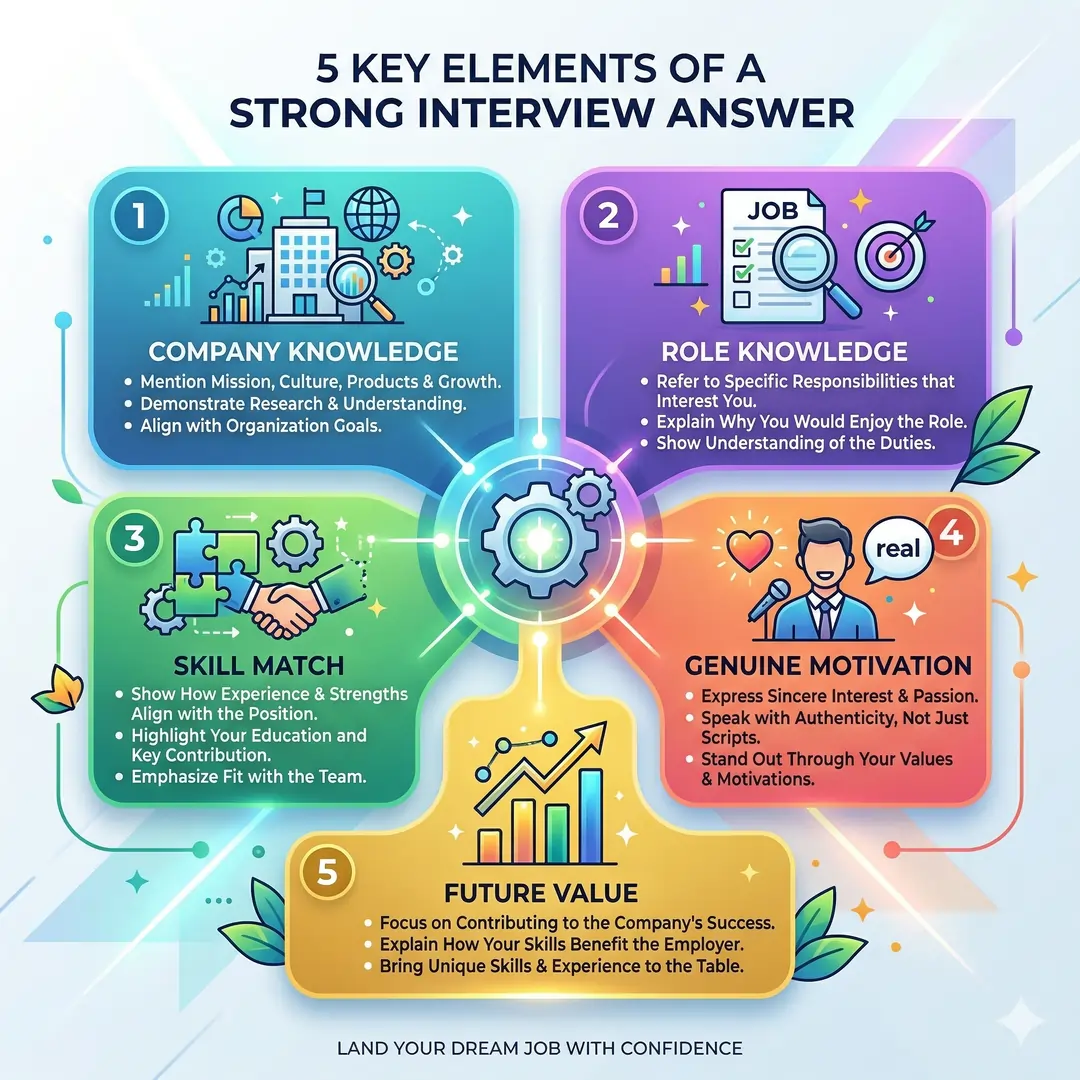
A strong answer usually includes these elements:
- Company knowledge
- Mention the mission, culture, products, services, growth, or reputation of the organization. UNC recommends showing that you know the company and its goals.
- Role knowledge
- Refer to responsibilities in the job description that genuinely interest you. HBR suggests explaining why you would enjoy the responsibilities of the role.
- Skill match
- Show how your experience, education, or strengths align with the position. Harvard, UNC, and Cornell all emphasize contribution and fit.
- Genuine motivation
- Let your answer sound real. Stanford notes that successful candidates stand out through motivations and values, not just polished packaging.
- Future value
- Explain how you can help the company, not just how the company can help you. UNC Kenan-Flagler frames interviewing as a process of presenting the skills, experience, knowledge, and motivations you bring to the table.
A large table of answer-building blocks
| Part of the answer | What you should say | What it shows | Why it works |
|---|---|---|---|
| Company fit | Mention the company’s mission, products, values, or direction | You did your research | UNC recommends showing knowledge of the organization, including its mission and development. |
| Role fit | Talk about the actual responsibilities that interest you | You understand the work | HBR says to explain why you would enjoy the responsibilities of the role. |
| Skill fit | Connect your background to the position | You can contribute immediately | Harvard and Cornell stress contribution and transferable skills. |
| Motivation | Share a real reason the job appeals to you | You are genuinely interested | Stanford says interview success comes from motivations and values as well as skills. |
| Future fit | Explain how the role supports your career goals | You are likely to stay engaged | Harvard says interviews also help evaluate whether the opportunity aligns with your professional interests, skills, values, and goals. |
| Contribution | Show how your strengths solve problems for the employer | You are valuable, not just interested | UNC and Harvard both emphasize what you can contribute to the organization. |
How to prepare your answer before the interview
Preparation makes the answer sound natural, not rehearsed. Start by reading the job description carefully and identifying the responsibilities that matter most. Then research the company’s mission, recent developments, products, services, and culture. UNC specifically recommends researching the organization’s mission, history, growth, products, competitors, and locations. Cornell’s interview guidance also suggests reviewing the job posting and company news so you can uncover useful details to discuss.
After that, connect the role to your background. Ask yourself:
- What parts of this job genuinely excite me?
- Which parts of my experience are most relevant?
- What result can I help this employer achieve?
- Why does this organization stand out from similar employers?
Harvard says the interview is also your chance to decide whether the opportunity aligns with your own interests and goals, so your answer should feel like a thoughtful match rather than a forced sales pitch.
A practical answer formula you can reuse
Formula 1: Company, role, value
“I want to work here because of the company’s mission and the direction it is heading. I am especially interested in this role because it involves [task or responsibility], which matches my experience in [skill or project]. I believe I can contribute by [specific value].”
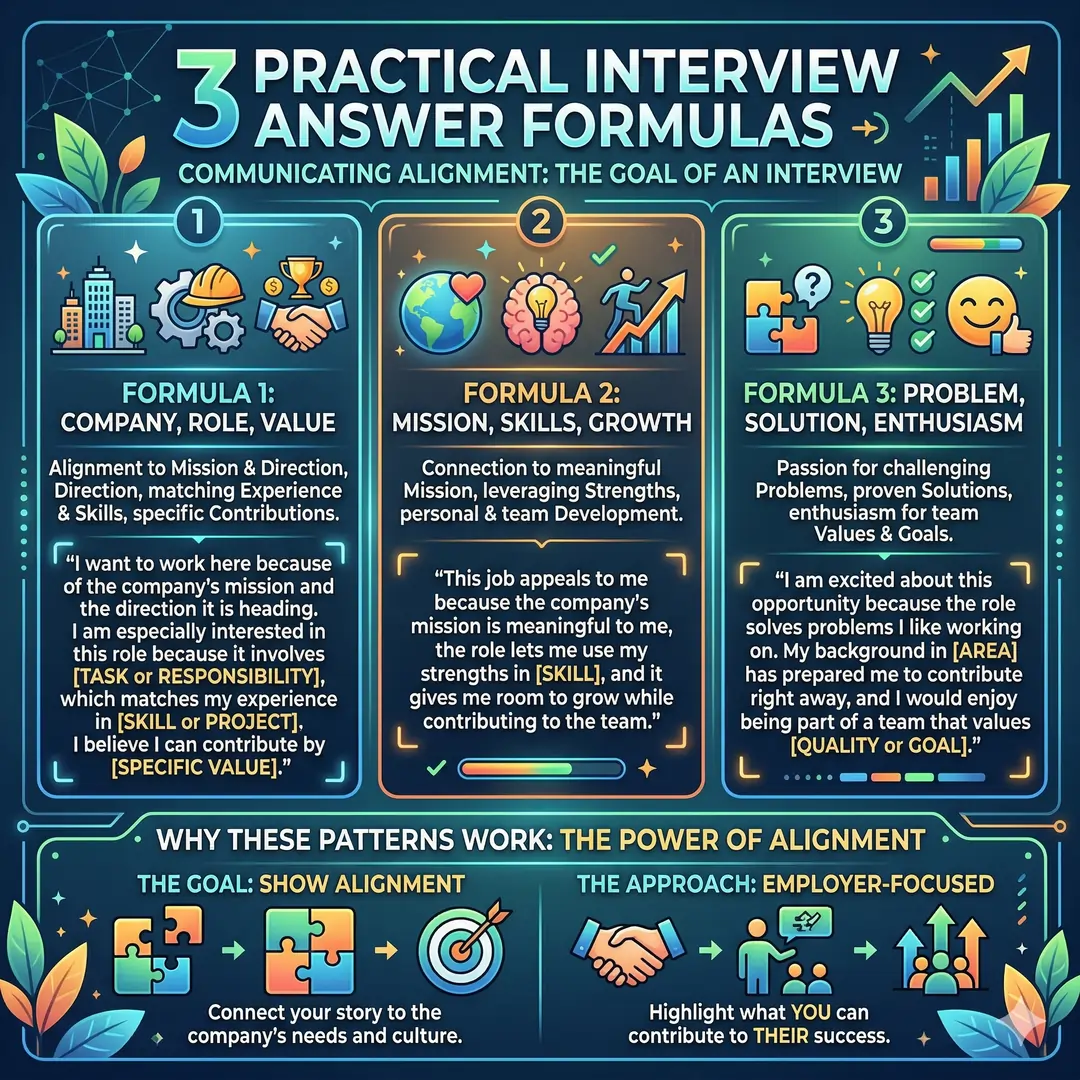
Formula 2: Mission, skills, growth
“This job appeals to me because the company’s mission is meaningful to me, the role lets me use my strengths in [skill], and it gives me room to grow while contributing to the team.”
Formula 3: Problem, solution, enthusiasm
“I am excited about this opportunity because the role solves problems I like working on. My background in [area] has prepared me to contribute right away, and I would enjoy being part of a team that values [quality or goal].”
These patterns work because they stay focused on alignment, which Stanford describes as the real goal of an interview. They also reflect the employer-focused approach highlighted by Harvard Business Review and UNC.
Strong sample answers
Below are sample answers you can adapt. They are written in simple, human language and can be adjusted for your own experience.
Example 1: Entry-level office role
“I want this job because it is a strong match for the kind of work I enjoy, especially organizing details, supporting a team, and helping things run smoothly. I also like that your company focuses on service quality, which feels important to me. My previous experience in coordinating tasks, communicating with different people, and handling deadlines has prepared me to contribute from day one.”
Example 2: Customer service role
“I am interested in this job because I enjoy helping people solve problems and I like fast-paced work where communication matters. Your company stands out to me because of its reputation for customer care. I believe my background in customer support, patience under pressure, and ability to stay organized would let me add value quickly.”
Example 3: Marketing role
“This role excites me because it combines creativity, data, and audience understanding, which are all areas I enjoy working in. I also appreciate that your brand has a clear voice and a strong identity. I would love to bring my experience with content planning, social media, and performance analysis to a team that is focused on growth.”
Example 4: Healthcare role
“I want this job because I am motivated by work that directly helps people. Your organization’s commitment to patient care is one of the main reasons I applied. I also see this role as a place where I can use my attention to detail, communication skills, and calm approach to support patients and the team effectively.”
Example 5: Technology role
“I am excited about this job because I enjoy solving technical problems and working with systems that make work easier for others. I also like that your company is known for innovation and continuous improvement. My experience with troubleshooting, process improvement, and learning new tools quickly would help me contribute in a meaningful way.”
A large table of sample answers by situation
| Situation | What the interviewer wants to hear | A strong answer angle | A weak answer to avoid |
|---|---|---|---|
| Fresh graduate | You are eager, prepared, and ready to learn | Connect coursework, internships, and interest in the company’s mission | “I need experience and this was the first opening I found.” |
| Career switcher | Your move is thoughtful, not random | Explain the new field, the skills that transfer, and why the role fits your goals | “I am just trying something different.” |
| Experienced professional | You are moving for a real reason, not only money | Focus on scope, challenge, leadership, or alignment with values | “I just want a better paycheck.” |
| Remote role | You understand the working style and can thrive in it | Mention self-management, communication, and comfort with distributed work | “I want to work from home, that is all.” |
| Leadership role | You can guide people and deliver results | Talk about mentorship, decision-making, and building strong teams | “I have always wanted a title like this.” |
| Mission-driven company | You care about the company’s purpose | Connect your values to the mission and the work itself | “The brand looks popular.” |
| Technical role | You like the actual problems this job solves | Mention tools, systems, debugging, building, or analysis | “Technology sounds cool.” |
| Client-facing role | You enjoy communication and relationship-building | Show enthusiasm for helping people and representing the company | “I am okay talking to customers.” |
UNC and Harvard are especially useful for this kind of answer because they emphasize that interviews are a two-way evaluation of fit, motivation, skills, and contribution.
Common mistakes to avoid
1. Giving a generic answer
Saying “I need a job” or “This seems like a good opportunity” is too vague. It does not show research, enthusiasm, or fit. HBR and UNC both emphasize that your answer should be specific and focused on the match.
2. Talking only about what you want
It is fine to mention growth, learning, and career goals, but the answer should not sound self-centered. Harvard advises candidates not to focus too much on salary or personal benefit. Instead, focus on the value and skill set you bring.
3. Complimenting the company without connecting it to the job
It is not enough to say “I admire your company.” You need to explain why that admiration matters for this role. UNC recommends linking your interest to the company’s mission and the job itself.
4. Sounding scripted
A memorized answer can feel cold. Stanford notes that strong candidates stand out when they are open about their real background and trajectory. Keep your answer structured, but speak naturally.
5. Ignoring your own contribution
The employer wants to know what you will bring to the team. Harvard, UNC, and Cornell all emphasize contribution, not just interest.
Useful phrases you can add to your answer
These phrases help your response sound polished and confident:
- “What especially attracted me was…”
- “I am drawn to this role because…”
- “This position matches both my skills and my interests.”
- “I was excited to see that your team values…”
- “My background in [skill] would help me contribute by…”
- “I see this as a chance to grow while adding value.”
- “The part of the role I find most meaningful is…”
These phrases work best when followed by a real example, not just a general statement.
How to make your answer sound more human
A human answer sounds specific, calm, and believable. It does not try too hard. It sounds like someone who thought carefully before applying. Stanford’s advice about alignment is useful here. A good interview answer is not a performance where you pretend to be perfect. It is a conversation about why the job makes sense for both sides. UNC Kenan-Flagler similarly frames interviewing as a conversation where both sides decide whether they want to work together.
A natural answer usually has three qualities:
- It is specific
- It is positive
- It is balanced
That means you show excitement, but you also show judgment. You show confidence, but not arrogance. You show interest in the company, but you do not forget to explain your contribution.
A detailed table of strong vs weak wording
| Weak wording | Why it is weak | Stronger wording |
|---|---|---|
| “I need a job.” | Too blunt and self-focused | “I am looking for a role where I can contribute and continue growing.” |
| “This company is famous.” | Says nothing about the role | “I admire the company’s direction, especially its focus on innovation and service.” |
| “I can do anything.” | Too broad and unconvincing | “My background in coordination, communication, and problem-solving fits this role well.” |
| “It sounded interesting.” | Too vague | “The responsibilities around project coordination and stakeholder communication stood out to me.” |
| “I want better pay.” | Makes the employer feel secondary | “I am looking for a role that offers meaningful work, growth, and the chance to add value.” |
| “I like the office.” | Not tied to performance | “I like the team-focused culture and the chance to work in a collaborative environment.” |
| “I saw it on a job board.” | No real motivation | “I applied after researching the company’s mission and seeing how closely it matches my interests.” |
| “I just want experience.” | Too generic | “I want to build experience in this field while contributing to a team doing important work.” |
Best practices for different kinds of candidates
If you are a fresher
Focus on your education, projects, internships, volunteer work, and your willingness to learn. Harvard and UNC both note that employers look for transferable skills such as communication and professionalism, not only long job histories.
If you are changing careers
Explain the reason for the switch in a way that feels intentional. Talk about the part of the new field that attracts you, the skills that transfer, and the reason this role is the right next step. Cornell’s interview guidance supports this kind of connection between past experience and future contribution.
If you are experienced
Use your answer to show that you are moving toward more responsibility, more challenge, or a better alignment with your values. Stanford’s discussion of motivation and values is useful here, because experienced candidates are often evaluated for both skill and purpose.
If you are applying to a mission-driven organization
Mention the mission clearly and honestly. Do not force enthusiasm. If the mission is real to you, explain why it matters. HBR recommends expressing personal passion for the employer’s mission or service and linking it to why you would enjoy the role.
Thoughts that make your answer stronger
A strong answer is not just a polished speech. It is a reflection of how seriously you took the opportunity.
Think about these ideas before the interview:
- What is the real problem this job helps solve?
- What part of the work would I enjoy even on a stressful day?
- Which part of my background can help the team most?
- Why does this company feel like a better fit than another similar employer?
- What would I want a hiring manager to remember about me after the interview?
Berkeley Career Engagement and UNC both highlight that interviews are a chance to see whether the role fits your own interests, too. That means a thoughtful answer also shows self-awareness.
A final polished answer example
Here is a longer example that sounds natural and professional:
“I want this job because the role combines the kind of work I do best with the kind of environment I want to grow in. I was especially drawn to the company’s focus on quality and continuous improvement, and I like that this position gives me the chance to contribute directly to the team’s goals. My background in organizing projects, communicating clearly, and solving problems under pressure has prepared me well for this kind of work. I also see this opportunity as a good long-term fit because it matches my interests and the direction I want my career to move in.”
This answer works because it includes company interest, role interest, skill match, and future fit. That combination reflects the advice from Harvard, Berkeley, UNC, Stanford, and Cornell.
Conclusion
The best way to answer “Why do you want this job?” is to show that your interest is real, your research is solid, and your skills match what the employer needs. A strong answer is specific, positive, and focused on the alignment between the company, the role, and your strengths. Career centers at Harvard, Berkeley, UNC, Stanford, and Cornell all point in the same direction. Interviewers want to see your motivation, your fit, and your ability to contribute.
When you prepare with that in mind, your answer becomes much easier. You are no longer trying to invent the perfect line. You are simply explaining why the job makes sense for you and why you make sense for the job.
Also, Read these Articles in Detail
- Top Interview Questions and Answers Guide
- Interview Questions and Answers for Freshers and Experienced Candidates
- Common Interview Questions and Best Answers for Job Seekers
- “Tell me about yourself” Interview Answer Examples and Tips
- Strengths and Weaknesses Interview Questions and Sample Answers
- Behavioral Interview Questions and Answers Using the STAR Method
- How to Answer “Why Should We Hire You” in a Job Interview
Article References and Sources
- Harvard University Faculty of Arts and Sciences. (n.d.). Prepare for an interview. Harvard Office of Career Services.
https://careerservices.fas.harvard.edu/channels/prepare-for-an-interview/ - Harvard University Faculty of Arts and Sciences. (2024). Interview tips for job seekers. Harvard Office of Career Services.
https://careerservices.fas.harvard.edu/blog/2024/02/27/interview-tips-for-veterans-on-the-job-hunt/ - Harvard Business Review. (2022). How to answer “Why do you want to work here?”.
https://hbr.org/2022/08/how-to-answer-why-do-you-want-to-work-here - Stanford University School of Engineering. (n.d.). Think of a job interview as a mutual search for alignment.
https://engineering.stanford.edu/news/think-job-interview-mutual-search-alignment - University of North Carolina at Chapel Hill. (n.d.). Interview tips and strategies. UNC Career Services.
https://careers.unc.edu/resource/interview-tips-strategies/ - University of North Carolina at Chapel Hill. (2018). Job interview questions handout.
https://research.unc.edu/wp-content/uploads/2018/02/Handout-Job-Interview-Questions-Feb-2018.pdf - UNC Kenan-Flagler Business School. (n.d.). Interviewing guide.
https://www.kenan-flagler.unc.edu/alumni/career-management/interviewing/ - University of California, Berkeley. (n.d.). Interviewing for success. Berkeley Career Engagement.
https://career.berkeley.edu/prepare-for-success/interviewing/ - Cornell University. (n.d.). Interviewing for industry positions. Cornell Postdoctoral Studies.
https://postdocs.cornell.edu/postdoc-careers/documents-for-the-job-search/interview-position-in-industry/
Frequently Asked Questions
FAQ 1: How should I answer “Why do you want this job?” in a job interview?
A strong answer to “Why do you want this job?” should show three things clearly: you understand the company, you are interested in the role, and your skills can help the employer. The best answers sound thoughtful and specific, not copied or memorized. You should explain what attracted you to the position, what part of the work you genuinely enjoy, and how your background makes you a useful fit for the team.
A simple way to build your answer is to connect the job to your own experience. For example, you can mention the company’s mission, the kind of work the role includes, and the strengths you bring. A good answer might sound like this: “I want this job because the role matches my strengths, and the company’s values really appeal to me. I enjoy this kind of work, and I believe I can contribute by using my communication, problem-solving, and teamwork skills.” This kind of response feels natural and professional at the same time.
FAQ 2: Why do interviewers ask this question so often?
Interviewers ask this question because they want to know whether you are truly interested in the job or just applying randomly. They also want to see whether you have done your homework on the company and whether you understand what the role actually involves. In many cases, this question helps the interviewer judge your motivation, your commitment, and your level of fit for the team.
This question also gives the employer a chance to see how you think about your career. A candidate who gives a clear and honest answer usually appears more confident and more prepared. That matters because interviewers are not only checking your qualifications. They are also deciding whether you will be a positive and reliable addition to the workplace. A strong answer reassures them that you are serious about the opportunity and not just looking for any job.
FAQ 3: What is the best structure for answering this interview question?
The easiest and most effective structure is to divide your answer into three parts. First, explain why the company interests you. Second, mention why the job role itself appeals to you. Third, connect the role to your skills, experience, or career goals. This gives your answer a natural flow and helps you avoid sounding vague.
For example, you could say that the company’s reputation, mission, or growth caught your attention. Then you can explain which responsibilities in the job description excite you most. Finally, show how your background makes you a strong fit. A well-balanced answer can sound like this: “I am interested in this job because the company has a strong reputation for quality, the role includes work I enjoy, and my experience in teamwork and problem-solving would help me contribute quickly.” This structure keeps your answer focused and convincing.
FAQ 4: What should I avoid saying when answering this question?
You should avoid giving a generic answer that could fit any company. Phrases like “I just need a job”, “This seemed interesting”, or “I saw the opening online” do not tell the interviewer much. They may make you sound unprepared or unenthusiastic. The goal is to show genuine interest, not just basic availability.
It is also smart to avoid making your answer only about salary, comfort, or personal convenience. Those things may matter to you, but they should not be the main focus in the interview answer. Employers want to hear about value, interest, and fit. A better answer is one that connects your strengths to the company’s needs and shows that you understand why this opportunity is meaningful to you.
FAQ 5: How can I make my answer sound natural instead of rehearsed?
The best way to sound natural is to keep your answer simple, specific, and honest. Do not try to sound like a textbook or use overly formal language that does not feel like you. Instead, speak as if you are explaining your real reasons to another person in a professional conversation. A natural answer is usually easier to trust because it feels genuine.
You can also practice your answer out loud before the interview, but do not memorize it word for word. Focus on the key points you want to include, such as your interest in the company, the role, and your ability to contribute. That way, your answer will stay organized but still sound flexible. A real conversation always sounds better than a perfect script.
FAQ 6: How do I answer this question if I am a fresher or recent graduate?
If you are a fresher, the interviewer does not expect years of work experience. Instead, they want to see your interest, your willingness to learn, and your understanding of the job. You can talk about your studies, projects, internships, volunteer work, or any practical experience that helped prepare you for the role. Even without long experience, you can still give a strong answer.
A good fresher’s answer should show that you are excited to grow in the job and that you have thought seriously about your future. For example, you can say, “I want this job because it gives me the chance to use what I learned in college in a real work environment. I am also excited to learn from experienced people and build my skills while contributing to the team.” This shows both humility and enthusiasm, which are very attractive qualities in a new candidate.
FAQ 7: How should I answer this question if I am changing careers?
If you are changing careers, your answer should explain why the new field makes sense for you. You do not need to hide your past experience. In fact, your previous experience can become a strength if you explain how it transfers to the new role. The interviewer wants to understand your decision and see that your move is thoughtful, not random.
You can say what attracted you to the new field, what skills you already have that still apply, and why this job is the right next step. For example, “I want this job because I have always enjoyed work that involves communication and problem-solving, and this role gives me the chance to use those strengths in a new direction. My previous experience has taught me how to work under pressure, learn quickly, and adapt to new systems.” This kind of answer shows confidence, maturity, and purpose.
FAQ 8: What are some good examples of answers for different jobs?
Good answers always depend on the role, but the basic idea stays the same. For a customer service job, you can focus on helping people and solving problems. For a marketing job, you might talk about creativity, communication, and audience understanding. For a healthcare role, you could mention your desire to help people and work in a meaningful environment. For a technology role, you might highlight problem-solving and innovation.
Here is a simple example: “I want this job because I enjoy helping people, and this role gives me the chance to support customers in a meaningful way. I also like that your company values service and teamwork, which are important to me. My experience in communication and handling pressure would help me do well here.” You can adjust this format for almost any profession by changing the details to fit the job description and company values.
FAQ 9: How important is company research when answering this question?
Company research is extremely important because it helps your answer feel specific and believable. If you know something about the company’s mission, products, services, culture, or recent achievements, you can connect your answer to real details instead of saying something general. This instantly makes you sound more serious and better prepared.
Research also helps you decide whether the company is actually a good fit for you. A thoughtful answer should not just flatter the employer. It should show that you understand what makes this organization different and why that matters to you. When you mention those details in your response, you show that your interest is real. That often makes a stronger impression than saying something broad like “I heard this is a great place to work.”
FAQ 10: Can I mention career growth and learning when answering this question?
Yes, you can mention career growth and learning, but those should not be the only things you talk about. Employers are happy to hear that you want to grow, improve, and build your skills. That shows ambition and a long-term mindset. However, your answer should also explain why the company benefits from hiring you.
A balanced answer might sound like this: “I want this job because it offers the kind of work I am excited about, and it also gives me room to grow professionally. I am eager to keep learning, but I also want to contribute right away with the skills I already have. That balance makes this opportunity especially attractive to me.” This sounds thoughtful because it shows both your personal goals and your value to the employer.
