

Behavioral interviews can feel stressful at first, but they become much easier once you understand what hiring managers are really trying to learn. Instead of asking only about your skills on paper, they want to hear how you have actually handled real situations in the past. That is why the STAR method is so useful. It helps you turn your experience into clear, confident, and job-focused answers that are easy for an interviewer to follow. Career guidance from government and university sources consistently describes behavioral interview questions as questions that ask about past experiences and uses the STAR method as a structured way to answer them.
Table of Contents
What Is a Behavioral Interview?
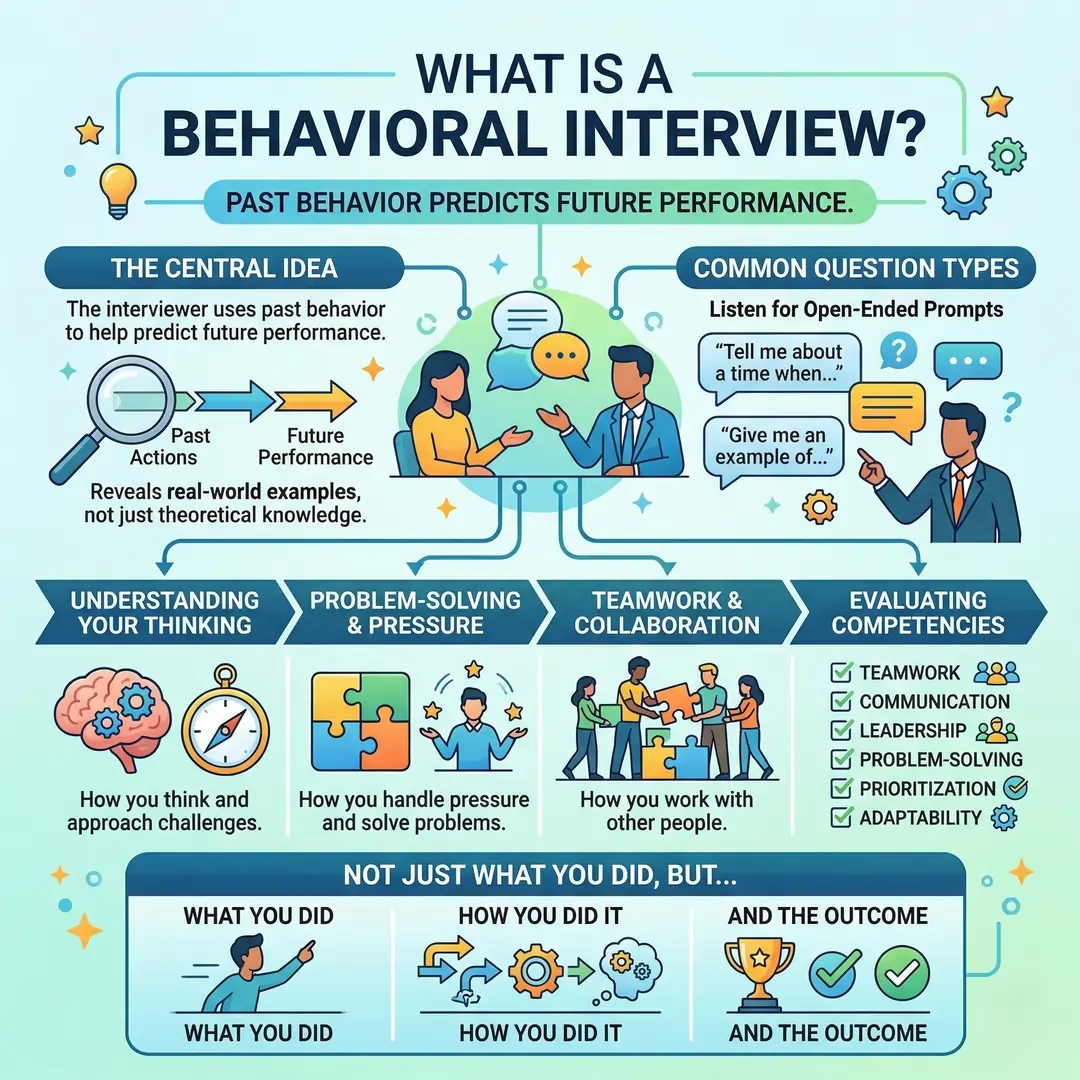
A behavioral interview is built around the idea that past behavior can help predict future performance. That is why interviewers often ask questions like, “Tell me about a time when…” or “Give me an example of…” They are trying to understand how you think, how you solve problems, how you handle pressure, and how you work with other people. Official interview guidance from federal and university career resources explains that these questions are designed to reveal real examples from your past, not just theoretical knowledge.
These interviews are common because they help employers evaluate competencies such as teamwork, communication, leadership, problem-solving, prioritization, and adaptability. Many interview guides also explain that behavioral questions often cover areas such as conflict, initiative, decision-making, and working under pressure. In other words, the interviewer is not only judging what you did, but also how you did it and what the outcome was.
Why the STAR Method Works So Well
The STAR method gives your answer a clear shape. It keeps you from rambling and helps you focus on one meaningful example instead of jumping between several stories. Career centers and federal interview guides describe STAR as a simple structure for answering behavioral interview questions clearly and compellingly. It is especially helpful when you want your answer to sound organized, confident, and professional.
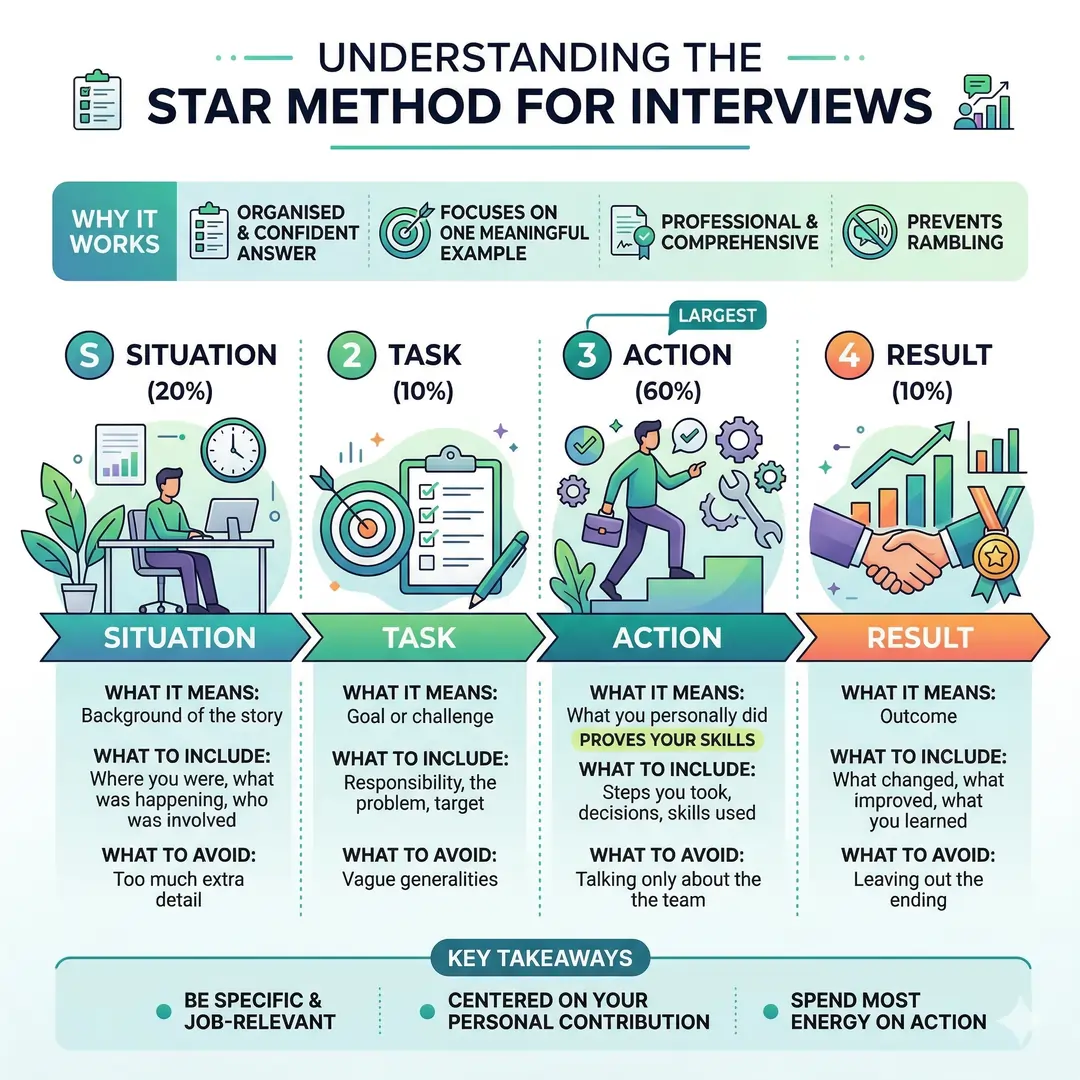
MIT’s career guidance breaks STAR into approximate time balance, with Situation at 20%, Task at 10%, Action at 60%, and Result at 10%. That breakdown is not a rigid rule, but it is a very useful reminder that your answer should spend most of its energy on the Action section, because that is where you prove your actual skill.
The STAR Method Explained in Simple Terms
| STAR Part | What It Means | What to Include | What to Avoid |
|---|---|---|---|
| Situation | The background of the story | Where you were, what was happening, who was involved | Too much extra detail |
| Task | The goal or challenge | Your responsibility, the problem, the target | Vague generalities |
| Action | What you personally did | Steps you took, decisions you made, skills you used | Talking only about the team |
| Result | The outcome | What changed, what improved, what you learned | Leaving out the ending |
This structure is consistent with guidance from MIT, federal interview materials, and multiple university career centers. The most important idea is that your answer should be specific, job-relevant, and centered on what you personally contributed.
How to Choose the Right Story Before You Answer
One of the smartest ways to prepare for behavioral interviews is to collect a small set of stories before the interview even starts. University and government guides recommend choosing actual experiences from work, internships, academic projects, volunteer roles, or other meaningful activities. They also advise using examples that are specific, honest, and relevant to the job.
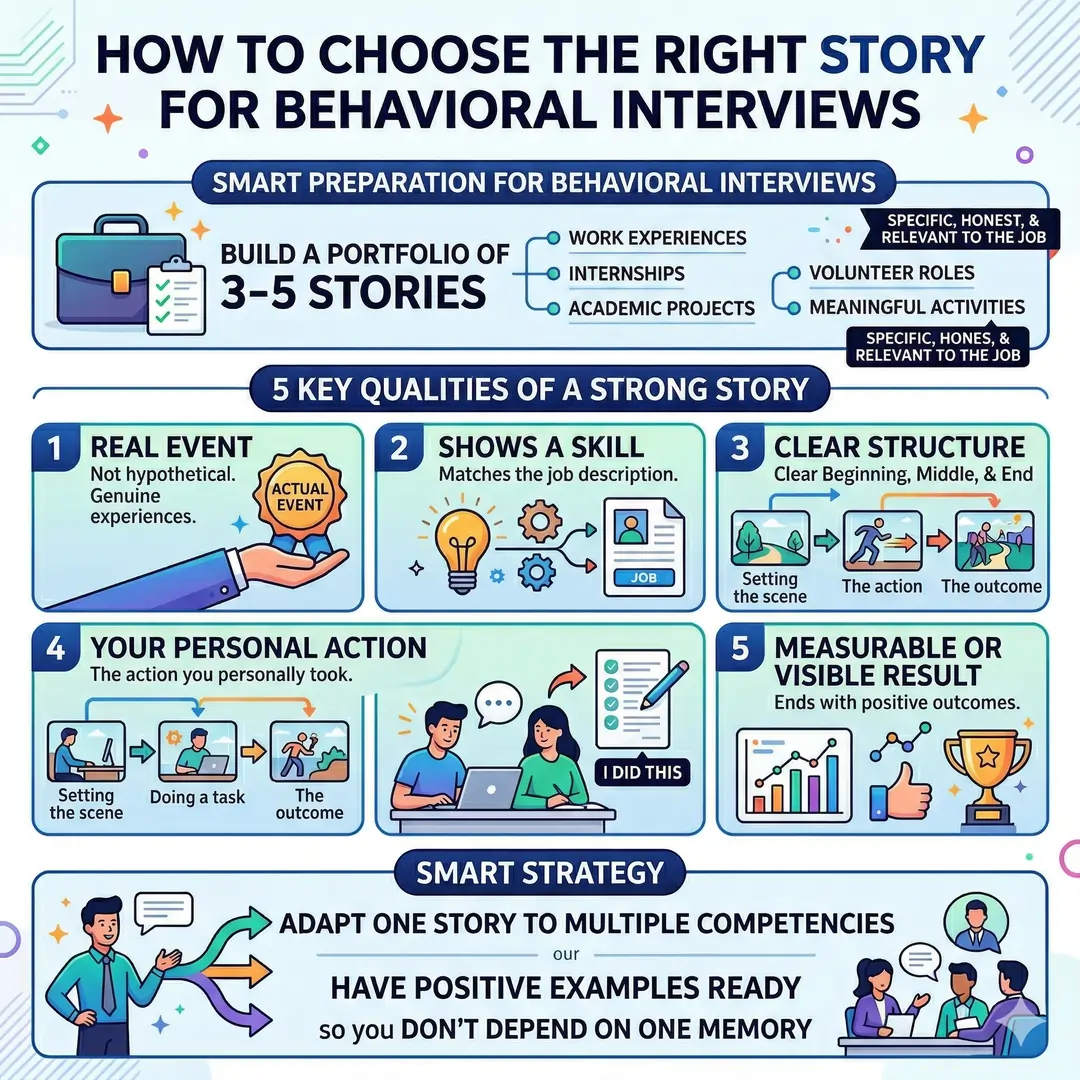
A strong story usually has these qualities:
- It is based on a real event, not a hypothetical one.
- It shows a skill that matches the job description.
- It has a clear beginning, middle, and end.
- It shows the action you personally took.
- It ends with a measurable or visible result.
A good practical habit is to prepare three to five strong stories that can be adapted to different questions. One story can often support more than one competency if you think carefully about what part of the story to emphasize. Some career centers explicitly recommend having several positive work-related examples ready, so you do not depend on just one memory in the interview room.
Common Behavioral Interview Questions Employers Ask
Below is a large table of question themes and examples based on common behavioral interview guidance. These questions are designed to reveal how you have handled real workplace situations and common job challenges.
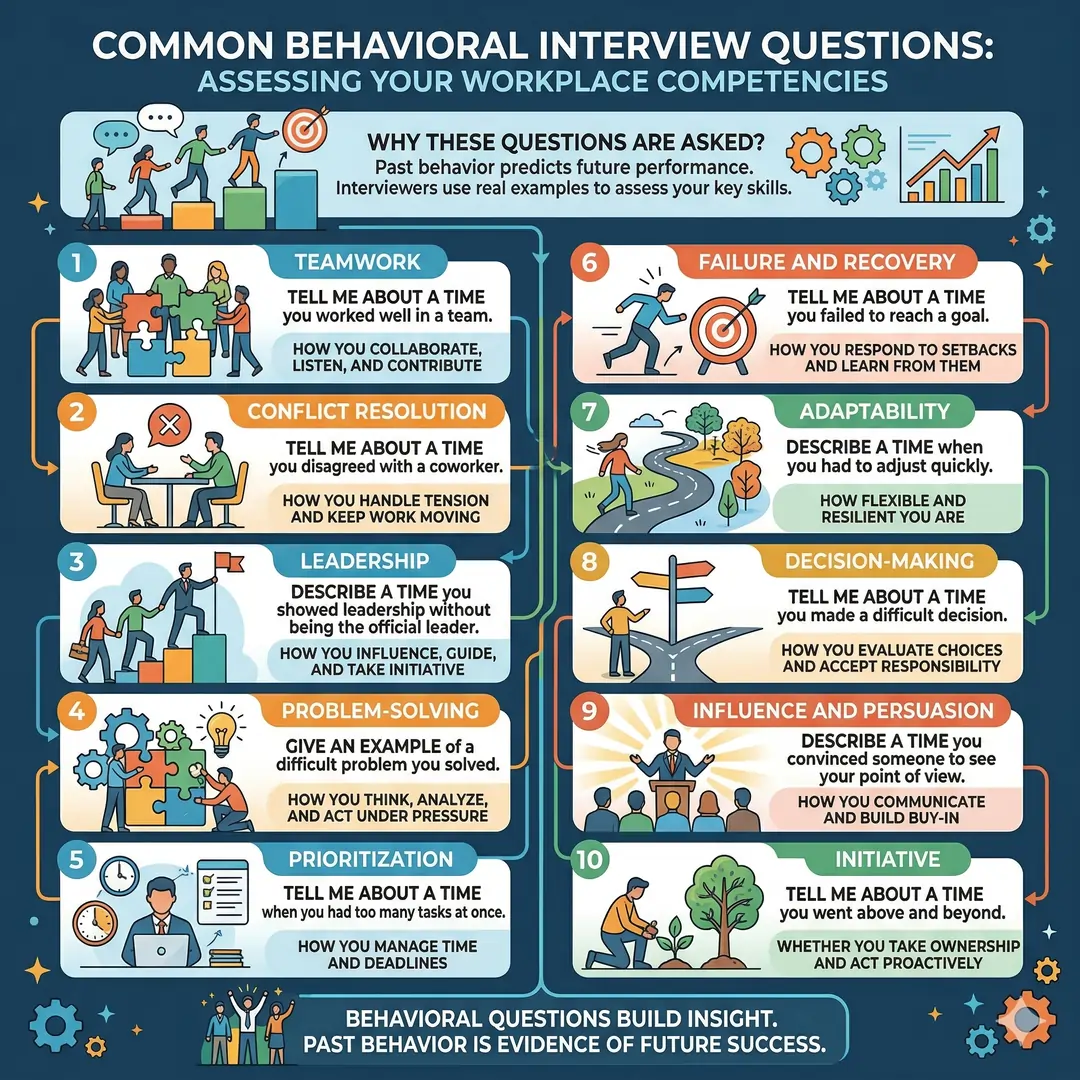
| Competency Area | Example Behavioral Questions | What the Interviewer Wants to Learn |
|---|---|---|
| Teamwork | Tell me about a time you worked well in a team. | How you collaborate, listen, and contribute |
| Conflict Resolution | Tell me about a time you disagreed with a coworker. | How you handle tension and keep work moving |
| Leadership | Describe a time you showed leadership without being the official leader. | How you influence, guide, and take initiative |
| Problem-Solving | Give an example of a difficult problem you solved. | How you think, analyze, and act under pressure |
| Prioritization | Tell me about a time when you had too many tasks at once. | How you manage time and deadlines |
| Failure and Recovery | Tell me about a time you failed to reach a goal. | How you respond to setbacks and learn from them |
| Adaptability | Describe a time when you had to adjust quickly. | How flexible and resilient you are |
| Decision-Making | Tell me about a difficult decision you made. | How you evaluate choices and accept responsibility |
| Influence and Persuasion | Describe a time you convinced someone to see your point of view. | How you communicate and build buy-in |
| Initiative | Tell me about a time you went above and beyond. | Whether you take ownership and act proactively |
These question types are not random. Federal and university sources repeatedly show that behavioral interviews are built around job-related competencies and that interviewers often use past behavior as the best evidence of future performance.
How to Build a Strong STAR Answer
A strong STAR answer sounds natural, but it is carefully structured underneath. The best responses usually begin with a short setup, move quickly into the challenge, spend most of the time on the actions you personally took, and finish with a result that sounds real and useful. MIT’s guidance is especially clear on this point because it recommends putting the largest share of attention on the Action section.
1. Situation
Start with just enough background so the interviewer understands the context. Keep it short, specific, and easy to follow. You do not need to explain your entire life story. You only need the details that matter for this example. Career centers recommend giving enough context for clarity without overloading the interviewer with unnecessary information.
2. Task
Explain what you had to accomplish. What was your responsibility? What was the challenge? What needed to be fixed, improved, delivered, or decided? This section should connect your story to a clear goal.
3. Action
This is the heart of the answer. Describe the exact steps you took, the tools or methods you used, and the judgment you showed. It is important to focus on your actions, not just the group’s achievements. Several interview guides stress that even when the example involves a team, the candidate should clearly explain what they did.
4. Result
End with the outcome. Did you save time, improve quality, reduce errors, increase customer satisfaction, finish a project early, or learn something valuable? The strongest answers often include quantifiable results when possible. If the result was not perfect, you can still discuss what you learned and how you improved.
A Practical STAR Answer Template
Here is a simple template you can use in nearly any interview:
Situation: In my previous role, I was part of a project where…
Task: My responsibility was to…
Action: To handle it, I first…, then I…, and finally I…
Result: As a result, we…, and I learned…
This format reflects the same structure recommended by official career resources. It keeps the answer organized, easy to remember, and easy for the interviewer to follow.
Sample STAR Answers for Common Behavioral Questions
The table below gives you a wide set of examples. These are not meant to be memorized word for word. They are meant to show how the STAR method can be adapted to different situations and different kinds of jobs. The examples reflect the kinds of themes career centers and government interview guides commonly highlight, such as teamwork, leadership, conflict, failure, initiative, and time management.
| Question | Example STAR Response Outline | What Makes It Strong |
|---|---|---|
| Tell me about a time you worked in a team. | Situation: I joined a group project with a tight deadline. Task: I had to help organize the work. Action: I set up a shared task list, clarified responsibilities, and checked in daily. Result: We finished on time and received positive feedback. | Shows collaboration, planning, and communication |
| Tell me about a time you handled conflict. | Situation: Two team members disagreed about the best approach. Task: I needed to keep the project moving. Action: I listened to both sides, restated the shared goal, and suggested a testable compromise. Result: We agreed on a direction and avoided delay. | Shows calm communication and problem-solving |
| Describe a time you showed leadership. | Situation: A class or work group lacked direction. Task: Someone needed to organize the work. Action: I created deadlines, assigned tasks based on strengths, and followed up. Result: The group stayed focused and delivered a better outcome. | Shows initiative and ownership |
| Tell me about a time you failed. | Situation: I missed a deadline early in my career. Task: I needed to fix the issue and prevent it again. Action: I identified what went wrong, asked for feedback, and changed my planning system. Result: I improved my time management and avoided repeat mistakes. | Shows accountability and growth |
| Tell me about a time you had many priorities. | Situation: I had several deadlines at once. Task: I had to decide what to do first. Action: I ranked tasks by urgency and impact, communicated with stakeholders, and worked through the most critical items first. Result: Everything was completed with minimal delay. | Shows prioritization and judgment |
| Tell me about a time you took initiative. | Situation: I noticed a recurring problem in a process. Task: I wanted to reduce confusion or wasted time. Action: I documented the issue, proposed a better workflow, and helped implement it. Result: The team worked faster and with fewer mistakes. | Shows proactive thinking |
| Tell me about a difficult decision you made. | Situation: A project needed a choice between speed and quality. Task: I had to recommend a path. Action: I reviewed risks, discussed tradeoffs, and chose the option that protected long-term results. Result: The decision reduced errors and improved confidence in the final output. | Shows reasoning and responsibility |
| Tell me about a time you handled pressure. | Situation: A key deadline was moved earlier. Task: I had to adjust quickly. Action: I broke the work into parts, focused on the essentials, and communicated progress clearly. Result: I delivered on time and kept the work stable. | Shows composure and planning |
These sample answers are intentionally broad so you can adapt them to your own background. Career guidance consistently recommends using real examples from work, internships, academics, or volunteering, as long as the story is relevant and honest.
More Strong Behavioral Questions to Practice
Below is a larger question bank you can use while preparing. These are the kinds of prompts that often appear in interviews because they reveal how you act in realistic workplace situations.
| Category | Practice Question |
|---|---|
| Leadership | Tell me about a time when you led a project without formal authority. |
| Teamwork | Tell me about a time when you helped a team succeed. |
| Communication | Give an example of when you had to explain something complex clearly. |
| Conflict | Describe a disagreement you had with a colleague and how you resolved it. |
| Adaptability | Tell me about a time when plans changed suddenly. |
| Problem-Solving | Tell me about a time when you solved a difficult problem. |
| Initiative | Tell me about a time when you improved a process on your own. |
| Customer Service | Tell me about a time you handled an upset customer. |
| Decision-Making | Tell me about a time you had to make a quick decision. |
| Failure | Tell me about a time something did not go as planned. |
| Learning | Tell me about a time you had to learn a new skill quickly. |
| Ethics | Tell me about a time you had to do the right thing, even when it was difficult. |
| Time Management | Tell me about a time when you had to juggle multiple deadlines. |
| Creativity | Tell me about a time you came up with a creative solution. |
| Accountability | Tell me about a time you made a mistake and corrected it. |
A useful way to prepare is to take each question and ask yourself, “Which of my stories best proves this skill?” That approach helps you stay focused and stops you from freezing in the interview when a question sounds unexpected.
Common Mistakes People Make With STAR Answers
Even strong candidates can weaken their answers by speaking too generally, telling the story out of order, or spending too much time on the setup. Career resources also warn against exaggeration, using vague examples, or sharing too many unrelated events in one answer.
| Mistake | Why It Hurts Your Answer | Better Approach |
|---|---|---|
| Too much background | The interviewer loses the main point | Keep the situation short and relevant |
| No clear task | The story feels unfocused | State the goal or responsibility directly |
| Talking too much about the team | Your own contribution becomes invisible | Emphasize your personal actions |
| No result | The answer feels incomplete | End with the outcome and lesson |
| Vague language | The interviewer cannot judge the impact | Use concrete details and numbers when possible |
| Overly polished or fake story | It can sound rehearsed or dishonest | Use a real example and speak naturally |
| Negative ending with no recovery | It may sound like you did not learn | Show growth, reflection, and improvement |
One of the clearest pieces of advice in official guidance is to be honest and specific. That means choosing one event, describing it clearly, and letting the quality of the example do the work. Even if the final result was not perfect, you can still frame it in a way that shows maturity and learning.
How to Tailor STAR Answers to the Job Description
A behavioral answer becomes much stronger when it is customized to the role. University interview resources recommend reviewing the job description first and deciding which skills are most important for the position. Then you should choose stories that match those skills as closely as possible.
Here is a simple way to do that:
- For a leadership role, highlight planning, delegation, decision-making, and accountability.
- For a customer service role, highlight patience, communication, and problem resolution.
- For a project role, highlight organization, prioritization, deadlines, and follow-through.
- For a technical role, highlight analysis, accuracy, troubleshooting, and learning.
- For a team-based role, highlight collaboration, flexibility, and conflict resolution.
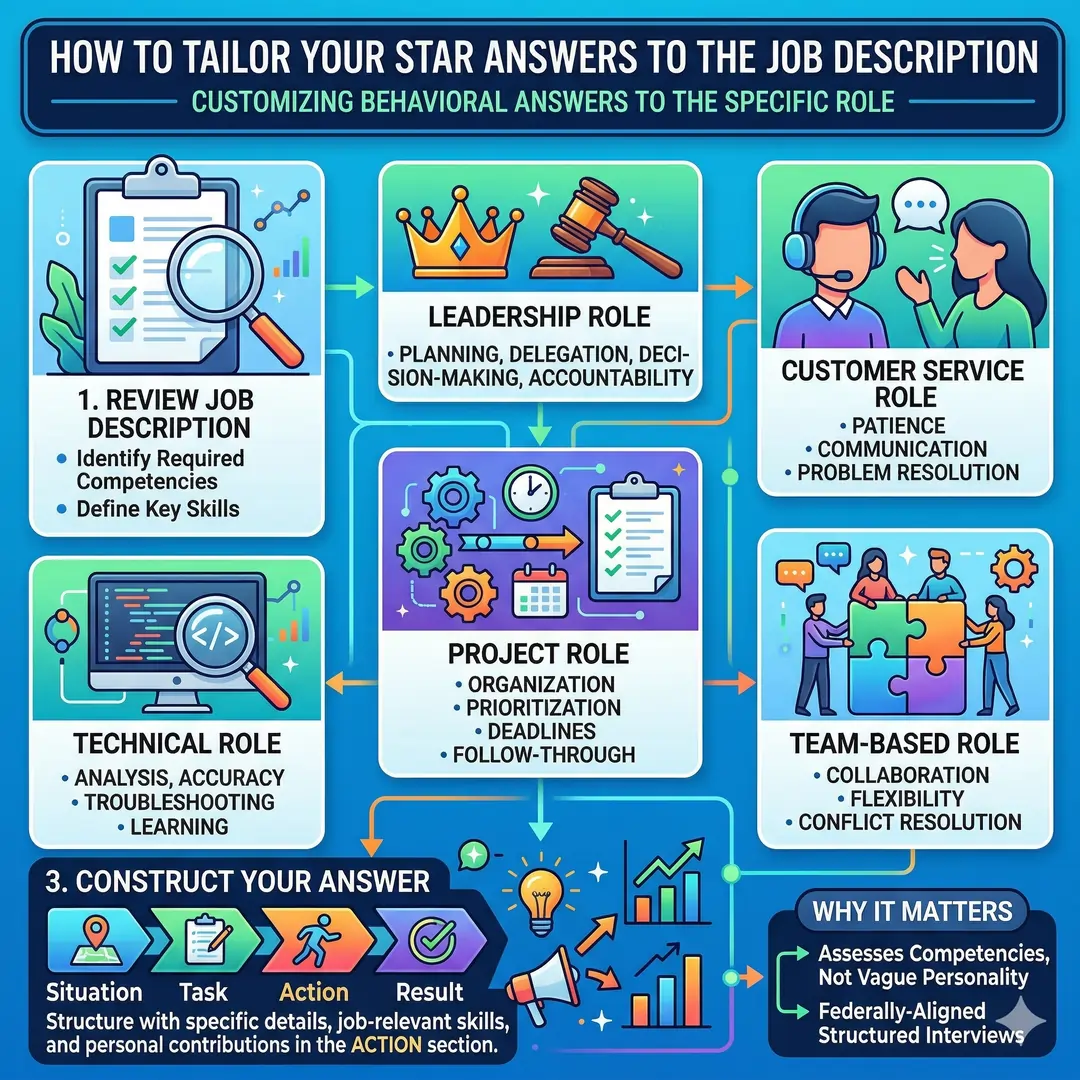
This matching process matters because hiring managers usually assess a small number of job-related competencies rather than your personality in a vague sense. Federal hiring guidance says interview questions should be tied to competencies identified through the job analysis, and many structured interviews are designed around that idea.
How to Make Your Answers Sound Natural, Not Memorized
A good STAR answer should sound prepared, but not robotic. That is one reason people benefit from practicing out loud. You want to know your main points well enough to speak comfortably, while still sounding like a real person sharing a real experience. Several career sources recommend staying concise, focusing on important details, and avoiding a rambling style.
A natural answer usually has these qualities:
- It starts directly with the story.
- It uses simple, clear language.
- It sounds confident but not over-scripted.
- It mentions what you learned.
- It finishes with a strong result or takeaway.
A helpful trick is to practice your stories in bullet points rather than memorizing full sentences. That way, you can adapt your answer to the actual question instead of sounding like you are reciting a speech. Career centers commonly recommend concise preparation like this because it improves clarity and flexibility during the interview.
A Deeper Table for Building Your Own STAR Stories
This table can help you turn raw experience into interview-ready content. Use it as a planning tool before the interview. The structure is based on the STAR format and on common guidance to use real, relevant, and outcome-based stories.
| Story Element | Questions to Ask Yourself | Example Notes |
|---|---|---|
| Situation | What was happening? Who was involved? Where did it happen? | A team project, customer issue, internship task, or volunteer challenge |
| Task | What was my responsibility? What needed to be done? | Finish a deadline, fix a process, help a teammate, solve a problem |
| Action | What did I personally do first, next, and finally? | Organized, researched, communicated, tested, led, decided |
| Result | What happened because of my actions? What improved? What did I learn? | Saved time, improved quality, reduced confusion, finished on time |
| Skill shown | Which job skill does this story prove? | Leadership, teamwork, initiative, problem-solving, adaptability |
| Best fit question | Which interview question matches this story best? | Teamwork, conflict, pressure, failure, achievement, influence |
This kind of preparation makes the interview feel less like a memory test and more like a chance to present your experience clearly. That is one of the main strengths of the STAR method. It helps you organize your thoughts around what matters most to employers.
A Step-by-Step Example of a Strong STAR Answer
Here is a full example you can model when preparing your own answers.
- Question: Tell me about a time when you had to manage multiple deadlines.
- Situation: During my final semester, I had two major assignments due in the same week, and I was also helping with a group project for another class.
- Task: I needed to complete my own work on time and still contribute meaningfully to the team project.
- Action: I made a task list, estimated how long each part would take, and ranked the deadlines by urgency. I also spoke with my group early, so everyone knew what I could deliver and when. Then I blocked out specific study hours and worked on the most difficult tasks first.
- Result: I submitted all three pieces of work on time, and the group project ran smoothly because we planned ahead. I also learned that I work best when I plan early instead of waiting until pressure builds.
This example works because it is specific, organized, and focused on your process. It also ends with a clear result and a practical lesson, which career guidance says makes the answer stronger and more memorable.
Why Quantifiable Results Make Answers Stronger
Whenever possible, include numbers, percentages, time saved, quality improvement, or other visible outcomes. MIT and other career resources specifically encourage candidates to highlight quantifiable results when they can. Numbers help the interviewer see the impact of your work instead of just hearing that something “went well.”
For example, instead of saying:
- “I improved the process.”
Try saying:
- “I reduced the response time by 20%.”
- “I helped the team finish two days early.”
- “I cut down repeated errors by creating a checklist.”
- “I improved customer satisfaction through faster follow-up.”
These kinds of details make your answer more believable, more memorable, and more useful to the employer.
How to Handle a Question When You Do Not Have a Perfect Example
Sometimes you may get a question that does not match your background exactly. In that case, choose the closest honest example and connect it clearly to the skill being tested. Career guidance repeatedly emphasizes using real experiences from work, school, volunteering, internships, or other relevant settings. That means you do not need a perfect corporate story to give a strong answer. You need a real story that shows the skill.
If you are light on direct experience, you can use examples from:
- Academic projects
- Volunteer work
- Student clubs
- Internships
- Part-time jobs
- Community activities
This approach is especially useful for students, early career professionals, and career changers. What matters most is whether the story shows the kind of thinking and behavior the employer wants to see.
Final Preparation Checklist for Behavioral Interviews
Before your interview, it helps to review your stories one last time and make sure they are ready to use. A simple checklist can keep your answers focused and polished. The items below reflect the same general advice repeated by university, federal, and career-preparation sources.
| Checklist Item | Yes or No |
|---|---|
| I have at least three to five strong stories ready. | Yes or No |
| Each story is based on a real event. | Yes or No |
| I can explain the Situation clearly in one or two sentences. | Yes or No |
| I know the Task or challenge I faced. | Yes or No |
| I can describe my Action in detail. | Yes or No |
| I can explain the Result clearly. | Yes or No |
| I have at least one story for teamwork, conflict, leadership, and failure. | Yes or No |
| I can tailor each answer to the job description. | Yes or No |
| I have included at least one measurable outcome where possible. | Yes or No |
| I can speak naturally without sounding memorized. | Yes or No |
A checklist like this is valuable because it turns interview practice into a repeatable system. Instead of hoping you remember something useful under pressure, you walk in with a small library of strong examples already prepared.
Conclusion
The STAR method is one of the simplest and most effective ways to answer behavioral interview questions. It helps you stay organized, keep your answer focused, and show the interviewer how you actually handle real challenges. Career guidance from federal and university sources consistently recommends STAR because it turns vague experience into clear evidence of your skills, judgment, and results.
If you prepare a few strong stories, match them to the job description, and practice speaking about them naturally, you will be far more confident in any interview. The goal is not to sound perfect. The goal is to sound clear, honest, thoughtful, and ready for the job. That is exactly what the STAR method helps you do.
Also, Read these Articles in Detail
- Top Interview Questions and Answers Guide
- Interview Questions and Answers for Freshers and Experienced Candidates
- Common Interview Questions and Best Answers for Job Seekers
- “Tell me about yourself” Interview Answer Examples and Tips
- Strengths and Weaknesses Interview Questions and Sample Answers
Article References And Sources
- U.S. Office of Personnel Management (OPM)
How to Conduct a Successful Interview
https://www.opm.gov/policy-data-oversight/assessment-and-selection/examples/how-to-conduct-a-successful-interview.pdf - MIT Career Advising & Professional Development (CAPD)
The STAR Method for Behavioral Interviews
https://capd.mit.edu/resources/the-star-method-for-behavioral-interviews/ - Oregon Government Careers
The STAR Method: Behavioral Interviewing
https://www.oregon.gov/dcbs/jobs/pages/the-star-method.aspx - U.S. Senate Employment Office
Interview Preparation Guide for Applicants
https://employment.senate.gov/wp-content/uploads/2023/11/Interview-Preparation-Applicants-2023.11.16-FINAL.pdf - University of Virginia Career Center
STAR Method for Interviews
https://career.virginia.edu/Students/Launch/Interviews/STAR
Frequently Asked Questions
FAQ 1: What is the STAR method in behavioral interviews, and why is it so important?
The STAR method is a simple and effective way to answer behavioral interview questions by organizing your response into four clear parts: Situation, Task, Action, and Result. In a behavioral interview, the interviewer wants to know how you handled real situations in the past because past behavior often gives a good idea of how you may act in the future. The STAR method helps you tell your story in a way that is clear, focused, and easy to follow.
This method is important because it prevents your answer from becoming confusing or too long. Instead of speaking in a random way, you can guide the interviewer through your example step by step. It also helps you show your skills in a practical way. For example, if you want to prove that you are good at problem-solving, teamwork, or leadership, the STAR method gives you the structure to do it confidently. A strong STAR answer makes you sound organized, thoughtful, and prepared.
FAQ 2: How do I choose the best example for a STAR answer?
The best STAR example is one that is real, relevant, and easy to explain. You should choose a situation from your work, internship, school project, volunteer activity, or even a personal experience that shows the skill the interviewer is asking about. A good example has a clear challenge, a clear role for you, and a clear outcome. It should also be something you can explain naturally without sounding forced.
When choosing your example, think about the job you are applying for. If the role needs strong communication skills, pick a story that shows how you explained something clearly or worked with other people. If the role needs leadership, choose a situation where you guided a team or took responsibility. The best stories are not always the biggest ones. Sometimes, a simple story about solving a small problem well can make a stronger impression than a dramatic example that is hard to explain.
FAQ 3: What should I include in the Situation part of the STAR method?
The Situation part gives the interviewer the background they need to understand your story. This is where you explain what was happening, who was involved, and why the moment mattered. It should be short but clear. You do not need to give too much history. Just enough information so the interviewer can understand the setting and the challenge.
A strong Situation sounds focused and specific. For example, instead of saying, “I had a problem at work,” you could say, “During a group project at college, our team had a tight deadline and one member dropped out at the last minute.” This gives the interviewer a real picture of the issue. The goal is to set the stage without spending too much time here, because the main part of your answer should focus on the Action and the Result.
FAQ 4: Why is the Action part the most important part of a STAR answer?
The Action part is the heart of your answer because it shows what you actually did. Interviewers want to hear about your thinking, your decisions, and the steps you took to handle the situation. This section proves your skills in a real and practical way. It also shows whether you can take responsibility instead of only talking about the team as a whole.
A strong Action section should be detailed and personal. You should explain your own role clearly, even if the story involved a group effort. For example, you might say that you organized the work, communicated with the team, solved a problem, or changed the plan after noticing an issue. The more specific you are, the stronger your answer becomes. This is the part where you show your value, so it should be the longest and most meaningful part of the STAR response.
FAQ 5: What makes the Result part of a STAR answer strong and memorable?
The Result part is where you show the outcome of your actions. It tells the interviewer what changed because of what you did. A strong result may include success, improvement, learning, or a positive impact on the team, customer, or project. If possible, you should mention measurable outcomes such as saving time, reducing errors, improving performance, or completing work before the deadline.
Even if the result was not perfect, you can still make this part strong by showing what you learned. Interviewers appreciate honesty and growth. For example, if a project did not go as planned, you can explain how you adjusted your approach and what the experience taught you. A thoughtful Result section gives your story a clear ending and leaves the interviewer with a good impression of your maturity, awareness, and ability to improve.
FAQ 6: How many STAR stories should I prepare before a behavioral interview?
It is smart to prepare at least three to five strong STAR stories before your interview. These stories should cover common themes such as teamwork, conflict resolution, leadership, problem-solving, time management, and failure or learning. If you prepare a few flexible examples, you can use them for many different questions. This makes you feel calmer and more confident during the interview.
You do not need to memorize full speeches for each story. Instead, remember the key points of each one so you can adapt them based on the question. One story can often work for more than one question if it shows several skills. For example, a project story might show both teamwork and leadership. Having multiple stories ready also helps you avoid repeating the same example too often, which can make your answers sound weak or limited.
FAQ 7: What are the most common behavioral interview questions?
Some of the most common behavioral interview questions ask about how you handle work situations, solve problems, and deal with people. You may hear questions like, “Tell me about a time you worked in a team,” “Describe a challenge you faced and how you handled it,” “Tell me about a time you disagreed with someone,” or “Give an example of when you had to meet a tight deadline.” These questions are designed to reveal how you act in real situations.
Other common questions focus on leadership, adaptability, customer service, decision-making, and failure. The exact wording may change, but the purpose is usually the same. The interviewer wants to understand how you behave when things are difficult, uncertain, or fast-moving. If you prepare for the main question types, you will be able to respond more naturally and confidently, even when the question is worded differently than you expected.
FAQ 8: How can I make my STAR answers sound natural instead of memorized?
To sound natural, you should know your story well but not recite it word for word. It helps to practice the main points of each example so you can speak comfortably and adjust your answer to the actual question. A natural answer sounds like a real conversation, not like a script. This is one of the biggest strengths of the STAR method when used well.
Another way to sound natural is to keep your language simple and direct. Avoid trying to use overly formal or complicated words. Speak in a way that feels honest and clear. It also helps to focus on the story itself rather than trying to sound impressive. When you explain your experience with confidence and sincerity, your answer becomes much more believable and memorable. The best answers feel like a thoughtful story from a real person, not a rehearsed speech.
FAQ 9: What should I do if I do not have much work experience?
If you do not have much work experience, you can still give strong STAR answers using examples from school, internships, volunteer work, clubs, group projects, or even personal responsibilities. Employers understand that early-career candidates may not have a long job history. What matters most is whether your example shows the skill they are looking for. A class project can demonstrate teamwork, and a volunteer role can show initiative or communication.
The key is to be honest and choose a real example that matches the question. You do not need a perfect corporate story to make a good impression. If you handled a difficult assignment, helped solve a group problem, or learned a new skill quickly, those are all useful examples. What matters is how you explain the situation, the action you took, and the result you achieved. A well-told student example can be just as strong as a work example if it clearly shows your ability.
FAQ 10: What are the biggest mistakes to avoid when using the STAR method?
One of the biggest mistakes is giving too much background and not enough action. Many people spend too long explaining the situation and forget to describe what they personally did. Another common mistake is talking only about the team’s success without making your own contribution clear. Since the interviewer is trying to understand your skills, your role must be easy to see in the answer.
Other mistakes include giving vague answers, leaving out the result, or choosing an example that is not relevant to the question. It is also important not to exaggerate or tell a story that does not sound real. Strong STAR answers are specific, honest, and focused. If you avoid these mistakes, your answers will sound more professional, more believable, and more impressive. A clear answer with a real result will always be stronger than a long answer filled with unnecessary detail.
