The strengths and weaknesses interview question is one of the most common questions in hiring. Employers ask it because they want to understand more than your resume. They want to see your self-awareness, your communication skills, your ability to reflect on your work style, and your fit for the role and the organization. Harvard FAS explains that an interview helps employers assess qualifications, fit, transferable skills, and the reasons you applied, while Oxford notes that interviewers expect you to answer the question asked and support your points with specific evidence.
This question can feel simple on the surface, but it is often the one that makes candidates pause. Many people worry about sounding too proud when speaking about strengths or too risky when speaking about weaknesses. The good news is that this question becomes much easier when you prepare a clear structure, use honest examples, and connect your answer to the job description. Oxford and Harvard both recommend using the STAR technique, which stands for Situation, Task, Action, Result, especially when answering behavioral questions.
Table of Contents
Why Interviewers Ask About Strengths and Weaknesses
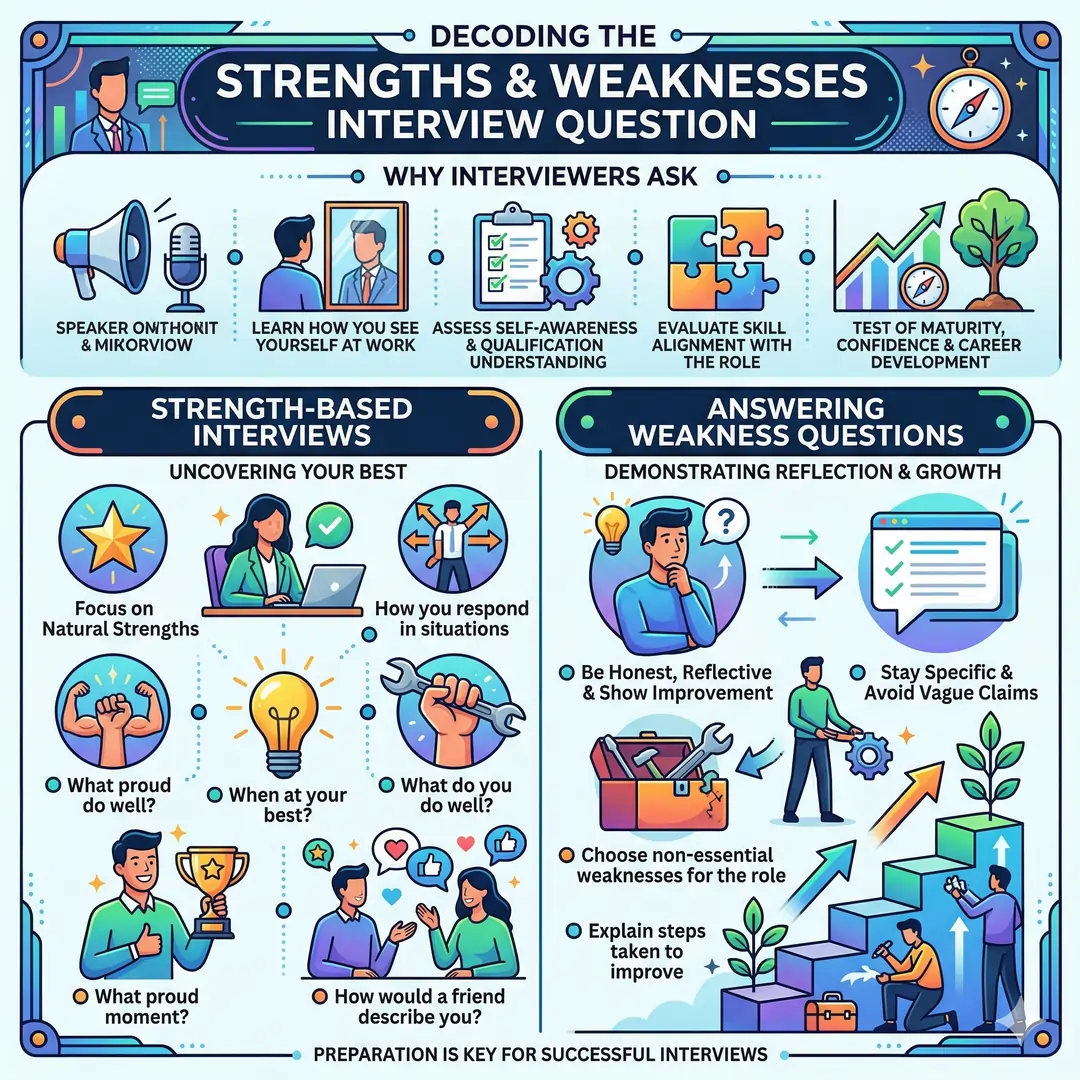
Interviewers are not asking this question just to make you nervous. They are trying to learn how you see yourself at work. Harvard FAS says employers use interviews to assess whether you understand your own qualifications and whether your skills align with the opportunity. NACE also treats awareness of your strengths and weaknesses as part of career and self-development, which makes this question more than a test of confidence. It is also a test of maturity and growth.
In strength-based interviews, employers may ask questions such as “When are you at your best?”, “What do you do well?”, “What are you most proud of?”, or “How would a close friend describe you?” Oxford explains that these interviews focus on your natural strengths and how you respond in different situations.
For weakness questions, interviewers usually want to see honesty, reflection, and improvement. Indeed advises candidates to stay specific, avoid vague claims, and choose weaknesses that are not essential to the role. The same guidance also recommends explaining what you are doing to improve.
Also, read this article in detail: “Tell me about yourself” Interview Answer Examples and Tips
The Best Way to Prepare Your Answer
A strong answer is usually short, clear, and supported by real examples. Oxford recommends being honest, using a clear structure, and emphasizing actions rather than rambling. Harvard recommends the STAR method, where you briefly describe the situation, the task, the action you took, and the result. In Oxford’s guidance, the Action part should take the most space because that is where your skills become visible.
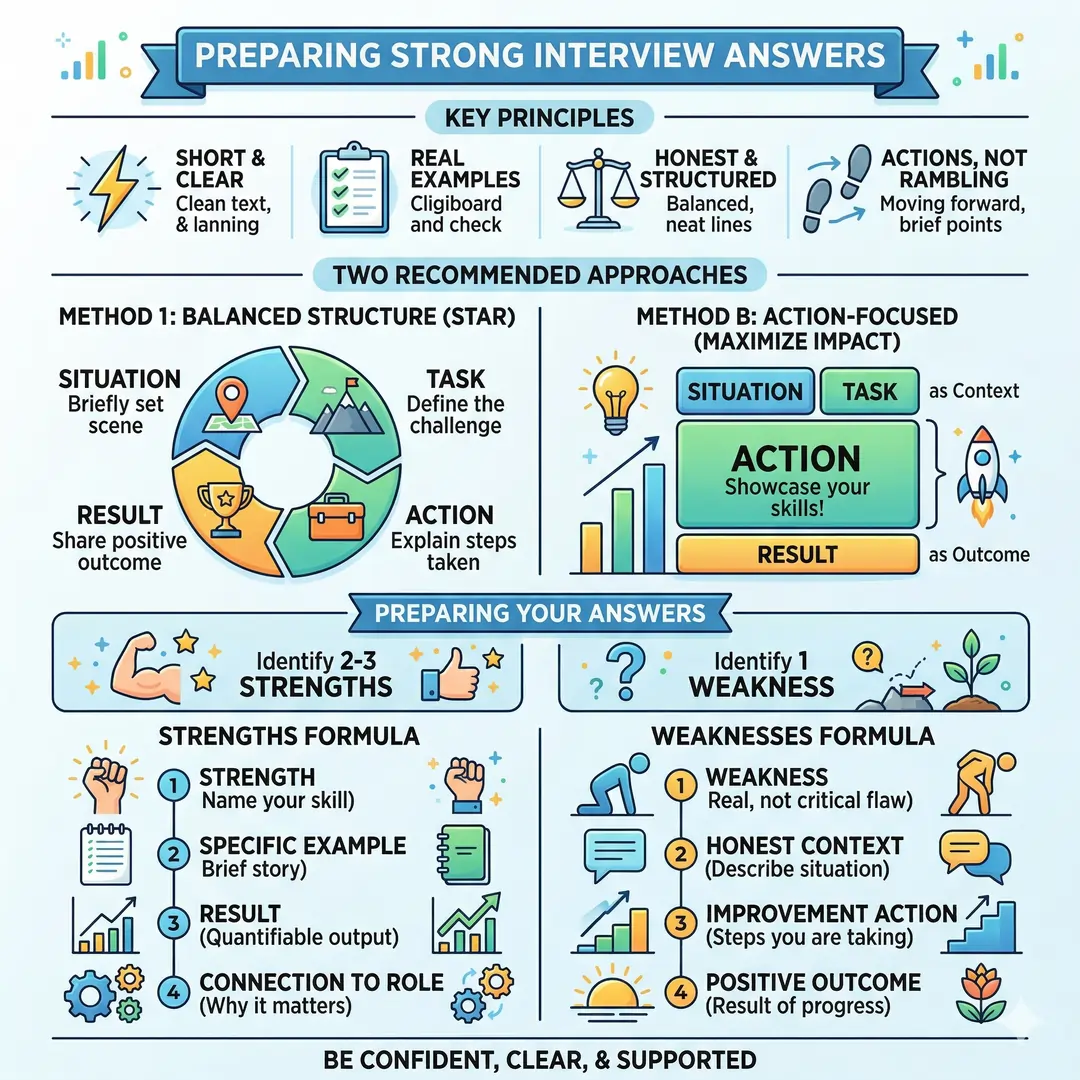
Before the interview, take time to identify two or three strengths and one weakness that you can discuss confidently. Indeed suggests focusing on one or two key strengths that match the role and supporting them with specific, relevant examples. For weaknesses, choose something real but not critical to the job, then explain the steps you are taking to improve.
A simple preparation formula looks like this:
Strengths formula:
Strength + specific example + result + connection to the role
Weakness formula:
Weakness + honest context + improvement action + positive outcome
Table 1. What Employers Really Want to Learn
| Interview question | What the interviewer is checking | Best way to respond |
|---|---|---|
| What are your strengths? | Whether you understand your best work habits and can match them to the role. Oxford says strength-based interviews are designed to reveal your real working style. | Choose one or two strengths, explain them clearly, and back them up with a real example. |
| What are your weaknesses? | Whether you are self-aware, honest, and committed to growth. Indeed says this is a chance to show self-awareness and professionalism. | Mention a weakness that does not hurt the job, then explain how you are improving it. |
| Why should we hire you? | Whether you can connect your strengths to the employer’s needs. Harvard says the interviewer is essentially asking, “Why should we hire you?” | Link your strengths to the role, the company, and the problems you can help solve. |
| How do you handle pressure? | Whether you can stay effective in real work situations. Oxford and Harvard both recommend structured, example-based answers. | Use STAR and show how you acted, adapted, and delivered a result. |
| What do you bring to the team? | Whether you understand teamwork, communication, and professionalism. NACE includes communication, professionalism, and teamwork as career-readiness competencies. | Show how your style helps the team move faster, communicate better, or solve problems more smoothly. |
How to Talk About Strengths in an Interview
A good strength is not just a nice personal trait. It is a quality that helps you do the job well. That is why strengths should always match the role. Oxford says you should think about what the organization is looking for and how your strengths fit that need. Indeed also recommends focusing on strengths that relate directly to the job and using examples that show those strengths in action.
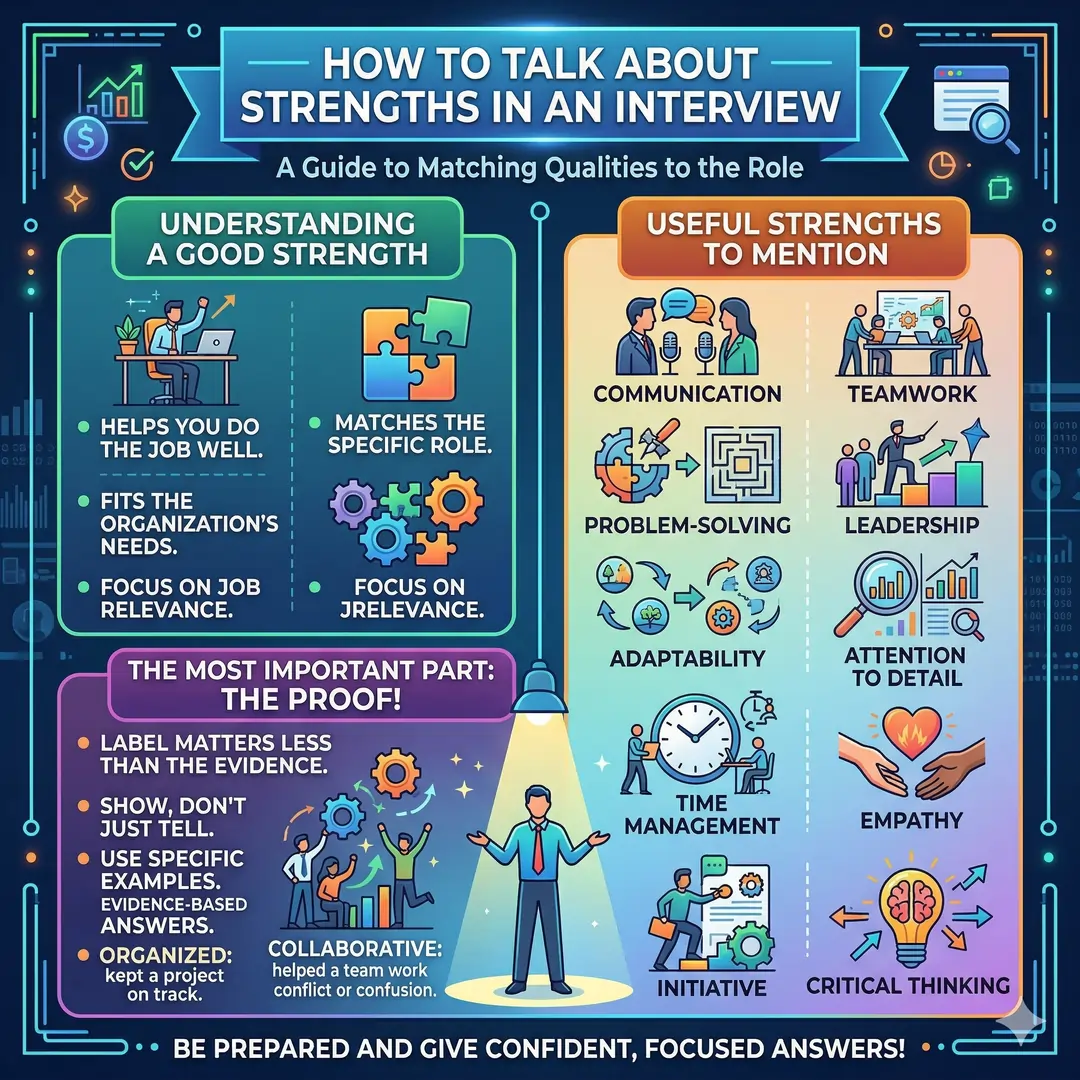
Some of the most useful strengths to mention include:
- Communication
- Teamwork
- Problem-solving
- Leadership
- Adaptability
- Attention to detail
- Time management
- Empathy
- Initiative
- Critical thinking
What matters most is not the label. What matters is the proof. If you say you are organized, show how you kept a project on track. If you say you are collaborative, show how you helped a team work through conflict or confusion. Oxford’s guidance makes it clear that answers should be specific and evidence-based, not general.
Table 2. Strong Strengths to Mention, With Sample Wording
| Strength | Why it works | Sample answer idea |
|---|---|---|
| Communication | Useful in almost every role, especially jobs that require teamwork, clients, or coordination. NACE lists communication as a key career-readiness skill. | “I explain ideas clearly and keep people informed. In my last role, that helped reduce confusion during project updates.” |
| Problem-solving | Shows logic, judgment, and calm thinking. Oxford and Harvard both value action-focused examples in interviews. | “When a process broke down, I looked at the root cause, fixed the immediate issue, and helped prevent it from happening again.” |
| Teamwork | Proves that you can work well with others toward common goals. NACE includes teamwork as a workplace competency. | “I work well in teams because I listen first, stay dependable, and make sure everyone knows their part.” |
| Adaptability | Useful in changing workplaces and growing roles. Oxford says strength-based interviews often explore how you handle setbacks and shifting conditions. | “I adjust quickly when priorities change, and I stay focused on the main goal instead of getting stuck on the original plan.” |
| Attention to detail | Shows care, accuracy, and professionalism. This is especially useful in roles involving data, writing, operations, or quality control. | “I naturally catch small errors early, which helps save time and keeps work more polished.” |
| Leadership | Good for roles where initiative and responsibility matter. NACE includes leadership as a career-readiness skill. | “I like taking ownership, helping others stay aligned, and keeping projects moving toward a clear result.” |
Sample Answers for Strengths
Below are simple sample answers that sound natural and professional. You can adapt them to your own background.
Sample Answer 1, Communication
“One of my biggest strengths is communication. I try to make my updates clear, practical, and easy to act on. In my previous role, I often helped different team members stay aligned on deadlines and responsibilities. That reduced confusion and made our projects run more smoothly.”
Sample Answer 2, Problem-solving
“My strength is problem-solving. I enjoy breaking down a challenge, finding the root cause, and testing a practical solution. In one project, we were missing deadlines because the workflow was not clear. I helped reorganize the steps, and the team became much more efficient.”
Sample Answer 3, Teamwork
“I am strong in teamwork because I listen carefully and try to support the people around me. I do not just focus on my own tasks. I also make sure the team has what it needs to move forward.”
Sample Answer 4, Adaptability
“I adapt well when things change. I am comfortable shifting priorities, learning new systems, and staying calm when a plan needs to be adjusted. That has helped me handle fast-moving work without losing focus.”
These answers work because they are clear, specific, and easy to connect to the job. They also follow the advice from Oxford and Harvard to use structure and emphasize actions.
How to Talk About Weaknesses Without Hurting Your Chances
A weakness answer should never sound fake. Interviewers usually recognize the overly polished answer, such as “I work too hard” or “I care too much.” Those answers often feel rehearsed and unhelpful. Instead, be honest about something real, but choose a weakness that is not central to the job. Indeed and The Balance both recommend focusing on improvement and avoiding weaknesses that would make the employer question your ability to do the role.
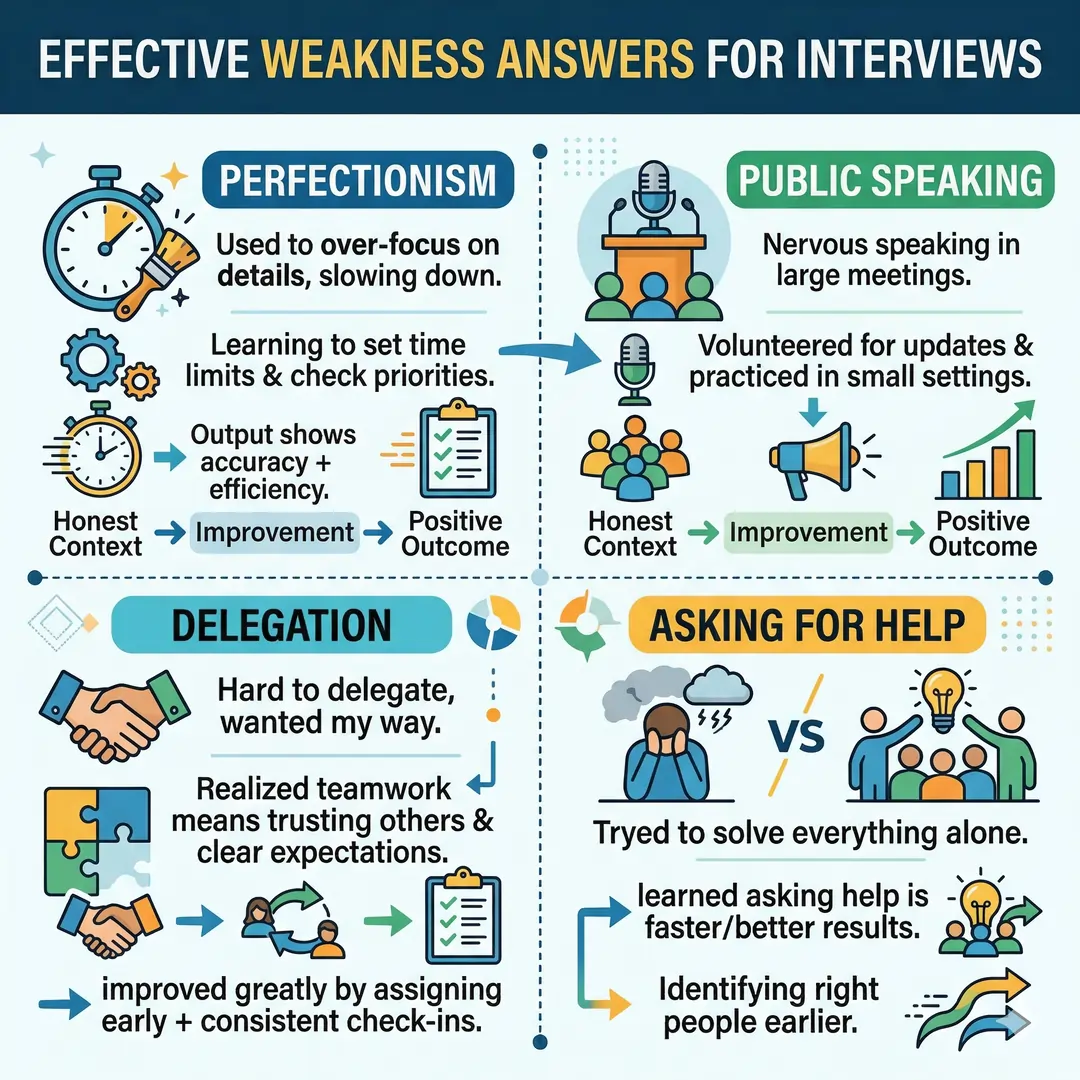
The strongest weakness answers usually have three parts:
- State the weakness honestly
- Explain what you learned from it
- Show how you are improving
This approach keeps the answer positive without sounding fake. The Balance says to begin where you started, explain the steps you took to improve, and then highlight the outcome. It also recommends avoiding overexplaining and keeping the focus on progress.
Table 3. Weakness Examples and Better Ways to Present Them
| Weakness | Safer way to frame it | Why this works |
|---|---|---|
| Public speaking | “I used to feel nervous speaking in front of large groups, so I have been practicing more presentations and speaking up in meetings.” | It is honest, but it also shows active improvement. |
| Delegating tasks | “I sometimes tried to handle too much myself, but I have learned to trust others more and assign work earlier.” | It shows maturity and better leadership habits. |
| Perfectionism | “I can spend too long refining small details, so I now set stronger time limits and check priorities sooner.” | It is real, but it also shows self-management. |
| Too self-critical | “I used to focus too much on what I could have done better, and I now make a point of reviewing wins as well as mistakes.” | It shows reflection without sounding defensive. |
| Limited experience with one tool | “I have not used that software much, but I have already started training and I am learning quickly.” | It is appropriate only if the skill is not essential for the job. |
| Overcommitting | “I sometimes took on too many responsibilities, and I have been working on planning my workload more carefully.” | It signals responsibility and a growth mindset. |
Sample Answers for Weaknesses
Sample Answer 1, Perfectionism
“One weakness I have worked on is perfectionism. In the past, I spent too much time polishing small details, which sometimes slowed me down. I have learned to set clearer time limits and check priorities earlier, so I can stay accurate without losing efficiency.”
Sample Answer 2, Public speaking
“I used to feel nervous speaking in large meetings. To improve, I started volunteering to share updates more often and practicing in smaller settings first. I am much more comfortable now, and I still keep building that skill.”
Sample Answer 3, Delegation
“Earlier in my career, I found it hard to delegate because I wanted everything to be done my way. Over time, I realized that good teamwork means trusting others and setting clear expectations. I have improved a lot by assigning work earlier and checking in more consistently.”
Sample Answer 4, Asking for help
“My weakness used to be trying to solve everything alone. I have learned that asking for help earlier is often faster and leads to better results. Now I make a point of identifying the right people to involve sooner.”
These answers work because they are honest, specific, and focused on improvement. That matches the guidance from Indeed, Oxford, Harvard, and The Balance.
Table 4. A Simple Formula You Can Use for Any Answer
| Part of the answer | What to include | Example |
|---|---|---|
| Strength or weakness | Name the trait clearly. | “One of my strengths is organization.” |
| Context | Give a short real-life example. | “In my last role, I managed several deadlines at once.” |
| Action | Explain what you did. | “I created a weekly schedule and tracked progress every day.” |
| Result | Show the outcome. | “That helped the team stay on time and reduced last-minute stress.” |
| Connection to the role | Tie it back to the job. | “That same habit would help me stay reliable in this position.” |
The formula above reflects the STAR technique, which Harvard and Oxford both recommend for interview answers. STAR helps you stay focused, specific, and easy to follow.
Common Mistakes to Avoid
Even a good candidate can weaken their answer by making a few common mistakes. Oxford advises candidates to be themselves, answer the actual question, and avoid sounding insincere. Indeed, it also warns against vague strengths, jokes, arrogance, and underestimating yourself.
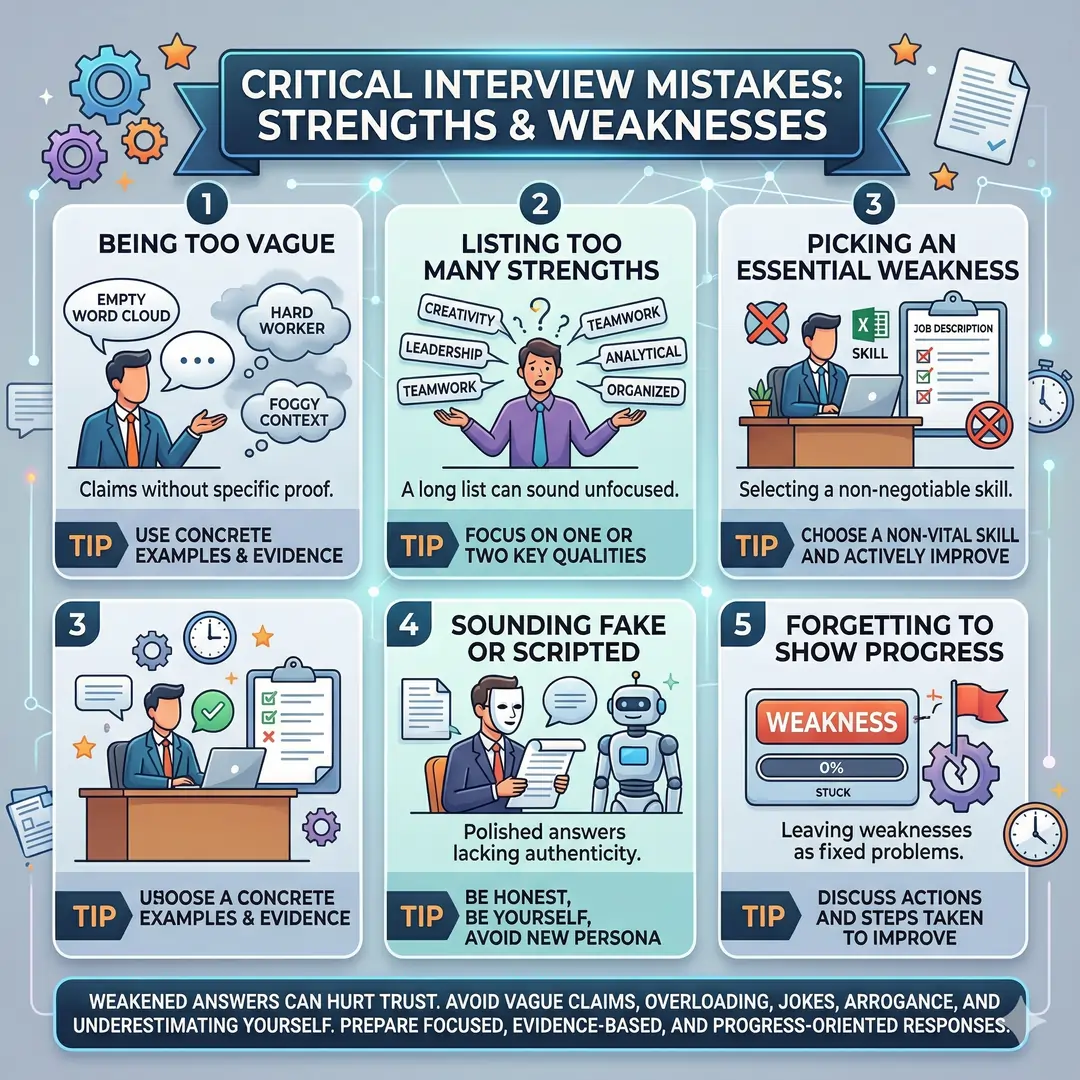
Here are the biggest mistakes:
1. Being too vague
Saying “I am a hard worker” without proof does not tell the interviewer much.
2. Listing too many strengths
Pick one or two. A long list can sound unfocused. Indeed specifically advises staying focused on one or two key qualities.
3. Choosing a weakness that is essential to the job
If the job needs Excel skills, do not say your weakness is spreadsheets.
4. Sounding fake or scripted
A polished but unrealistic answer can hurt trust. Oxford says honesty matters and that adopting a new persona can come across as insincere.
5. Leaving out improvement
A weakness without progress is just a problem. The Balance recommends focusing on the steps you are taking to improve.
How to Choose the Right Strengths and Weaknesses for Different Jobs
The best answer depends on the role. A strength that works beautifully in one job may be less useful in another. The same is true for weaknesses. The Balance and Indeed both explain that you should think carefully about the job before choosing what to say.
For example:
- In a customer service role, strengths like empathy, communication, patience, and problem-solving often matter most.
- In a technical role, strengths like analysis, attention to detail, and structured thinking may be more useful.
- In a leadership role, employers may value accountability, decision-making, delegation, and calm judgment.
- In a creative role, strengths like originality, curiosity, flexibility, and initiative can help you stand out.
A weakness should also fit the role carefully. For instance, if you are applying for an accounting position, it is not smart to say mathematics is your weakness. If you are interviewing for a writing role, it is not wise to say you are weak at written communication. The weakness should be real, but it should not block your ability to do the job.
Table 5. Role Based Strength and Weakness Ideas
| Job type | Good strength examples | Safer weakness examples |
|---|---|---|
| Customer service | Empathy, communication, patience, calmness | Overthinking difficult conversations, needing more confidence in presentations |
| Admin or operations | Organization, time management, attention to detail | Delegation, perfectionism, saying yes too often |
| Tech or data | Problem-solving, analysis, focus, learning mindset | Public speaking, presenting ideas to large groups, asking for help too late |
| Marketing or creative | Creativity, collaboration, adaptability, communication | Overediting, taking too long on details, being overly self-critical |
| Leadership or management | Decision-making, accountability, teamwork, delegation | Trying to do too much alone, being slow to delegate, perfectionism |
A Quick Preparation Checklist Before the Interview
Before your interview, review the following:
Know the job description.
Match your strengths to the role.
Pick one or two strengths.
Do not overload the answer.
Pick one weakness wisely.
Choose something honest but not critical.
Use a real example.
Facts and stories make your answer believable.
Show improvement.
Interviewers want to see progress, not excuses.
Keep it concise.
SHRM notes that interview answers should be short and focused, and Oxford encourages structured responses.
Final Thoughts
The strengths and weaknesses interview question is not a trap. It is a chance to show that you understand yourself, you know what the job needs, and you can reflect honestly on how you work. Harvard, Oxford, SHRM, and NACE all point in the same direction. Good interview answers are clear, specific, honest, and connected to the role. They also show growth, professionalism, and a willingness to learn.
The best approach is simple. Choose strengths that fit the role. Choose weaknesses that are real but manageable. Use examples. Stay honest. Focus on progress. When you do that, this question becomes much easier, and your answer starts working for you instead of against you.
Also, Read these Articles in Detail
- Top Interview Questions and Answers Guide
- Interview Questions and Answers for Freshers and Experienced Candidates
- Common Interview Questions and Best Answers for Job Seekers
- “Tell me about yourself” Interview Answer Examples and Tips
Article References and Sources
- Harvard Faculty of Arts & Sciences. (n.d.). Prepare for an Interview. Retrieved from:
https://careerservices.fas.harvard.edu/channels/prepare-for-an-interview/ - Harvard Law School. (n.d.). Interview Questions and the STAR Method. Retrieved from:
https://hls.harvard.edu/bernard-koteen-office-of-public-interest-advising/opia-job-search-toolkit/interview-questions/ - University of Oxford Careers Service. (n.d.). Interview Technique. Retrieved from:
https://www.careers.ox.ac.uk/interview-technique - University of Oxford Careers Service. (n.d.). Types of Interviews. Retrieved from:
https://www.careers.ox.ac.uk/types-of-interview - University of Oxford Careers Service. (n.d.). Demonstrate You Fit the Job Criteria. Retrieved from:
https://www.careers.ox.ac.uk/demonstrate-you-fit-the-job-criteria - Indeed Career Guide India. (n.d.). Interview Question: What Are Your Strengths and Weaknesses? Retrieved from:
https://in.indeed.com/career-advice/interviewing/interview-question-what-are-your-strengths-and-weaknesses - Indeed Career Guide India. (n.d.). List of Strengths and Weaknesses for Job Interviews. Retrieved from:
https://in.indeed.com/career-advice/interviewing/list-of-strengths-and-weaknesses - The Balance Careers. (n.d.). What Is Your Greatest Weakness? Retrieved from:
https://www.thebalancemoney.com/what-is-your-greatest-weakness-2061288 - The Balance Careers. (n.d.). List of Weaknesses: Examples and Tips. Retrieved from:
https://www.thebalancemoney.com/list-of-weaknesses-2063805 - The Balance Careers. (n.d.). Strengths and Weaknesses Interview Questions. Retrieved from:
https://www.thebalancemoney.com/strengths-and-weaknesses-interview-questions-2061221 - National Association of Colleges and Employers (NACE). (2024). Career Readiness Competencies Survey. Retrieved from:
https://www.naceweb.org/docs/default-source/default-document-library/2024/publication/survey-instrument/2024-nace-student-survey.pdf - Society for Human Resource Management (SHRM). (n.d.). Virtual Interview Do’s and Don’ts. Retrieved from:
https://www.shrm.org/membership/students/virtual-interview-dos-donts
Frequently Asked Questions
FAQ 1: What is the best way to answer strengths and weaknesses interview questions?
The best way to answer strengths and weaknesses interview questions is to stay honest, clear, and relevant to the job. For your strengths, choose qualities that match the role and explain them with a real example. For your weaknesses, mention something genuine that does not seriously hurt your ability to do the job, then show what you are doing to improve.
A strong answer should sound natural, not rehearsed. The goal is not to sound perfect. The goal is to show self-awareness, confidence, and a growth mindset. When you speak in a calm and simple way, the interviewer can understand your thinking more easily and see that you are serious about learning and improving.
FAQ 2: Why do interviewers ask about strengths and weaknesses?
Interviewers ask about strengths and weaknesses because they want to understand how you see yourself at work. They want to know whether you understand your own skills, how you handle challenges, and whether you are the right fit for the role. This question also helps them judge your honesty and your ability to reflect on your own performance.
It is not only about listing traits. It is about showing that you know how your qualities affect your work. A good answer tells the interviewer that you can think carefully about your behavior, learn from experience, and bring value to the team. That is why this question is so common in interviews for many kinds of jobs.
FAQ 3: What are some good strengths to mention in an interview?
Good strengths to mention in an interview are the ones that connect directly to the job. Some common examples include communication, teamwork, problem-solving, adaptability, leadership, time management, and attention to detail. These strengths are useful because they show that you can work well with others, manage tasks, and deal with different situations.
The most important thing is to support each strength with an example. For instance, if you say you are good at communication, explain how you helped your team stay organized or how you made instructions easier to understand. This makes your answer more believable and more useful to the interviewer.
FAQ 4: How should I choose my strengths for a specific job role?
You should choose strengths that fit the requirements of the job. Read the job description carefully and look for words like teamwork, organization, problem-solving, customer service, or leadership. Then think about which of your own strengths match those needs best. This helps you give a more targeted and impressive answer.
For example, if you are applying for an office job, organization and time management may be strong choices. If you are applying for a customer-facing role, communication and empathy may be better. The more your answer matches the role, the more likely the interviewer is to see you as a strong candidate.
FAQ 5: What is a safe weakness to mention in an interview?
A safe weakness is one that is real but not essential to the job. Common examples include public speaking, delegating tasks, overthinking details, or being too self-critical. These weaknesses are often safe because they show honesty, but they do not make you sound incapable of doing the work.
The best weakness answer also includes improvement. You should explain how you are working on the problem. For example, if public speaking is a weakness, you can say you have been practicing more presentations and speaking in smaller groups first. That shows progress, maturity, and a willingness to grow.
FAQ 6: What weaknesses should I avoid mentioning in an interview?
You should avoid weaknesses that are central to the job. For example, if you are applying for a role that requires attention to detail, do not say that you are careless. If the job needs strong writing, do not say that you struggle with written communication. Choosing the wrong weakness can make the interviewer question your fit for the position.
It is also smart to avoid fake answers like “I work too hard” or “I care too much.” These answers often sound dishonest because they are not real weaknesses in the usual sense. A better answer is honest, simple, and focused on improvement. That approach creates trust and helps the interviewer see your professional side.
FAQ 7: How can I turn a weakness into a positive interview answer?
You can turn a weakness into a positive interview answer by showing that you understand the weakness and have already started improving it. First, name the weakness clearly. Then explain what problems it caused in the past. After that, describe the steps you took to improve. Finally, share the results of that effort.
For example, if you used to struggle with delegation, you can say that you once tried to do too much alone, but later learned the value of trusting others and setting clear expectations. This kind of answer works because it shows honesty, self-improvement, and professional growth. It gives the interviewer a real sense of how you handle challenges.
FAQ 8: How long should my answer be when talking about strengths and weaknesses?
Your answer should be long enough to explain your point, but not so long that it becomes hard to follow. In most interviews, a good answer is usually one to two minutes long. That gives you enough time to name the strength or weakness, give a short example, and explain how it connects to the job.
A clear answer is better than a very long answer. Interviewers appreciate structure because it shows that you can communicate well. You do not need to give your life story. You only need a focused response that sounds natural, confident, and useful. A short, well-organized answer often makes a much stronger impression than a long, scattered one.
FAQ 9: Can I give the same strength and weakness in every interview?
You can reuse some strengths and weaknesses, but you should not give exactly the same answer in every interview without adjusting it. Each job is different, and the interviewer may be looking for different qualities. A strength that works well in one role may not be the best choice in another role.
It is a smart idea to prepare a few strong examples in advance and then adapt them to the job. For example, problem-solving may work in many roles, but the example you use should change based on the position. This makes your answer feel more relevant and shows that you understand the company’s needs.
FAQ 10: What is the biggest mistake people make when answering this question?
The biggest mistake is giving vague or fake answers. Some candidates say things like “I have no weaknesses” or give a strength without any example. Others choose a weakness that makes them look unsuitable for the job. These answers do not help the interviewer understand the real person behind the resume.
Another common mistake is failing to show improvement. A weakness should not just be a problem. It should also show that you are learning and growing. The strongest answers are honest, simple, and specific. They tell a small story about who you are, how you work, and how you keep improving over time.
FAQ 11: How do I describe my strengths without sounding arrogant?
The best way to describe your strengths without sounding arrogant is to stay modest, specific, and focused on results. You do not need to claim that you are the best at everything. Instead, speak about the qualities you genuinely use to do good work and explain them with a real example. This keeps your answer confident but still humble.
A good interview answer sounds more like a thoughtful reflection than a sales pitch. For example, instead of saying “I am excellent at everything I do,” you can say “One of my strengths is staying organized, which helps me manage deadlines and support my team effectively.” This type of answer feels professional because it shows confidence without exaggeration.
It also helps to connect your strength to the needs of the role. That way, the interviewer sees that you are not just listing nice qualities. You are showing how your skills, work habits, and attitude can create value in the job. A calm, practical answer often makes a better impression than a dramatic one.
FAQ 12: Is it okay to mention a weakness that I have already improved?
Yes, it is not only okay, but it is also often the best approach. A weakness that you have already improved is a strong interview choice because it shows self-awareness and growth. It tells the interviewer that you can recognize a gap, take action, and make progress over time. That is a very positive sign in any candidate.
For example, you might say that you used to struggle with public speaking, but you have improved by practicing more often, speaking in smaller groups, or preparing better before meetings. This answer is honest, but it also shows that you are active in building your skills. The interviewer can see that you do not just notice problems. You work on them.
This kind of answer is especially useful because it keeps the conversation balanced. You are not pretending to be perfect, and you are not leaving the interviewer with a negative impression. You are showing that you understand how personal improvement works in real life.
FAQ 13: What should I do if I cannot think of any good weaknesses?
If you cannot think of a weakness, start by looking at small habits that make your work a little harder. Most people have something they are still improving. The key is to choose a weakness that is honest, manageable, and not dangerous for the role. Think about times when you needed more patience, better planning, stronger confidence, or better balance in how you handle tasks.
A useful way to find a weakness is to ask yourself what others have suggested you improve. For example, maybe people have told you that you sometimes take too long making a decision, or that you can be too careful with small details. These kinds of answers are often safe because they are real, but they also allow room for improvement.
If you are still unsure, choose a weakness that is not central to the job and describe the steps you are taking to improve it. That is much better than saying “I do not have weaknesses” because that sounds unrealistic. Interviewers usually respect honesty more than perfection.
FAQ 14: How can I prepare examples for strengths and weaknesses before an interview?
The best preparation starts with writing down two or three strengths and one carefully chosen weakness. Then, for each one, think of a short real-life example from school, work, volunteering, or daily tasks. A strong example helps your answer sound genuine and makes it easier for the interviewer to remember you.
For strengths, use a simple pattern. First, name the strength. Second, explain where you used it. Third, show the result. For weaknesses, use a different pattern. First, admit the weakness. Second, explain what you learned. Third, show the action you took to improve. This structure keeps your answer neat and easy to follow.
It is also useful to practice speaking your answers out loud. That helps you find words that sound natural instead of memorized. The more familiar you are with your examples, the easier it becomes to stay calm in the interview and answer with confidence.
FAQ 15: Should I use the STAR method for strengths and weaknesses questions?
Yes, the STAR method can be very helpful for strengths and weaknesses questions, especially when the interviewer wants examples. STAR stands for Situation, Task, Action, Result. It gives your answer a clear shape, so the listener can follow your thinking without getting lost. This is especially useful when you want to show how a strength has helped you in a real situation.
For a strength answer, you might describe a situation where your problem-solving or communication skills helped the team. Then you explain the task, what you did, and what happened in the end. This makes your answer feel real and professional. It also proves that your strength is not just a word on paper.
For a weakness answer, you can still use a lighter version of STAR. Describe the situation where the weakness showed up, explain the issue, tell what action you took to improve, and mention the result. This shows that you are thoughtful and capable of learning from experience. That kind of answer is often very well received.
FAQ 16: How do I answer if the interviewer asks for more than one strength?
If the interviewer asks for more than one strength, it is best to keep your answer focused and organized. Choose two strengths that are clearly different from each other but still relevant to the role. For example, you might mention communication and time management, or teamwork and attention to detail. That gives the interviewer a fuller picture of how you work.
Each strength should be explained with a short example. You do not need a long story for every point. A brief example is enough if it clearly shows the strength in action. The goal is to make your answer easy to understand and easy to remember.
It is important not to overload the interviewer with too many qualities. A long list can sound unfocused and weaken your message. Two well-chosen strengths are usually better than five vague ones. Quality always matters more than quantity in an interview answer.
FAQ 17: Can I say that I am a perfectionist as a weakness?
You can say perfectionism is a weakness, but only if you handle the answer carefully. This is a very common response, so the danger is that it can sound like a rehearsed or fake answer. If you use it, be honest about how it has affected your work and explain how you are managing it better now.
For example, you might say that you used to spend too much time adjusting small details, which sometimes slowed down your work. Then you can explain that you now set clearer deadlines and check priorities earlier, so you stay both accurate and efficient. That makes your answer feel thoughtful instead of scripted.
The key is to show that perfectionism is not just a label you are repeating. It should be tied to a real behavior and a real improvement process. That gives the interviewer confidence that you understand the limits of the weakness and are working to become more balanced.
FAQ 18: What are some strengths that work well for freshers or beginners?
For freshers or beginners, the best strengths are often the ones that show learnability, reliability, and positive attitude. Good examples include quick learning, adaptability, communication, teamwork, curiosity, and willingness to take feedback. These strengths matter a lot when you do not yet have many years of experience.
A fresher does not need to pretend to have advanced leadership experience or a long work history. Instead, they should focus on habits that show potential. For example, if you are a fast learner, you can explain how you picked up new tools, adapted to a new class project, or learned a new task quickly. That gives the interviewer confidence in your ability to grow.
Freshers often worry that they do not have enough to say, but that is not true. School projects, internships, volunteer work, and group assignments all provide useful examples. The important thing is to connect those experiences to the job and show that you are ready to learn and contribute.
FAQ 19: How do I answer strengths and weaknesses questions for a career change?
If you are changing careers, your answer should focus on transferable skills. These are strengths that can move from one field to another, such as communication, problem-solving, organization, adaptability, and teamwork. The interviewer wants to know that even if your background is different, you still bring useful abilities to the new role.
You should also show that you understand the new field and are serious about learning. For example, if you are moving into a new industry, you can explain how your past experience taught you how to handle pressure, work with people, or manage deadlines. Then you can connect that skill to the new job. This makes your answer feel practical and convincing.
For weaknesses, it is smart to choose something that is part of the learning process rather than something that blocks the career change. For example, you may say you are still getting used to a new tool, system, or workflow, but you are already improving through study and practice. That tells the employer you are not afraid of growth.
FAQ 20: Why is honesty so important when answering strengths and weaknesses?
Honesty is important because interviewers can usually tell when someone is being fake or overly polished. A strong interview answer does not mean pretending to be perfect. It means speaking truthfully about your real strengths, real weaknesses, and real efforts to improve. That is what creates trust.
When you are honest, your answer becomes more believable and more memorable. You also give the interviewer a better idea of how you will behave at work. A person who can honestly reflect on their abilities is often seen as more mature, reliable, and coachable. Those are qualities many employers value highly.
Honesty does not mean sharing every flaw or weakness in detail. It means choosing the right level of truth for the interview situation. You should be open, but also thoughtful. When you combine honesty with structure and improvement, your answer becomes both professional and persuasive.
