“Tell me about yourself” is usually the first big moment in an interview, and it often sets the tone for everything that follows. Career experts from Harvard Business Review, Harvard Career Services, Penn Career Services, Princeton, the University of Arizona, and other university career centers agree on the same core idea. This question is not a request for your life story. It is a chance to give a focused, confident summary of your background, your strengths, and why you fit the role. The strongest answers are usually short, relevant, structured, and tailored to the job, often using a present-past-future flow and staying within about two minutes.
If you are preparing for interviews, learning how to answer this one question well can make a huge difference. A strong answer helps you sound prepared, organized, and easy to talk to. It also gives the interviewer a clear picture of your most relevant experience without forcing them to pull that story out of your resume piece by piece. That is why this question is so important, and why a good answer can quietly shape the rest of the conversation in your favor.
Table of Contents
Why interviewers ask “Tell me about yourself.”
Interviewers ask this question for more than small talk. They want to see how you think, how you communicate, and which parts of your background you believe matter most. They are also testing whether you can stay focused, connect your experience to the role, and present yourself in a way that is professional but still natural. Harvard Business Review notes that the interviewer already has your resume, so the real goal is not repetition. The goal is to frame your experience in a way that helps them remember you for the right reasons.
Also, read this in detail: Common Interview Questions and Best Answers for Job Seekers
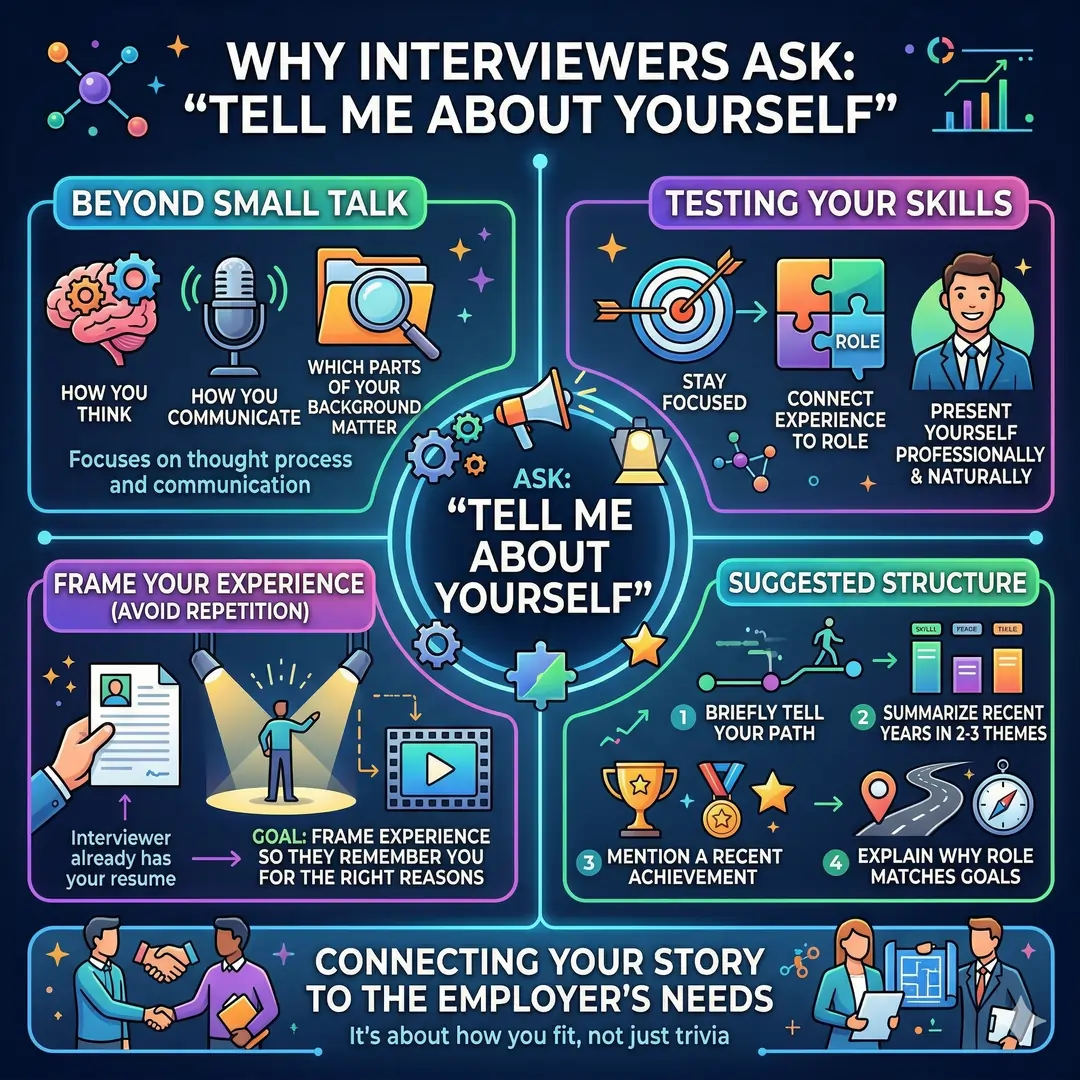
University career centers describe this question as a chance to break the ice, offer context, and tell a brief story about your path so far. Princeton says to summarize the past few years in 2 to 3 themes related to the role, while the University of Arizona recommends a professional structure, a recent achievement, and a clear explanation of why the role matches your goals. That is why this question is less about personality trivia and more about whether you can connect your story to the employer’s needs.
The best structure for your answer
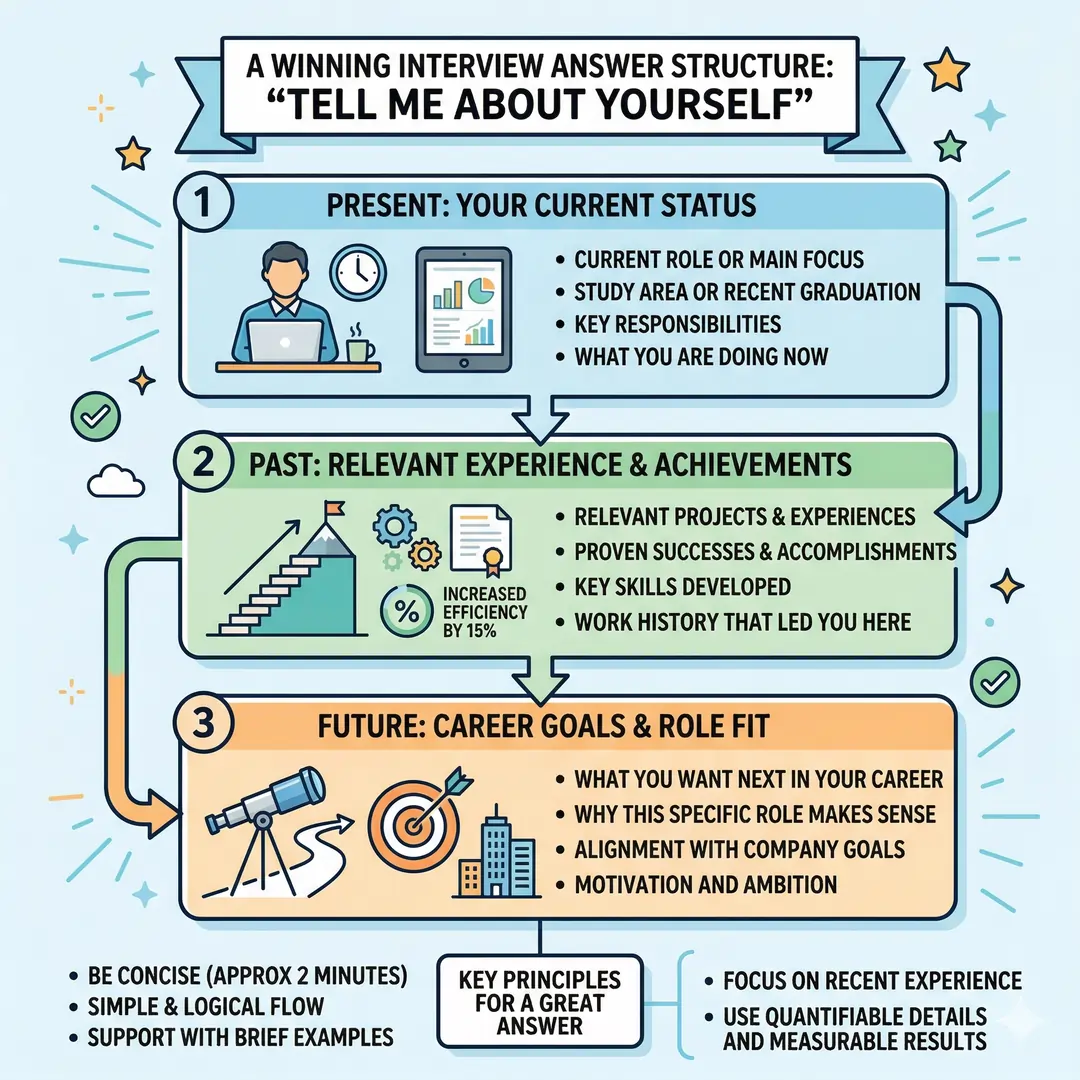
The most widely recommended structure is present-past-future. You start with what you are doing now, move to the experience that brought you here, and finish with what you want next and why this role makes sense. Several career centers recommend this pattern because it is simple, logical, and easy for interviewers to follow. It also keeps your answer tight and relevant instead of wandering into unnecessary details.
A simple version of the structure
- Present: Your current role, study area, or main focus
- Past: Relevant experience, projects, or achievements
- Future: What you want next and why this job is a fit
That flow works because it helps you move naturally from your current position to your career story and then to your motivation. The University of Alabama and the University of Arizona both emphasize that answers should be concise, usually around two minutes, and supported with a brief example or measurable result where possible. Indeed also recommends focusing on recent experience, proven successes, and details that can be quantified.
Table 1: The best answer framework
| Part of the answer | What to include | What to avoid | Why it works |
|---|---|---|---|
| Present | Current role, field of study, or main responsibility | A full resume recap | Gives the interviewer an immediate snapshot of where you are now. |
| Past | Relevant experience, key projects, achievements, transferable skills | Unrelated life history | Shows how your background prepared you for this role. |
| Future | Why do you want this role, and where do you want to grow | Generic statements like “I want a good job.” | Makes your interest feel intentional and role-specific. |
| Proof | Numbers, outcomes, and short examples | Vague claims with no evidence | Quantified results are more convincing than broad labels. |
| Tone | Conversational, confident, clear | Reading from memory like a speech | Helps the answer sound natural and human. |
How to build a strong answer step by step
Start by reading the job description carefully and picking out the skills that matter most. Then match those skills to your own experience and choose a few stories, achievements, or responsibilities that prove you have them. Indeed recommends using recent professional experience first, with volunteer work or community activity only when it supports your narrative and adds useful context.
Next, write your answer in short sections. Keep your wording simple. A useful answer usually sounds like a polished mini-story, not a script full of buzzwords. The University of Alabama recommends speaking honestly, adding brief examples where appropriate, and keeping your response within about two minutes. Princeton similarly recommends using 2 to 3 themes rather than trying to say everything at once.
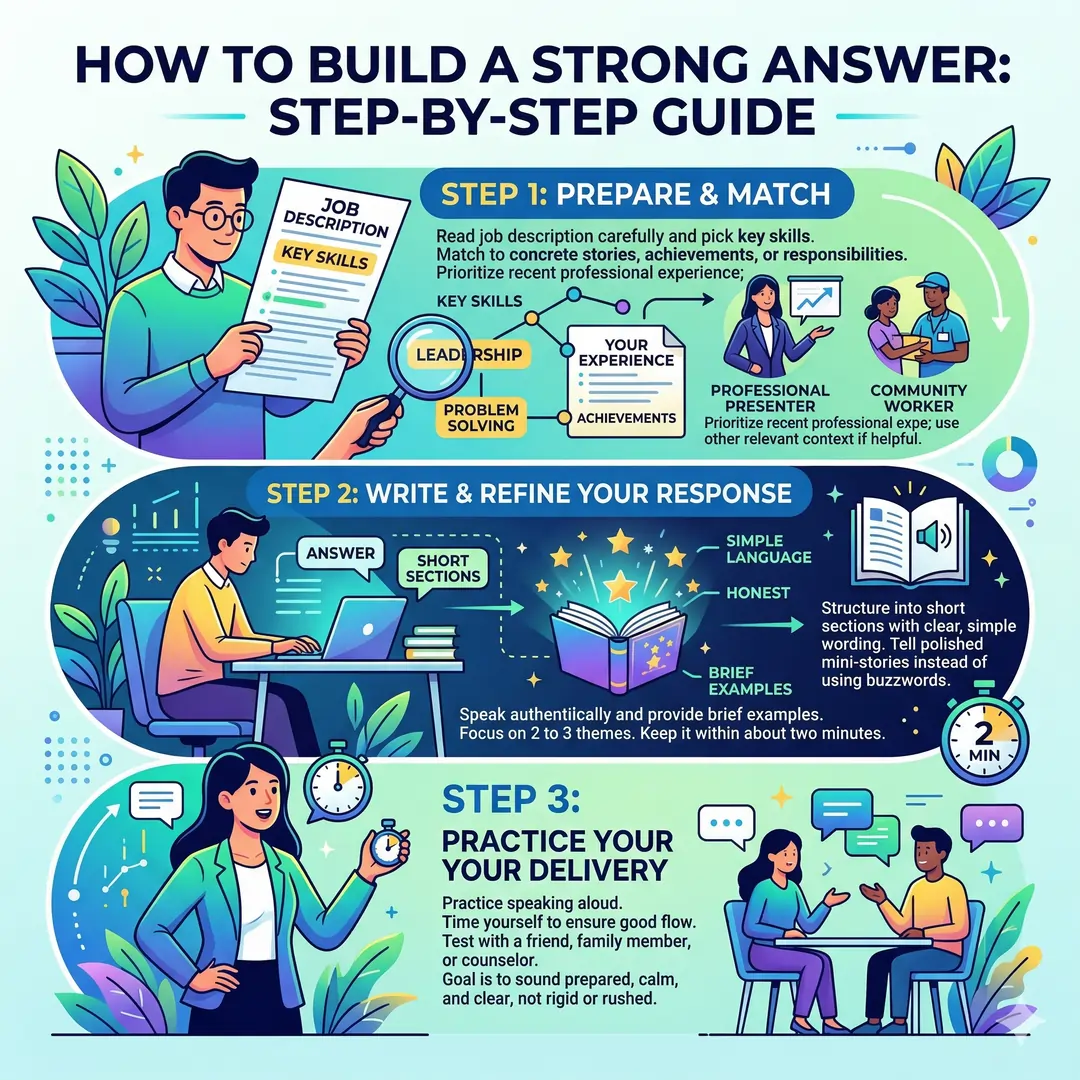
Finally, practice aloud. The University of Arizona recommends timing yourself and testing your response with a friend, family member, or counselor. That practice matters because even a well-written answer can sound awkward if it is rushed, too long, or memorized too rigidly. The goal is not perfection. The goal is to sound prepared, calm, and clear.
Table 2: What to include in your answer and what to skip
| Include this | Example | Skip this | Why it matters |
|---|---|---|---|
| Current role or status | “I am a marketing associate focused on campaign performance.” | “I was born in…” | The interviewer wants career context, not a personal biography. |
| Relevant achievement | “I helped improve response time by 15%.” | “I work hard and learn quickly.” | Specific results are stronger than vague self-praise. |
| Transferable skills | “I use stakeholder communication and planning daily.” | A full list of unrelated responsibilities | The answer should connect directly to the role. |
| Why this role | “This role fits my next step in project management.” | A generic statement about wanting any job | Tailoring shows real interest and preparation. |
| A touch of personality | “I enjoy mentoring and community volunteering.” | Personal details about religion, marital status, or politics | Some personal details are fine, but not personal disclosure that is irrelevant to work. |
A smart way to think about the question
A helpful way to think about this question is, “What do I want the interviewer to remember about me?” That idea appears directly in Harvard Career Services guidance. Your answer should leave the interviewer with a clear impression of your strengths, your path, and the value you can bring. That is more useful than trying to tell every detail of your background.
Penn Career Services makes a similar point. This is one of the few parts of the interview where you have direct control, so you should use it to set the tone and introduce the most important parts of your story. In other words, this is your opening pitch. It should guide the interviewer toward the themes you want them to notice.
Sample answer examples
Below are example answers you can adapt. They are written in natural, simple language and follow the present-past-future structure recommended by several career centers. You should adjust the details so they match your own experience, the job description, and the company.
1. Sample answer for a fresher or recent graduate
“I recently completed my degree in business administration, where I focused on marketing and communication. During college, I worked on team projects that helped me build strong writing, presentation, and research skills. I also completed an internship where I supported social media planning and learned how to work with deadlines, feedback, and performance data. At this stage, I am looking for a role where I can keep learning, contribute to a real team, and grow in a company that values creativity and clear communication.”
This answer works because it is brief, professional, and future-focused. It does not waste time on unrelated personal details, and it uses the candidate’s current stage of life as the starting point.
2. Sample answer for an experienced professional
“I am currently a customer support team lead, where I manage daily operations, support team performance, and handle complex customer issues. Over the past few years, I have worked a lot on improving service quality, training new team members, and finding ways to make communication faster and more consistent. Earlier in my career, I built a strong foundation in client handling and problem-solving. Now I am looking for a role where I can use that experience in a broader operations or service leadership position.”
This version is effective because it shows current responsibility, past development, and future direction. That is exactly the kind of professional story career centers recommend.
3. Sample answer for a career switcher
“I started my career in sales, where I learned how to understand client needs, communicate clearly, and stay focused under pressure. Over time, I became especially interested in data and process improvement, so I began developing those skills through projects and training. That is what led me toward business analysis. I am now looking for a role where I can combine my communication background with analytical thinking and contribute more strategically.”
Career changers should not apologize for the change. Instead, they should explain the connection between the old path and the new one. Princeton recommends crafting a narrative that connects the past with the future, while UConn recommends sharing how experiences inside and outside the classroom influenced career goals.
4. Sample answer for a technical candidate
“I am a software developer with a focus on building reliable web applications. In my current role, I work on frontend features, bug fixing, and improving application performance. One thing I have enjoyed is collaborating with designers and backend engineers to turn business needs into practical solutions. Before this role, I built a strong base in JavaScript and API integration, and now I am looking for a team where I can take on more responsibility and continue improving both my technical and product thinking.”
This answer is strong because it translates technical work into business value. That matches the advice from career centers that recommend giving context around your work, your level of responsibility, and how your experience connects to the role.
5. Sample answer for a returning professional
“After taking time away from full-time work, I have stayed active by building my skills through learning, personal projects, and community involvement. My background is in administration and coordination, so I am comfortable handling details, communication, and scheduling. During my time away, I also strengthened my organization and time management skills in new ways. I am now looking for a role where I can bring that experience back into a structured professional setting and contribute right away.”
This type of answer works best when it is calm, confident, and focused on readiness rather than explanation. Indeed recommends highlighting strengths, achievements, and current relevance, while avoiding unnecessary personal detail.
Table 3: Example answer formulas for different situations
| Situation | Best emphasis | Sample opening line | Key finishing idea |
|---|---|---|---|
| Fresher | Education, projects, internship, learning mindset | “I recently graduated in…” | “I am excited to grow in a role where I can learn and contribute.” |
| Experienced professional | Current role, measurable achievements, leadership | “I currently work as…” | “I am looking for a role with broader responsibility.” |
| Career switcher | Transferable skills, bridge experience, motivation | “I started my career in…” | “That is what led me toward this new path.” |
| Technical candidate | Tools, problem solving, collaboration | “I build and improve…” | “I want to keep growing in a team that values quality and impact.” |
| Returning professional | Readiness, refreshed skills, professional maturity | “I have stayed active by…” | “I am ready to step back into a full-time role.” |
The biggest mistakes to avoid
The most common mistake is turning the answer into a full resume recital. Career services at Harvard, Penn, Princeton, and Indeed all warn against repeating your CV word for word. That kind of answer feels flat because it does not tell the interviewer why your background matters or what they should remember about you.
Another mistake is being too personal. Indeed specifically advises avoiding details like marital status, children, or political and religious views, and UConn recommends keeping the answer personal but not too personal. A light mention of hobbies or community involvement can be useful, but only when it adds something meaningful to your professional picture.
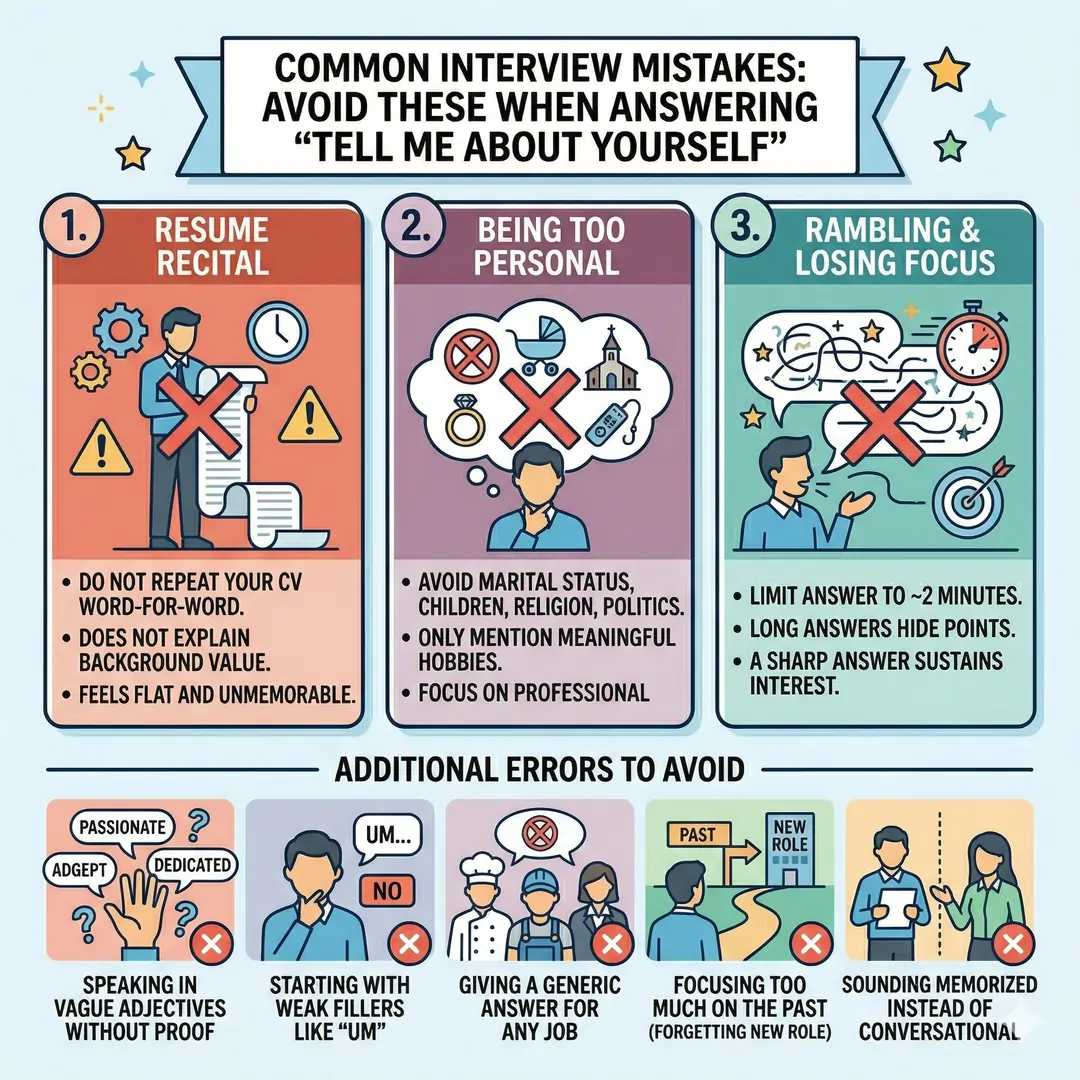
A third mistake is rambling. The University of Alabama recommends answers of no longer than two minutes, and the University of Arizona says to time your response because even experienced professionals can keep talking too long. A long answer can hide your best points. A sharp answer keeps the interviewer interested.
Other mistakes to avoid
- Speaking only in vague adjectives like hardworking, passionate, or dedicated without proof.
- Starting with weak fillers like “Um” or “Well, I am just…” when you could begin with a confident professional summary.
- Giving a generic answer that could fit any job.
- Focusing too much on the past and forgetting why the role itself matters now.
- Sounding memorized instead of conversational.
Table 4: Weak answer versus strong answer
| Weak answer | Why is it weak | Strong answer | Why is it better |
|---|---|---|---|
| “I am a hard worker and a quick learner. I like working with people.” | Too vague, no proof, no job connection | “I currently work in customer service, where I handle high-volume inquiries and solve issues quickly. I am now looking for a role where I can use that communication experience in a more client-facing position.” | Specific, relevant, and tied to the role. |
| “I studied a lot of subjects in college and did many things.” | Too broad and unmemorable | “I studied business, led group projects, and completed an internship in digital marketing, which helped me build teamwork and analysis skills.” | Focused and easy to follow. |
| “I am looking for any job where I can grow.” | Generic and not tailored | “I am interested in this role because it fits my background in operations and my goal to grow into process improvement work.” | Shows motivation and alignment. |
How to sound natural while speaking
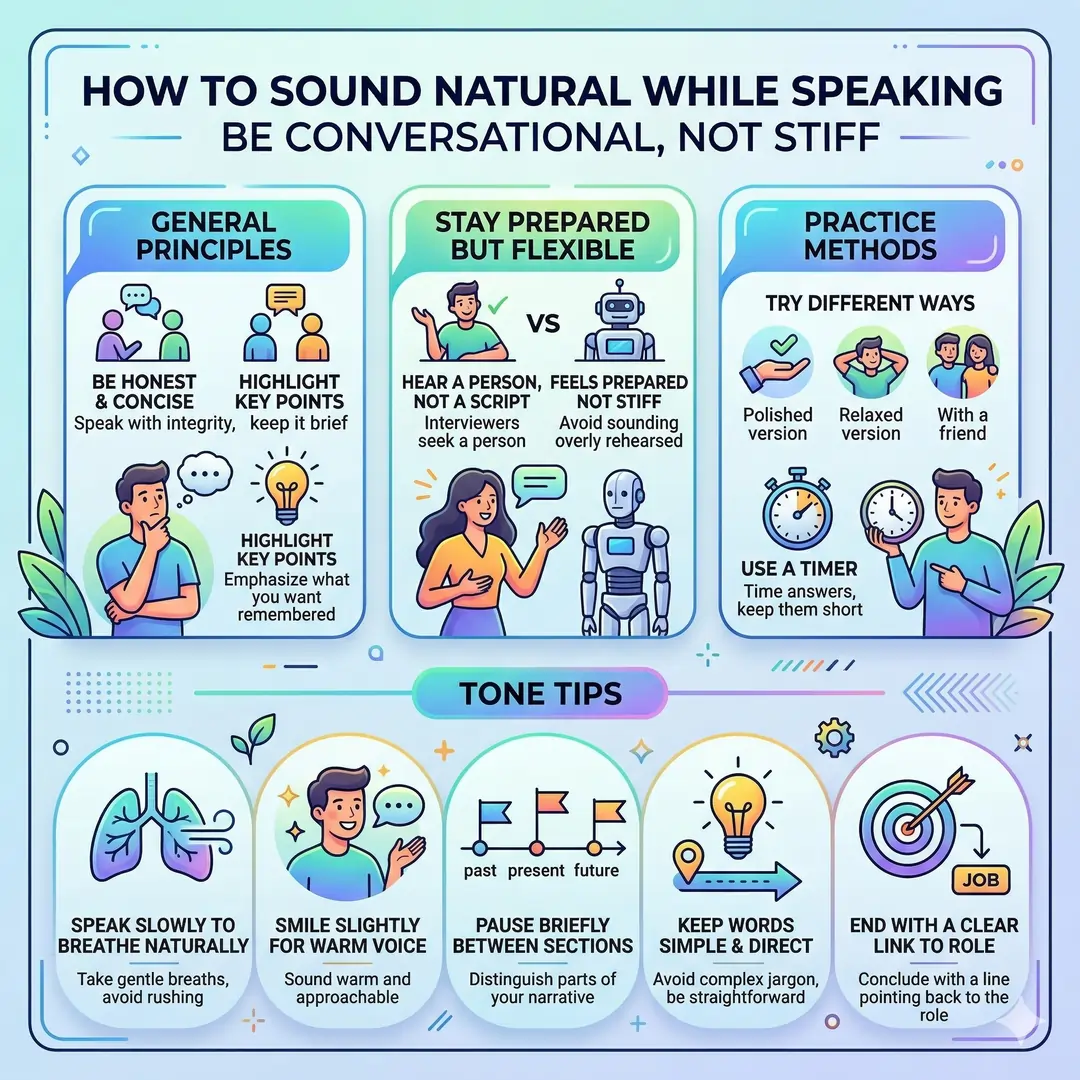
A natural answer sounds like a conversation, not a speech. The University of Alabama recommends being honest and concise, while Harvard Career Services points out that you should highlight the points you want remembered. That means your answer should feel prepared, but not stiff. The interviewer should hear a person, not a script.
A useful trick is to practice the same idea in different ways. Say your answer out loud once in a polished version, once in a relaxed version, and once with a friend. That helps you stay flexible during the actual interview. Arizona recommends practicing with a timer, and that is especially useful because most good answers stay inside a short time window.
Tone tips
- Speak slowly enough to breathe naturally.
- Smile slightly so your voice sounds warm.
- Pause briefly between the present, past, and future sections.
- Keep your words simple and direct.
- End with a line that clearly points back to the role.
A practical formula you can copy
Here is a simple template you can adapt for almost any interview:
Present: “I am currently…”
Past: “Before that, I worked on…”
Proof: “One result I am proud of is…”
Future: “Now I am looking for…”
This structure works because it gives the interviewer a clean story with just enough detail. It also follows the advice repeated across career resources, which is to keep the answer professional, relevant, concise, and focused on how your background connects to the job.
More sample mini-answers for inspiration
For a sales role
“I have spent the last few years working in sales and client communication. I enjoy understanding customer needs, building trust, and closing the gap between problems and solutions. I am now looking for a role where I can keep improving my performance and work with a team that values long-term relationships.”
For a teacher or trainer
“I work in education and enjoy helping people learn clearly and encouragingly. Over time, I have developed strong planning, communication, and classroom management skills. I am looking for a role where I can continue supporting learners and contribute to a positive learning environment.”
For an operations role
“My background is in operations and coordination, so I am very comfortable with planning, details, and making sure work moves smoothly. I have handled scheduling, reporting, and process support in my current role. I am now looking for an opportunity where I can bring that structure and reliability to a larger team.”
For an entry-level candidate
“I am early in my career, but I have built a solid foundation through my studies, projects, and internships. I have learned how to work in teams, manage deadlines, and communicate clearly. I am excited to start in a role where I can contribute, keep learning, and build long-term skills.”
These examples are intentionally simple. That is the point. Interview answers work best when they are clear, relevant, and easy to remember. Career guidance from universities repeatedly emphasizes the value of short, structured, example-backed responses rather than overexplained stories.
Table 5: Quick checklist before your interview
| Checklist item | Ask yourself |
|---|---|
| Relevance | Does every line connect to the job I am applying for? |
| Structure | Does my answer move from present to past to future? |
| Length | Can I say it in about two minutes or less? |
| Proof | Have I included at least one example or result? |
| Tone | Does it sound natural, calm, and conversational? |
| Focus | Did I avoid unnecessary personal details and resume repetition? |
Final tips for a stronger first impression
Use your answer to show three things clearly. First, show that you understand your own background. Second, show that you can connect that background to the role. Third, show that you are someone the interviewer would be comfortable speaking with again. Those three things matter a great deal because this opening question is not only about information. It is about trust, clarity, and communication.
The best answers are not dramatic. They are simply well chosen. They sound like a person who knows their story, respects the interviewer’s time, and understands what the role requires. That is why a good “Tell me about yourself” answer can quietly become one of the strongest parts of your interview.
Conclusion
A strong “Tell me about yourself” answer is built on a simple idea. Keep it professional, keep it relevant, keep it brief, and connect your story to the role. The most reliable advice from reputable career resources is to use a present-past-future structure, stay close to two minutes, avoid repeating your resume, and support your strengths with real examples and measurable results. If you do that, your answer will sound confident, natural, and memorable.
Article References And Sources
- Harvard Business Review
How to Respond to “So, Tell Me About Yourself” in a Job Interview
https://hbr.org/2019/08/how-to-respond-to-so-tell-me-about-yourself-in-a-job-interview - University of Pennsylvania Career Services
So Tell Me About Yourself
https://careerservices.upenn.edu/blog/2020/02/19/so-tell-me-about-yourself/ - Princeton University Career Development
Decoding Interview Questions
https://careerdevelopment.princeton.edu/interview-guide/decoding-interview-questions - ECPI University Career Services
How to Answer “Tell Me About Yourself” in an Interview (Plus Examples)
https://careerservices.ecpi.edu/blog/2024/07/15/how-to-answer-tell-me-about-yourself-in-an-interview-plus-examples/ - Indeed Career Guide (India)
Interview Question: “Tell Me About Yourself” (With Answers)
https://in.indeed.com/career-advice/interviewing/interview-question-tell-me-about-yourself - University of Alabama Career Center
Interview Questions and Tips
https://career.sa.ua.edu/develop/interview-skills/interview-questions/ - University of Arizona Eller College of Management
9 Essential Things to Include in Your “Tell Me About Yourself” Interview Answer
https://eller.arizona.edu/news/9-essential-things-include-your-tell-me-about-yourself-interview-answer - University of Connecticut Center for Career Development
Types of Interview Questions
https://career.uconn.edu/types-of-questions/ - Harvard Faculty of Arts & Sciences Career Services
How to Answer “Tell Me About Yourself” in an Interview (Plus Examples)
https://careerservices.fas.harvard.edu/blog/2024/04/09/how-to-answer-tell-me-about-yourself-in-an-interview-plus-examples/
Also, Read these Articles in Detail
- Top Interview Questions and Answers Guide
- Interview Questions and Answers for Freshers and Experienced Candidates
- Common Interview Questions and Best Answers for Job Seekers
Frequently Asked Questions
FAQ 1: What is the best way to answer “Tell me about yourself” in an interview?
The best way to answer “Tell me about yourself” is to give a clear, focused summary of your professional background, your key strengths, and why you are a good fit for the role. A strong answer should not sound like your full life story. Instead, it should feel like a short professional introduction that helps the interviewer understand who you are and what value you bring.
A simple and effective method is the present-past-future structure. Start with your current role or current situation, then move into your relevant background, and finish by explaining what you are looking for next. This approach keeps your answer organized, natural, and easy to follow. It also helps you stay relevant to the job rather than drifting into unrelated details.
You can make your answer stronger by including one or two specific examples, achievements, or skills. For example, if you improved a process, managed a team, or completed an internship, mention that briefly. The goal is to sound confident, clear, and connected to the role you are applying for.
FAQ 2: How long should my answer to “Tell me about yourself” be?
Your answer should usually be around one to two minutes long. That is long enough to give a meaningful introduction, but short enough to keep the interviewer interested. If you talk for too long, your answer may feel unfocused. If you answer too briefly, it may seem like you are unprepared or unsure.
A good way to control the length is to practice your answer out loud. Time yourself and make sure you can say it smoothly without rushing. The best answers feel complete, but they do not include every detail from your resume. You only need the most important points that help explain your background and your fit for the job.
Think of it like a professional summary, not a speech. When your answer is concise and well-structured, it creates a much stronger first impression. It shows that you respect the interviewer’s time and know how to communicate clearly.
FAQ 3: Should I include personal details in my interview answer?
You can include a little personality in your answer, but it is usually best to keep the focus on your professional background. A small mention of hobbies, volunteering, or interests can help you sound more human, but the main part of your answer should stay centered on work, education, skills, and career goals.
It is better to avoid deeply personal details unless they clearly support the conversation. For example, you do not need to talk about family life, religion, or other private matters. Those details do not usually help the interviewer understand your job readiness. A professional answer should feel warm and natural, but still relevant to the role.
A useful rule is this. If the detail helps explain your skills, values, or career direction, it may be worth including. If it does not add value to the interview, leave it out. This keeps your answer clean, respectful, and professional.
FAQ 4: What is the present-past-future formula, and why does it work?
The present-past-future formula is a simple answer structure that helps you build a strong response to “Tell me about yourself.” You begin with your current role or situation, move to the background that brought you here, and end with the direction you want to go next. This makes your answer easy for the interviewer to follow.
For example, you might start by saying what you do now, then explain the experience or skills you built before that, and finally talk about why this opportunity interests you. This structure works because it tells a mini story about your career. It gives the interviewer context instead of just a list of facts.
Another reason this formula works so well is that it keeps your answer focused.
Many people struggle with this question because they try to say too much at once. The present-past-future method helps you organize your thoughts and speak with more confidence. It also gives your answer a natural flow, which makes you sound polished and prepared.
FAQ 5: How do I answer this question if I am a fresher or recent graduate?
If you are a fresher or recent graduate, your answer should focus on your education, projects, internships, skills, and career interests. You may not have years of work experience yet, but you still have useful strengths to share. The key is to show that you are prepared, eager to learn, and serious about the role.
You can begin by mentioning your degree or field of study, then talk about the practical experience you gained through internships, group projects, volunteer work, or academic activities. If you led a project, solved a problem, or built a useful skill during college, include that in your answer. This helps the interviewer see that you already have a foundation to build on.
Finish by explaining what kind of role you are looking for and why it matches your goals. A strong fresher answer sounds positive and forward-looking. It should show that you are not just looking for any job, but for a role where you can grow and contribute meaningfully.
FAQ 6: How should experienced professionals answer “Tell me about yourself”?
Experienced professionals should focus on their current role, their most relevant achievements, and the type of impact they have made in their career. The answer should show progression. In other words, it should explain what you do now, what you have done in the past, and why this new role is the right next step.
Instead of listing every job you have ever had, choose the most important experiences that connect to the position. For example, if you are applying for a leadership role, talk about managing people, improving performance, or handling responsibilities. If the role is technical, emphasize your tools, systems, or problem-solving experience.
A strong, experienced professional answer also includes some proof. Numbers, results, and measurable improvements make your answer more believable. For example, you might mention that you improved response time, increased efficiency, or trained new team members. That kind of detail helps the interviewer quickly understand your value.
FAQ 7: What mistakes should I avoid when answering this interview question?
One major mistake is giving a full resume recap. The interviewer already has your resume, so repeating every job or responsibility is not helpful. Your answer should add context, not duplicate the document in spoken form. It should help the interviewer understand the story behind your experience.
Another mistake is being too vague. Words like hardworking, passionate, or team player are nice, but they are not enough on their own. You need to support those qualities with short examples or achievements. Otherwise, the answer may sound generic and forgettable.
You should also avoid rambling, talking too long, or including personal details that do not matter to the role. A strong answer is focused and controlled. It should feel confident, professional, and easy to listen to. If you can stay organized and relevant, you will already be ahead of many candidates.
FAQ 8: How can I make my answer sound natural and not memorized?
To sound natural, do not try to recite your answer word for word like a script. Instead, learn the main points you want to say and practice them conversationally. This gives you structure without making your speech sound stiff. The interviewer should feel like they are talking to a real person, not listening to a prepared speech.
One helpful method is to practice with different versions of the same answer. Say it once in a polished way, once in a relaxed way, and once while imagining a real interview setting. That makes it easier to stay flexible. If you forget a phrase during the interview, you can continue confidently because you know the overall message.
It also helps to pause naturally between ideas. A small pause after your current role, your background, or your future goal makes the answer easier to follow. Natural speech is not perfect speech. It is clear, calm, and honest. That is what creates a strong impression.
FAQ 9: Can I use the same answer for every job interview?
You can use a basic version of the same answer, but it should always be tailored to the specific job. A general framework may stay the same, but the details should change based on the company, role, and industry. This matters because every interviewer wants to know why you are a good fit for their particular position.
For example, if you are applying for a marketing role, you should highlight communication, campaign support, and creative thinking. If you are applying for an operations role, you should focus on planning, coordination, and process improvement. The better your answer matches the job description, the more relevant and convincing it will sound.
A reusable structure is helpful, but a copied answer is not enough. Spend a few minutes before each interview reviewing the role and adjusting your story. This small effort can make your answer feel more authentic and stronger.
FAQ 10: What makes a strong “Tell me about yourself” answer stand out?
A strong answer stands out because it is clear, relevant, confident, and easy to remember. It does not try to impress with big words or unnecessary details. Instead, it gives the interviewer a clean and thoughtful picture of who you are professionally and what you can bring to the company.
The best answers usually include a few important ingredients. They show your current situation, highlight relevant experience, mention a meaningful achievement, and explain why the role is a good fit for your next step. When these parts come together well, your answer feels complete and purposeful.
Most importantly, a strong answer sounds human. It feels like a real person speaking with clarity and intention, not a rehearsed robot. That combination of professionalism and natural language is what makes the response memorable and effective.
