Job interviews can feel exciting, stressful, and unpredictable all at once. For many job seekers, the biggest challenge is not the interview room itself, but the fear of not knowing what to say. The good news is that most interviews follow a familiar pattern. Employers usually ask a mix of introductory questions, behavioral questions, situational questions, and role-specific questions to understand your experience, confidence, communication style, and problem-solving skills.
This article is designed to help you prepare clearly and practically. You will find common interview questions, best answer examples, helpful tables, simple bullet points, and professional advice you can use for many different jobs. The language is kept simple and natural, so it is easy to understand, but the content is still deep enough to help you prepare seriously for your next interview.
Table of Contents
Why Interview Preparation Matters
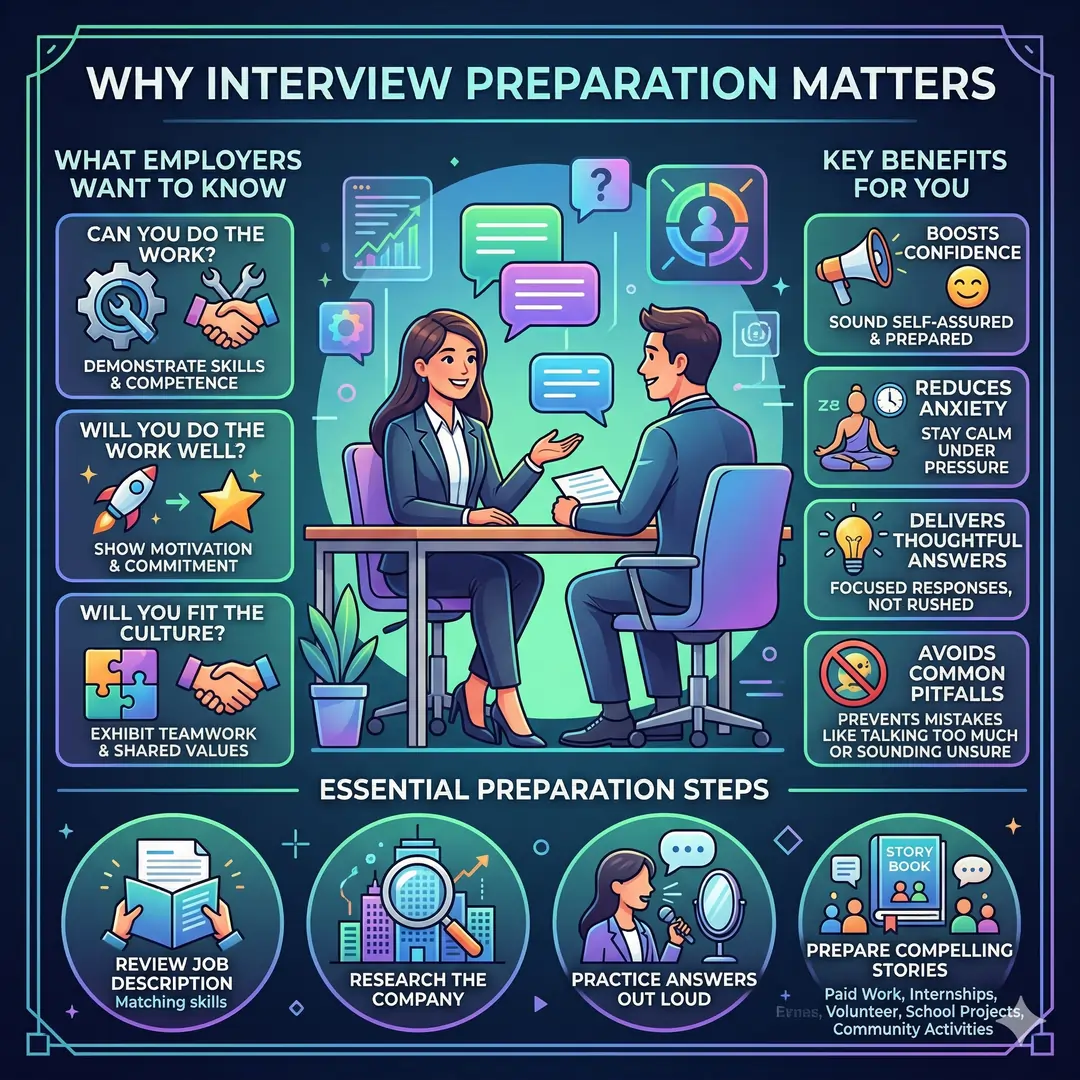
A strong interview is not about memorizing perfect lines. It is about showing that you can do the job, work well with others, and communicate with confidence. Employers often want to know three main things: Can you do the work? Will you do the work well? And will you fit the team and company culture? That is why preparation matters so much.
A well-prepared candidate usually sounds more confident, stays calmer under pressure, and gives answers that feel thoughtful rather than rushed. Preparation also helps you avoid common mistakes such as talking too much, sounding unsure, or giving answers that do not connect to the role.
Before your interview, it is smart to review the job description, research the company, practice your answers out loud, and prepare a few stories from your experience. These stories can come from paid work, internships, freelance work, volunteer work, school projects, or community activities.
What Employers Really Want to Hear
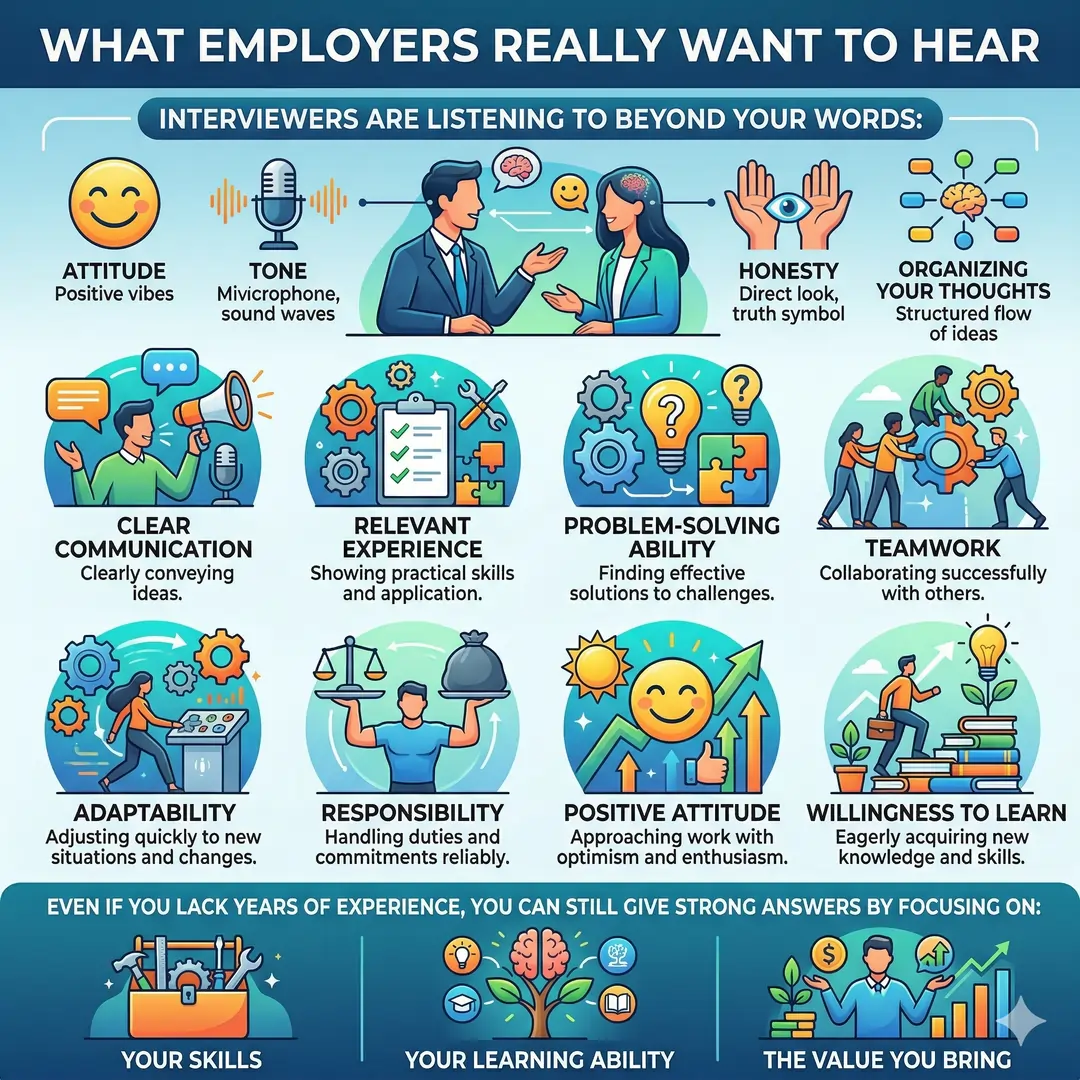
Interviewers are not only listening to your words. They are also paying attention to your attitude, your tone, your honesty, and the way you organize your thoughts. Strong candidates usually show the following qualities:
- Clear communication
- Relevant experience
- Problem-solving ability
- Teamwork
- Adaptability
- Responsibility
- Positive attitude
- Willingness to learn
Even if you do not have years of experience, you can still give strong answers by focusing on your skills, your learning ability, and the value you bring.
How to Structure a Strong Interview Answer
One of the best ways to answer behavioral interview questions is to use the STAR method. This method helps you stay organized and avoid vague answers.
STAR stands for:
- Situation – What was happening?
- Task – What was your responsibility?
- Action – What did you do?
- Result – What happened because of your actions?
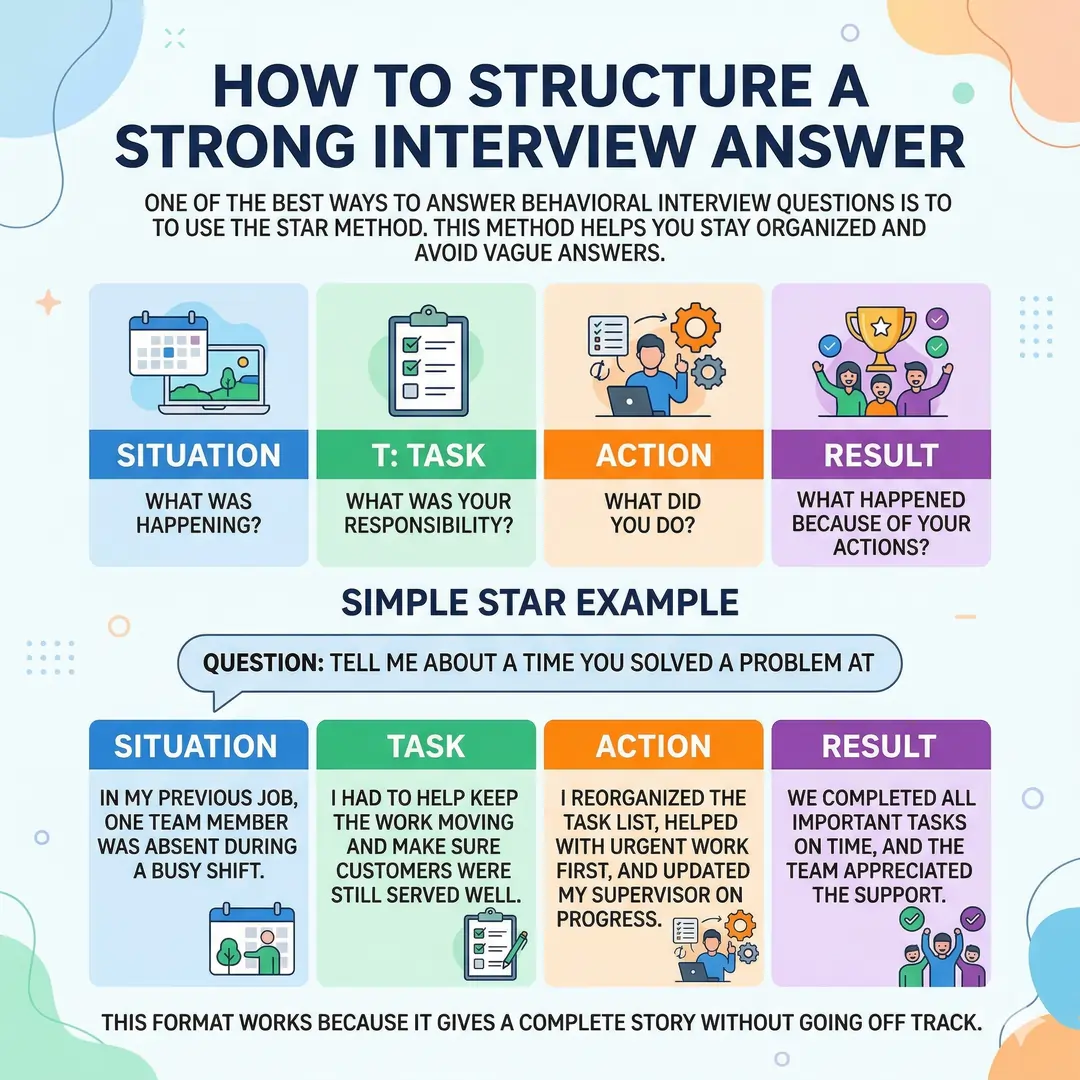
Simple STAR Example
Question: Tell me about a time you solved a problem at work.
Answer:
- Situation: In my previous job, one team member was absent during a busy shift.
- Task: I had to help keep the work moving and make sure customers were still served well.
- Action: I reorganized the task list, helped with urgent work first, and updated my supervisor on progress.
- Result: We completed all important tasks on time, and the team appreciated the support.
This format works because it gives a complete story without going off track.
Common Interview Questions and Best Answers
Below are some of the most frequently asked interview questions, along with simple guidance on how to answer them well.
1. Tell Me About Yourself
This is often the first question in an interview. It is your chance to give a short and professional introduction. Do not tell your life story. Focus on your background, your experience, and why you are interested in the role.
Good answer structure
- Start with your current role or background
- Mention 2 or 3 relevant strengths
- Briefly explain your career interest
- Connect your background to the position
Sample answer
“I am a detail-oriented professional with experience in customer support and office coordination. In my last role, I handled customer communication, managed records, and supported daily operations. I have always enjoyed work that requires organization and problem-solving. I am now looking for a role where I can use my communication skills and continue growing in a professional environment.”
What to avoid
- Talking too long
- Sharing personal details that are not relevant
- Repeating your resume word-for-word
2. Why Do You Want to Work Here?
Employers ask this to see whether you researched the company and whether your goals match the role.
A strong answer should include
- Something specific about the company
- Something specific about the role
- A connection between their needs and your skills
Sample answer
“I want to work here because your company has a strong reputation for quality and customer service. I also like that this role combines communication, problem-solving, and teamwork, which are areas where I have experience. I believe I could contribute positively while also learning from a well-organized team.”
Tip
Avoid saying only that you need a job or that the office is close to your home. Those reasons may be true, but they do not show genuine interest.
3. What Are Your Strengths?
Choose strengths that are useful for the job. Do not list too many. Pick the ones that best match the role.
Examples of useful strengths
- Communication
- Leadership
- Attention to detail
- Time management
- Adaptability
- Customer service
- Problem-solving
Sample answer
“One of my biggest strengths is attention to detail. In my previous role, I was responsible for checking reports, updating records, and making sure information was accurate before it was shared. I also work well under pressure, especially when tasks need to be completed quickly without losing quality.”
Tip
Always support your strength with a real example.
4. What Is Your Greatest Weakness?
This question is tricky, but it is not meant to trap you. Interviewers want to know if you are self-aware and willing to improve.
How to answer well
- Choose a real but manageable weakness
- Show that you are working on it
- End with progress
Sample answer
“Earlier in my career, I sometimes spent too much time perfecting small details. Over time, I learned to balance quality with efficiency by setting time limits for each task and focusing first on the most important priorities. That has helped me become more productive.”
Avoid
- Saying you have no weakness
- Choosing a weakness that is essential for the job
- Giving a fake weakness like “I work too hard.”
5. Why Should We Hire You?
This is your chance to confidently explain your value.
Sample answer
“You should hire me because I bring a strong mix of reliability, communication, and a willingness to learn. I have experience handling similar tasks, and I understand the importance of being organized, professional, and responsive. I would bring a positive attitude and a strong work ethic to the team.”
Tip
Focus on what makes you useful to the employer, not just what you want from the job.
6. Tell Me About a Challenge You Faced and How You Handled It
This is a behavioral question. The interviewer wants to see your problem-solving ability and your mindset under pressure.
Sample answer
“In one role, our team had a sudden increase in customer requests during a busy season. I noticed that the usual workflow was slowing down response times. I suggested a simple task-priority system, helped divide the work more clearly, and kept communication open with the team. As a result, we responded faster and reduced confusion during the busiest hours.”
Tip
Do not focus only on the problem. Focus on your action and the result.
7. Tell Me About a Time You Worked on a Team
Employers value teamwork because most jobs require some level of cooperation.
Sample answer
“I worked on a team project where each person had different responsibilities and deadlines. I stayed in communication with my teammates, shared updates regularly, and helped others when they were falling behind. The project was completed on time, and I learned how important clear communication is for teamwork.”
Strong teamwork traits
- Cooperation
- Respect
- Communication
- Flexibility
- Supportiveness
8. How Do You Handle Stress or Pressure?
Most jobs involve deadlines, busy days, and unexpected changes. This question checks how you react when things get difficult.
Sample answer
“I handle stress by staying organized and focusing on one task at a time. When pressure increases, I make a quick priority list, communicate early if something needs attention, and avoid panic. I have found that staying calm helps me make better decisions and keep quality high.”
Tip
Do not say you never feel stress. That does not sound believable. Instead, explain how you manage it.
9. Where Do You See Yourself in Five Years?
The employer wants to know if you are serious about growth and whether the job fits your long-term goals.
Sample answer
“In five years, I hope to have built strong experience in this field and taken on more responsibility. I want to continue learning, improve my skills, and become someone the team can rely on for consistent quality and good judgment.”
Tip
Keep your answer realistic and connected to the role.
10. Why Did You Leave Your Last Job?
This question should be answered honestly and professionally. Never speak badly about former employers.
Sample answer
“I learned a lot in my last position, but I felt ready for a role with more growth and responsibility. I am looking for a position where I can contribute more actively and continue building my career.”
What to avoid
- Complaining about your previous manager
- Sharing conflict in a negative way
- Sounding bitter or defensive
11. What Is Your Salary Expectation?
This question can feel uncomfortable, but it is common. Research the usual pay range for the role before the interview.
Sample answer
“Based on my research and the responsibilities of this role, I would expect a salary in the range of X to Y. That said, I am open to discussing the full compensation package and the overall fit of the opportunity.”
Tip
Be flexible, but do not undersell yourself.
12. Do You Have Any Questions for Us?
The answer should almost always be yes. Asking thoughtful questions shows interest and professionalism.
Good questions to ask
- What does success look like in this role?
- What are the biggest priorities for this team right now?
- How would you describe the company culture?
- What are the next steps in the hiring process?
- What tools or systems does the team use most often?
Questions to avoid
- How soon can I take time off?
- What exactly do you do here?
- How quickly can I get promoted?
Table: Common Interview Questions, What Employers Want, and How to Answer
| Interview Question | What the Employer Wants to Know | Best Way to Answer | Example Approach |
|---|---|---|---|
| Tell me about yourself | Your background and communication style | Give a short professional summary | Current role, key strengths, and career interests |
| Why do you want this job? | Your interest and motivation | Mention the company and role specifically | Explain why the work matches your skills |
| What are your strengths? | Whether you can add value | Choose strengths that fit the job | Support with one real example |
| What is your weakness? | Self-awareness and growth mindset | Be honest and show improvement | Share a weakness you are actively improving |
| Why should we hire you? | Why you are the right fit | Connect your skills to the employer’s needs | Highlight reliability, skills, and attitude |
| Tell me about a challenge you handled | Problem-solving and resilience | Use the STAR method | Explain the situation, action, and result |
| How do you handle stress? | Emotional control and work habits | Show practical coping strategies | Prioritize, organize, communicate early |
| Tell me about teamwork | Collaboration and communication | Use a work example | Show how you helped the group succeed |
| Where do you see yourself in five years? | Career goals and loyalty | Keep it realistic and professional | Show a desire to grow in the field |
| Do you have questions for us? | Interest and preparation | Ask thoughtful role-based questions | Ask about success, culture, and next steps |
Table: Best Answer Styles for Different Question Types
| Question Type | What It Looks Like | How to Answer | Best Example Format |
|---|---|---|---|
| Introductory | Tell me about yourself | Brief professional summary | Past experience, current goals |
| Motivational | Why do you want this job? | Show company knowledge | Company + role + your fit |
| Behavioral | Tell me about a time you failed | Use STAR | Situation, task, action, result |
| Situational | What would you do if… | Explain your thought process | Step-by-step decision making |
| Strength-based | What are your strengths? | Pick job-related strengths | Strength + example |
| Weakness-based | What is your weakness? | Show improvement | Weakness + progress |
| Closing | Do you have questions? | Ask smart questions | Role, team, growth, next steps |
More Common Interview Questions with Sample Guidance
Here are more questions you may hear in interviews, especially for office jobs, customer-facing roles, administrative positions, and entry-level roles.
Common Questions
- What do you know about our company?
- How do you handle conflict?
- What motivates you?
- How do you stay organized?
- Tell me about a time you made a mistake.
- How do you manage deadlines?
- How do you deal with a difficult customer or coworker?
- What makes you a good fit for this position?
- How do you handle change?
- What kind of work environment helps you do your best work?
Simple answer tips
- Keep your answers focused
- Speak clearly and calmly
- Use real examples whenever possible
- Avoid negative comments about past jobs
- Show that you can learn and adapt
How to Prepare Before the Interview
Preparation can make a huge difference. A candidate who prepares well usually feels less nervous and speaks more naturally.
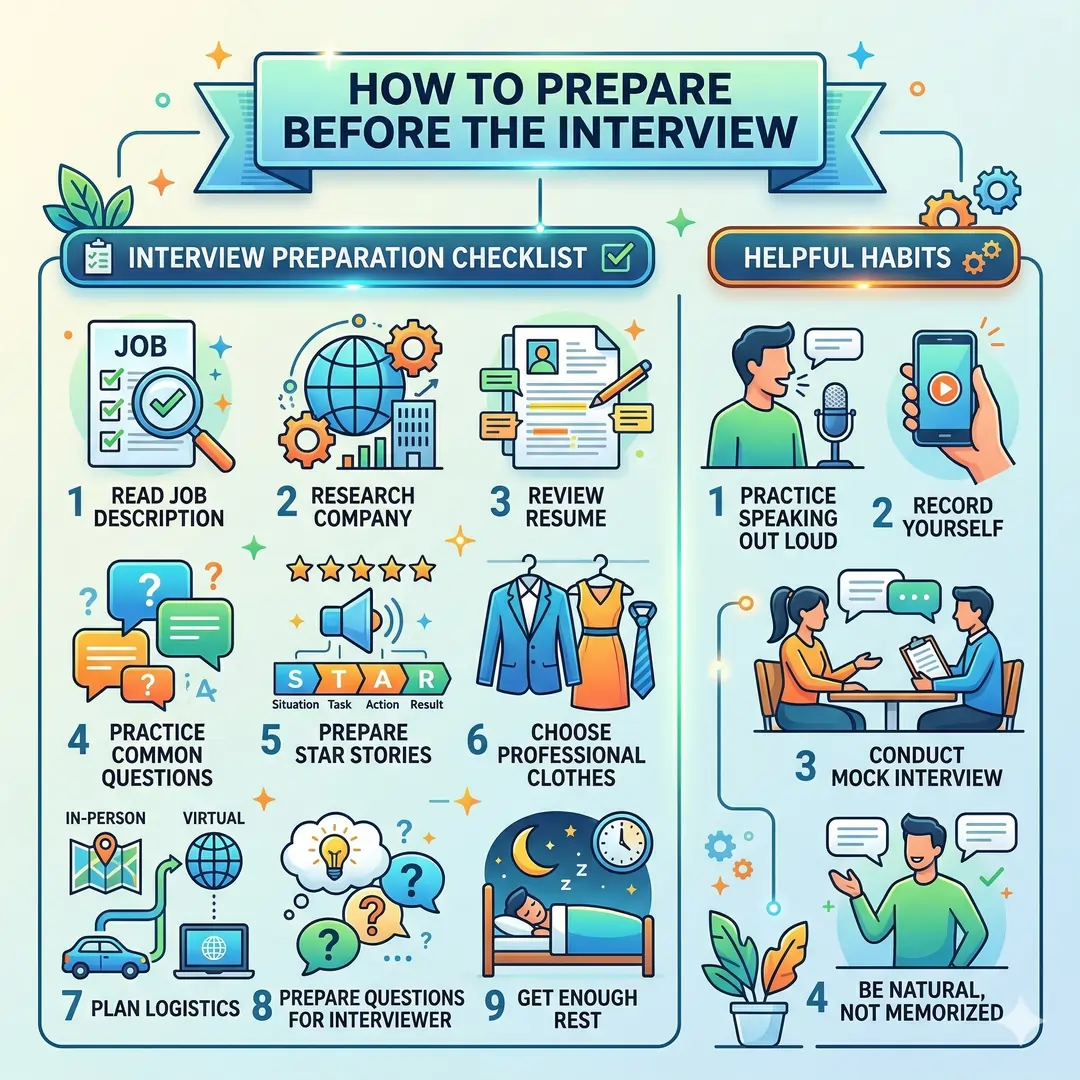
Interview preparation checklist
- Read the job description carefully
- Research the company, its mission, and its services
- Review your resume and be ready to explain it
- Practice answers to the most common questions
- Prepare 3 to 5 work stories using the STAR method
- Choose professional clothes in advance
- Plan your route or check your internet connection for virtual interviews
- Prepare questions to ask the interviewer
- Get enough rest the night before
Helpful habits
- Practice speaking out loud
- Record yourself if possible
- Ask a friend to do a mock interview with you
- Keep your answers natural, not memorized
Table: Interview Preparation Checklist
| Task | Why It Matters | Status |
|---|---|---|
| Review the job description | Helps you match your answers to the role | Done / Not done |
| Research the company | Shows real interest | Done / Not done |
| Practice common questions | Improves confidence | Done / Not done |
| Prepare STAR examples | Helps with behavioral questions | Done / Not done |
| Plan your outfit | Creates a polished first impression | Done / Not done |
| Prepare questions to ask | Shows curiosity and professionalism | Done / Not done |
| Check travel or internet details | Prevents last-minute stress | Done / Not done |
| Sleep well before the interview | Improves focus and energy | Done / Not done |
How to Answer Without Sounding Robotic
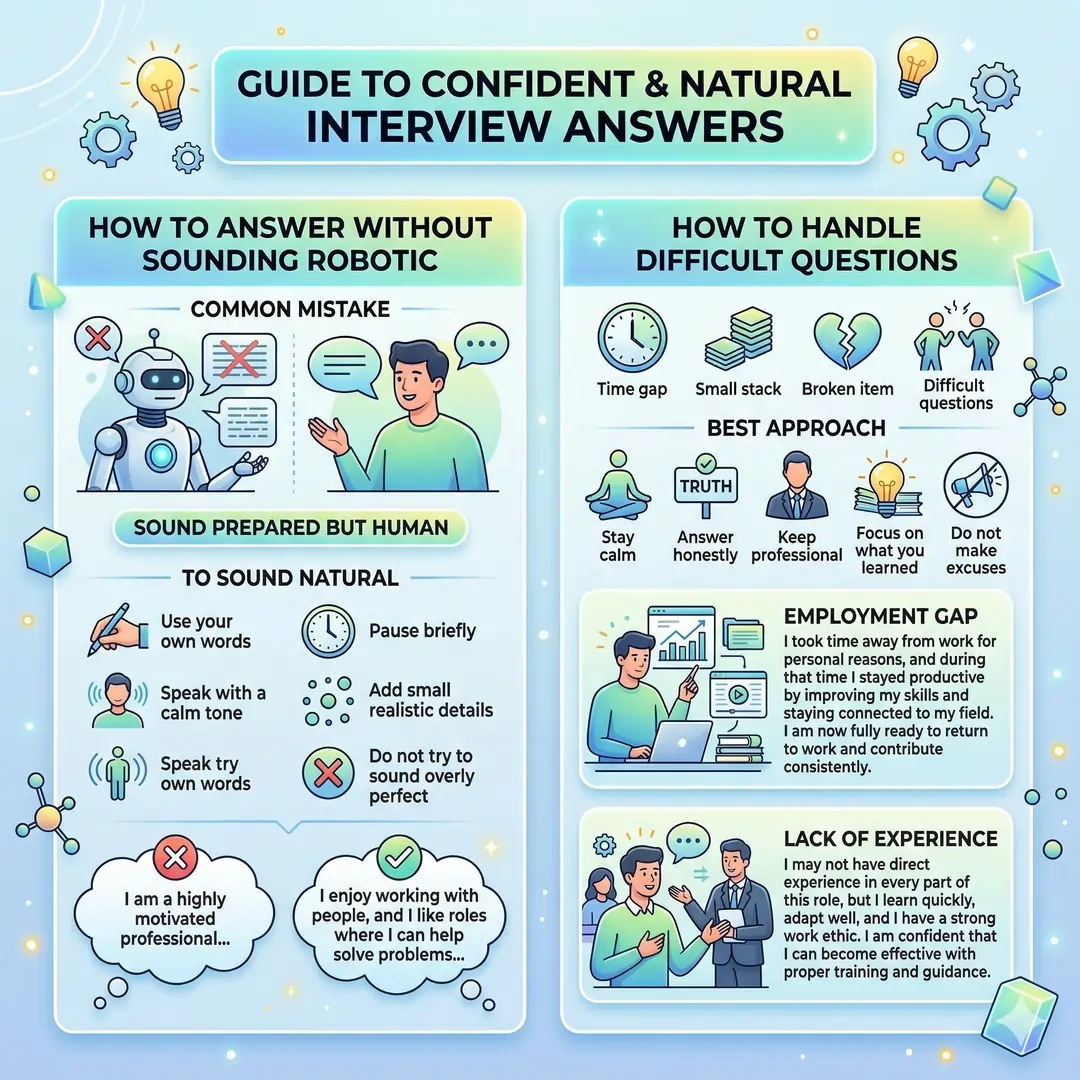
A common mistake is sounding like you memorized a script. The best answers sound prepared but still human.
To sound natural
- Use your own words
- Pause briefly before answering
- Speak with a calm tone
- Add small, realistic details
- Do not try to sound overly perfect
Example of a natural answer
Instead of saying, “I am a highly motivated professional with excellent interpersonal skills,” you could say, “I enjoy working with people, and I like roles where I can help solve problems and keep things organized.”
That sounds more human and believable.
How to Handle Difficult Questions
Some questions are harder than others. These may include questions about gaps in employment, lack of experience, failure, or conflict.
Best approach
- Stay calm
- Answer honestly
- Keep your response professional
- Focus on what you learned
- Do not make excuses
Example: employment gap
“I took time away from work for personal reasons, and during that time, I stayed productive by improving my skills and staying connected to my field. I am now fully ready to return to work and contribute consistently.”
Example: lack of experience
“I may not have direct experience in every part of this role, but I learn quickly, adapt well, and I have a strong work ethic. I am confident that I can become effective with proper training and guidance.”
What to Do During the Interview
Your answers matter, but your behavior matters too.
Good interview habits
- Arrive early
- Greet everyone politely
- Maintain good posture
- Make eye contact
- Listen carefully before answering
- Do not interrupt
- Stay positive
- Thank the interviewer at the end
Body language that helps
- A calm smile
- Firm but polite handshake where appropriate
- Open posture
- Confident voice
- Steady eye contact
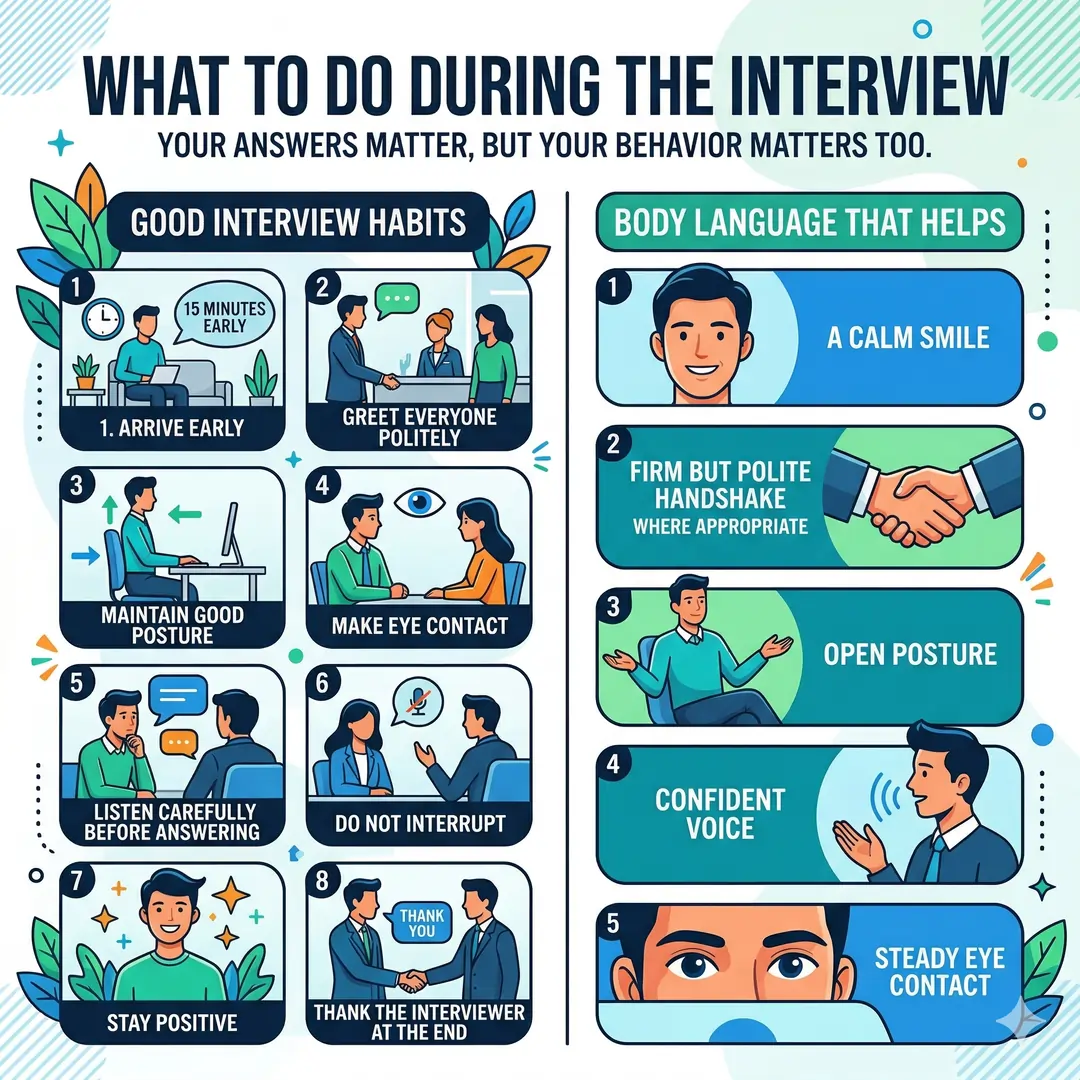
Table: Good Interview Behavior vs Poor Interview Behavior
| Good Interview Behavior | Poor Interview Behavior |
|---|---|
| Arriving early | Arriving late |
| Speaking clearly | Mumbling or rushing |
| Listening carefully | Interrupting the interviewer |
| Giving specific examples | Giving vague answers |
| Staying positive | Complaining about past jobs |
| Asking thoughtful questions | Saying you have no questions |
| Thanking the interviewer | Ending abruptly |
Virtual Interview Tips
Online interviews are now very common. The same rules of preparation still apply, but technology also becomes important.
Before the virtual interview
- Test your camera and microphone
- Check your internet connection
- Use a quiet space
- Keep your background neat
- Charge your device fully
- Keep notes nearby, but do not read from them word for word
During the virtual interview
- Look at the camera when speaking
- Sit upright
- Speak clearly
- Keep distractions away
- Stay focused even if the format feels less personal
Table: Best Questions to Ask the Interviewer
| Question | Why It Works |
|---|---|
| What does a successful employee in this role look like? | Shows ambition and interest in performance |
| What are the top priorities for this team right now? | Shows strategic thinking |
| How is success measured in this position? | Shows that you care about results |
| What training is available for new hires? | Shows a growth mindset |
| What do you enjoy most about working here? | Builds connection and insight |
| What are the next steps in the hiring process? | Shows professionalism and readiness |
Sample Answer Bank for Job Seekers
Below are short answer models you can customize for your own experience.
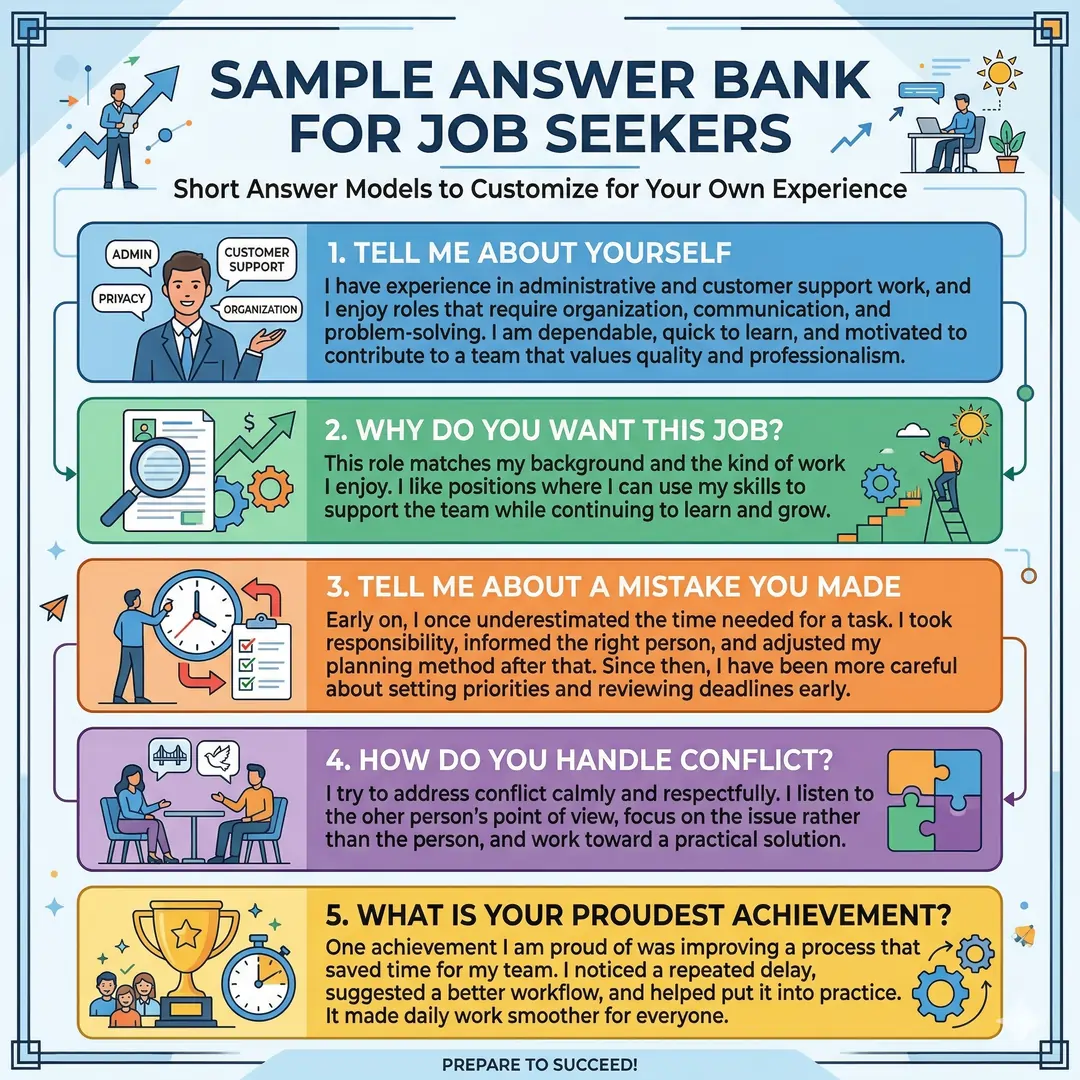
Tell me about yourself
“I have experience in administrative and customer support work, and I enjoy roles that require organization, communication, and problem-solving. I am dependable, quick to learn, and motivated to contribute to a team that values quality and professionalism.”
Why do you want this job?
“This role matches my background and the kind of work I enjoy. I like positions where I can use my skills to support the team while continuing to learn and grow.”
Tell me about a mistake you made
“Early on, I once underestimated the time needed for a task. I took responsibility, informed the right person, and adjusted my planning method after that. Since then, I have been more careful about setting priorities and reviewing deadlines early.”
How do you handle conflict?
“I try to address conflict calmly and respectfully. I listen to the other person’s point of view, focus on the issue rather than the person, and work toward a practical solution.”
What is your proudest achievement?
“One achievement I am proud of was improving a process that saved time for my team. I noticed a repeated delay, suggested a better workflow, and helped put it into practice. It made daily work smoother for everyone.”
Final Interview Tips That Make a Real Difference
Sometimes the smallest details create the strongest impression. Here are a few final tips that can help you stand out.
- Be honest, but always stay professional
- Keep your answers clear and relevant
- Show excitement about the opportunity
- Use examples that prove your skills
- Speak with confidence, not arrogance
- Treat every person you meet with respect
- Follow up after the interview with a thank-you message
A good interview is not about being perfect. It is about showing that you are thoughtful, prepared, reliable, and ready to contribute. Employers often remember candidates who communicate clearly, stay calm, and show genuine interest in the role.
Table: Final Interview Success Formula
| Step | What to Do | Why It Helps |
|---|---|---|
| Prepare | Research the role and the company | Builds confidence |
| Practice | Rehearse common questions | Improves fluency |
| Personalize | Use your own examples | Makes answers believable |
| Stay calm | Pause before answering | Helps you think clearly |
| Ask questions | Show curiosity | Leaves a strong impression |
| Follow up | Send a thank-you note | Shows professionalism |
Conclusion
Interview success comes from preparation, self-awareness, and clear communication. When you understand the most common interview questions and know how to answer them well, you walk into the conversation with much more confidence. You also give the employer a better picture of who you are, what you can do, and how you may fit into the team.
Use the ideas in this article to build your own answers, not to memorize someone else’s voice. The strongest interview answers sound natural, honest, and relevant. With practice, you can turn even difficult questions into opportunities to show your value.
Whether you are applying for your first job, changing careers, or preparing for a promotion, strong interview preparation can open the door to better opportunities. Keep practicing, stay positive, and approach each interview as a chance to tell your professional story in the best possible way.
Article References and Sources
- CareerOneStop. Interview Preparation Guide. U.S. Department of Labor.
Available at: https://www.careeronestop.org/JobSearch/Interview/get-ready.aspx - U.S. Office of Personnel Management (OPM). Structured Interviewing Guide.
Available at: https://www.opm.gov/policy-data-oversight/assessment-and-selection/structured-interviews/ - Harvard Business Review. How to Answer the Most Common Interview Questions.
Available at: https://hbr.org/ - Indeed Career Guide. Top Interview Questions and Answers.
Available at: https://www.indeed.com/career-advice/interviewing - Glassdoor. Common Interview Questions and Best Answers.
Available at: https://www.glassdoor.com/blog/common-interview-questions/ - The Balance Careers. Best Answers to Interview Questions.
Available at: https://www.thebalancemoney.com/job-interview-questions-and-best-answers-2061204 - LinkedIn Talent Solutions. Interview Preparation Tips for Job Seekers.
Available at: https://business.linkedin.com/talent-solutions - MindTools. STAR Technique for Behavioral Interviews.
Available at: https://www.mindtools.com/pages/article/star-technique.htm - Coursera Career Resources. Interview Skills and Preparation.
Available at: https://www.coursera.org/articles/interview-skills - Monster Career Advice. How to Answer Interview Questions Effectively.
Available at: https://www.monster.com/career-advice
Frequently Asked Questions
FAQ 1: What are the most common interview questions job seekers should prepare for?
The most common interview questions usually focus on your background, your skills, your motivation, and the way you handle work situations. Employers often ask questions like “Tell me about yourself,” “Why do you want this job?” “What are your strengths?” “What is your weakness?” and “Why should we hire you?” These questions are popular because they help the interviewer understand who you are, how you communicate, and whether you are a good fit for the role.
It is also very common to hear behavioral interview questions such as “Tell me about a time you solved a problem,” “Describe a challenge you handled,” or “Tell me about a time you worked in a team.” These questions are designed to help you learn how you act in real situations. The best way to prepare is to think of real examples from work, school, internships, volunteer work, or projects, then practice giving clear and confident answers.
FAQ 2: How should I answer “Tell me about yourself” in an interview?
This question is often the first one asked, so your answer should sound professional, clear, and easy to follow. A strong response usually includes your current role or background, your most relevant experience, and a short explanation of why you are interested in the job. The goal is to give the interviewer a quick picture of your professional identity without sharing too much personal detail.
A good answer should be short but meaningful. For example, you can mention your current experience, your key strengths, and your career interests. Try not to repeat your full resume word for word. Instead, speak naturally and connect your background to the role you want. This helps the interviewer see your value from the very beginning of the conversation.
FAQ 3: What is the best way to answer the question “Why do you want to work here?”
When an interviewer asks this question, they want to know whether you have researched the company and whether your goals match the job. A strong answer should show that you understand something important about the organization, such as its mission, reputation, values, services, or growth. It should also explain why the role matches your skills and interests.
The best answers are specific and sincere. For example, you might say that you admire the company’s customer service, teamwork, innovation, or commitment to quality. Then connect that to your own background. If your skills match the responsibilities of the job, mention that clearly. This shows that you are not applying randomly, but are genuinely interested in becoming part of the team.
FAQ 4: How do I answer “What are your strengths?” without sounding too vague?
A strong answer to this question should focus on job-related strengths that are useful in the role. Common strengths include communication, teamwork, problem-solving, adaptability, leadership, time management, and attention to detail. The most important part is not just naming the strength, but also showing how it has helped you in real situations.
To make your answer stronger, give a short example. For instance, if you say your strength is attention to detail, explain how that helped you avoid mistakes, improve accuracy, or keep work organized. This makes your answer more believable and useful to the interviewer. The best answers sound confident, but they should still feel natural and honest.
FAQ 5: How should I answer “What is your greatest weakness?”
This question can feel uncomfortable, but it is actually a chance to show self-awareness and a growth mindset. A good answer should mention a real weakness, but one that you are actively improving. It should never sound fake or rehearsed. For example, you can talk about something like spending too much time on small details or needing more experience with a particular tool, as long as you explain how you are working on it.
The most important part of this answer is the improvement. You should show that you understand the weakness, have taken steps to manage it, and are becoming better over time. This gives the interviewer confidence that you can learn and grow. Avoid saying you have no weakness, because that often sounds unrealistic and unprepared.
FAQ 6: What is the STAR method, and why is it useful in interviews?
The STAR method is one of the best ways to answer behavioral interview questions. STAR stands for Situation, Task, Action, and Result. It helps you organize your answer clearly so you do not forget important details or speak in circles. Many interviewers like this method because it gives a complete story that shows how you think and act in real work situations.
Here is how it works. First, describe the Situation, which is the background of the story. Then explain the Task, which is what you had to do. After that, describe the Action you took. Finally, share the Result, which is what happened because of your actions. This method is especially helpful when answering questions about teamwork, conflict, problem-solving, leadership, and mistakes.
FAQ 7: How can I answer behavioral interview questions with confidence?
Behavioral interview questions ask about how you handled real situations in the past. These questions may sound like, “Tell me about a time you solved a problem,” “Describe a challenge you faced,” or “Tell me about a time you worked under pressure.” The best way to answer them is to choose a real experience and explain it clearly using the STAR method. This keeps your answer focused and professional.
Confidence comes from preparation. Before the interview, think about a few examples from your past that show your skills in action. You can use stories from your job, internship, college, volunteer work, or group projects. When you practice those stories ahead of time, you will feel more relaxed and sound more natural during the interview. Strong examples make your answers more powerful and memorable.
FAQ 8: What should I say when asked about my salary expectations?
This question is important because it helps the employer understand your expectations and whether they fit the role. Before answering, it is smart to research the usual pay range for similar jobs in your area and industry. A good answer should be fair, flexible, and professional. You do not need to give an exact number right away unless the situation requires it.
A thoughtful response might say that your salary expectation is based on your experience, the responsibilities of the job, and the market value of similar roles. You can also mention that you are open to discussing the full compensation package. This shows that you are realistic and willing to have a professional conversation rather than sounding rigid or uncertain.
FAQ 9: How do I answer “Why should we hire you?” effectively?
This is one of the best chances to market yourself in an interview. The employer wants to know why you are the right person for the role. Your answer should focus on your relevant skills, experience, work ethic, attitude, and ability to contribute. Try to connect your background to the company’s needs so your answer feels practical and focused.
A strong response usually includes three parts. First, mention the value you bring. Second, explain how your skills match the job. Third, show enthusiasm for the opportunity. For example, you might say you are dependable, quick to learn, and able to work well with others. When you answer this question well, you leave a strong impression and show that you understand what the employer is looking for.
FAQ 10: What can I do to prepare well for an interview and improve my chances of success?
Good interview preparation can make a major difference in how you perform. Start by reading the job description carefully so you understand the responsibilities and required skills. Then, research the company, practice common interview questions, and prepare a few strong examples from your experience. It also helps to review your resume so you can explain every part of it clearly.
You should also prepare for the interview itself by planning your outfit, checking your travel or internet setup, and getting enough rest the night before. During the interview, speak clearly, listen carefully, and stay positive. After the interview, a polite thank-you message can also leave a good final impression. Preparation does not guarantee a job offer, but it greatly improves your chances of answering with confidence and professionalism.
