Job interviews can feel stressful, but they are also a chance to show that you are prepared, professional, and ready to add value. The U.S. Bureau of Labor Statistics notes that interviews are an opportunity to demonstrate enthusiasm and qualifications, and that preparation, practice, and professional presentation make a real difference. Harvard career guidance also emphasizes that interview success starts before the meeting itself, especially through research and practice.
This article is a complete guide for freshers and experienced candidates who want to answer interview questions with confidence. It covers common questions, sample answer ideas, behavioral interview strategy, technical interview expectations, and the best questions to ask the interviewer. It is written in simple, natural language and designed to help readers understand not just what to say, but why a strong answer works.
Table of Contents
Why interview preparation matters
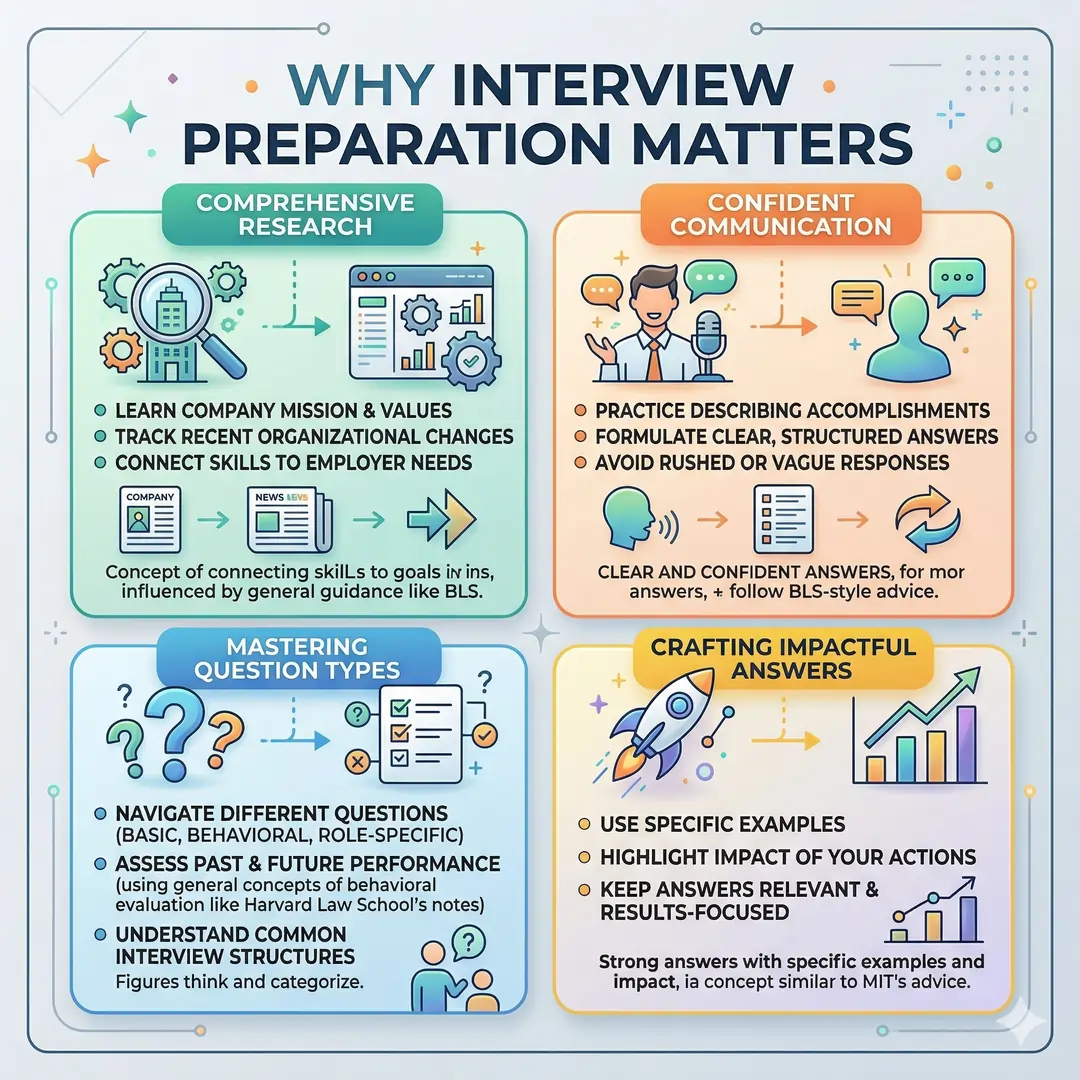
A good interview is not only about speaking well. It is about showing that you understand the role, the company, and the kind of contribution they need. BLS guidance says that learning about the company, its mission, and recent changes helps you connect your skills to the employer’s needs. It also advises candidates to practice describing past accomplishments before the interview, so their answers sound clear and confident instead of rushed or vague.
Also, read this in detail: Top Interview Questions and Answers Guide
Interviewers commonly ask a mix of basic, behavioral, and role-specific questions. Harvard Law School notes that behavioral questions are used to assess past and future performance, while MIT explains that strong answers should focus on specific examples and the impact of your actions. That is why a great interview answer usually sounds structured, relevant, and focused on results.
What interviewers usually want to know
Before you memorize answers, it helps to understand the purpose behind the questions. Most interview questions are trying to uncover one or more of these things: your communication skills, your confidence, your job knowledge, your problem-solving ability, your adaptability, and whether you will fit the team and the company culture. Harvard and Cornell career guidance both stress professional demeanor, enthusiasm, and specific examples during the interview.
Large overview table: common interview question types
| Question type | What the interviewer is checking | What a strong answer should include | Best for freshers | Best for experienced candidates |
|---|---|---|---|---|
| Introductory questions | Clarity, confidence, communication | Short professional summary, relevant background, career goals | Education, projects, internships, and strengths | Experience, achievements, growth, role fit |
| Behavioral questions | Past performance and future behavior | Real example, clear actions, result, lesson learned | College projects, internships, teamwork, volunteering | Workplace examples, leadership, deadlines, conflict resolution |
| Motivation questions | Interest in company and role | Specific reasons, research, alignment with goals | Learning interest, skill growth, company values | Career growth, impact, industry interest |
| Strength and weakness questions | Self-awareness and honesty | Strength linked to role, weakness with improvement plan | Academic strength, communication, fast learning | Leadership, decision-making, delegation, improvement area |
| Problem-solving questions | Thinking process and judgment | Step-by-step logic, practical solution, calm tone | Academic or project challenges | Business issues, team issues, process improvement |
| Technical questions | Job-specific knowledge | Correct concepts, examples, clear explanation | Fundamentals, coursework, projects | Tools, frameworks, systems, measurable experience |
| Closing questions | Interest, initiative, preparation | Smart questions about team, training, and growth | Ask about learning path and expectations | Ask about responsibilities, KPIs, culture, growth |
This table gives the big picture. The important idea is simple. The answer should not sound memorized. It should sound prepared, honest, and tied to the job. That is consistent with advice from BLS, Harvard, MIT, and several university career centers.
How to prepare before the interview
The strongest candidates usually prepare practically. BLS recommends researching the company and the role, practicing answers, and dressing appropriately. Harvard career guidance also notes that virtual interviews need the same seriousness as in-person interviews, including a quiet space, neutral background, and interview-appropriate attire.
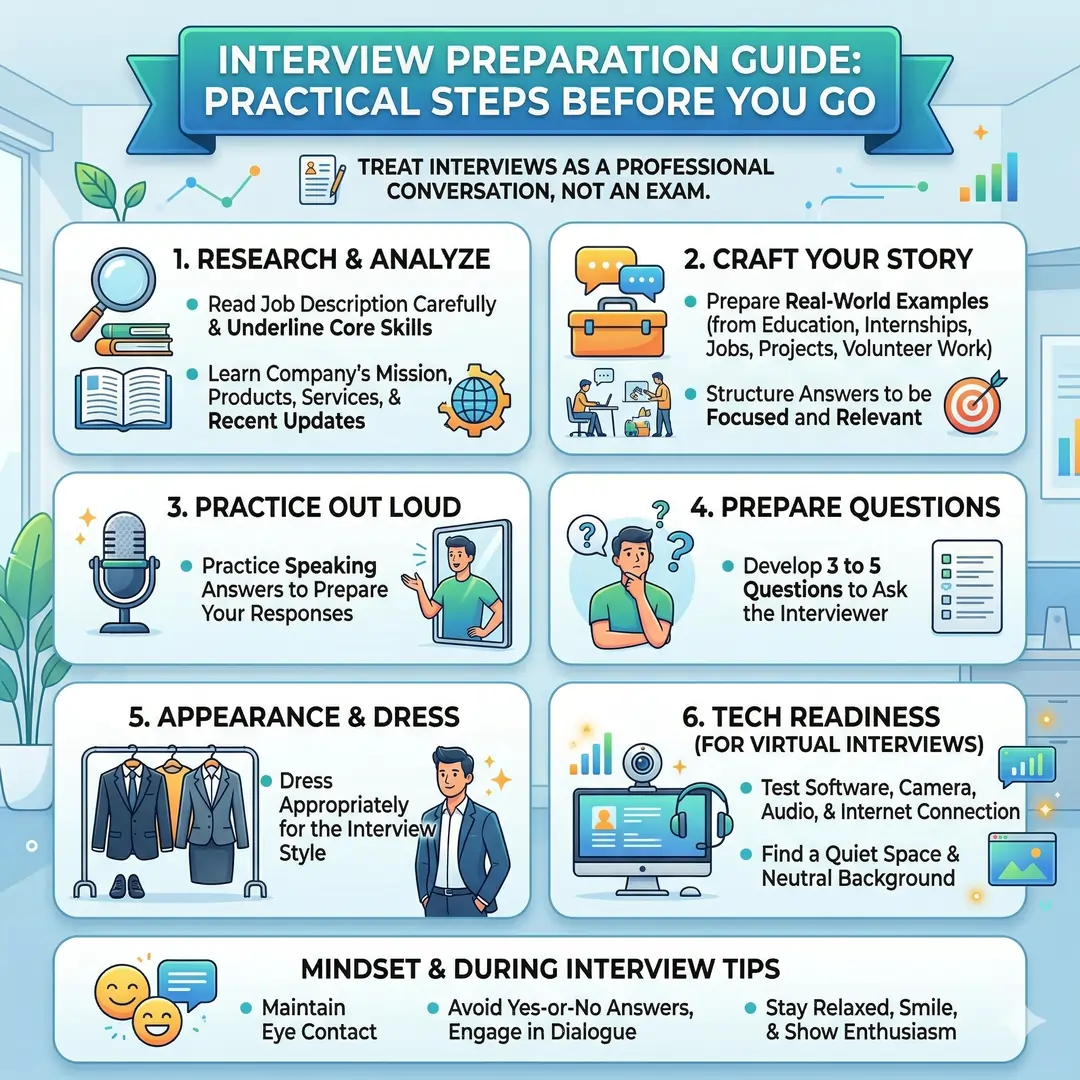
Here is a simple preparation checklist.
- Read the job description carefully and underline the core skills.
- Learn the company’s mission, products, services, and recent updates.
- Prepare examples from education, internships, jobs, projects, or volunteer work.
- Practice speaking your answers out loud.
- Keep your answers focused and relevant.
- Prepare 3 to 5 questions to ask the interviewer at the end.
- For video interviews, test the software, camera, audio, and internet connection in advance.
A useful mindset is to treat the interview as a professional conversation, not an exam. Rutgers career guidance recommends maintaining eye contact, avoiding yes-or-no answers, and engaging in a real dialogue. Cornell also advises candidates to stay relaxed, smile, and show enthusiasm without talking too much.
The STAR method for answering behavioral questions
One of the most important interview tools is the STAR method. MIT and Harvard Law School both recommend it for behavioral interview questions. STAR stands for Situation, Task, Action, and Result. The method helps you give a complete answer without wandering away from the question. MIT’s guidance explains that the Action part should be the largest and most detailed portion of your answer, while the Result should show the outcome, preferably with measurable impact.
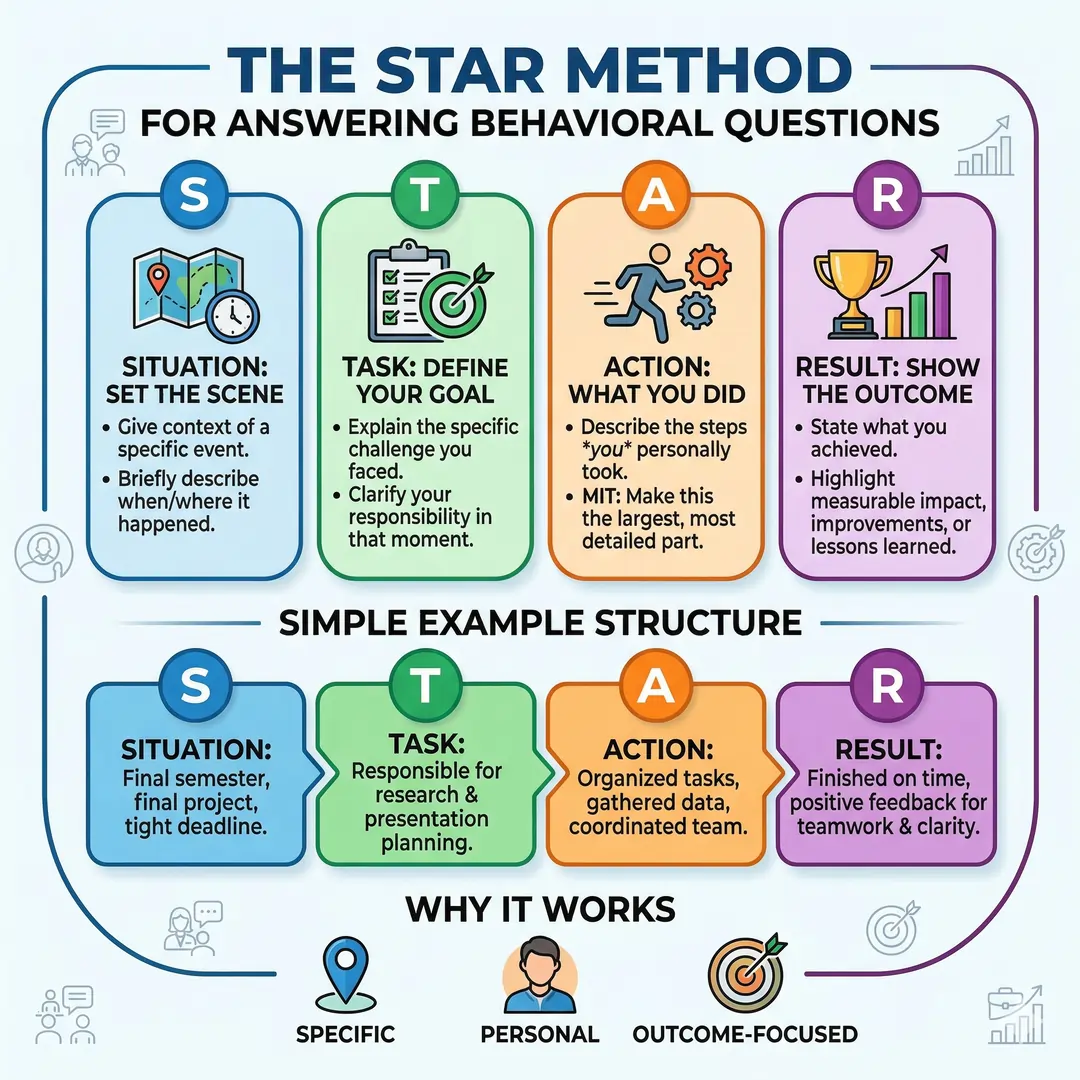
STAR method table
| Part | What to say | What not to do |
|---|---|---|
| Situation | Briefly set the context | Give too much background |
| Task | Explain your responsibility or goal | Describe the whole project in detail |
| Action | Explain what you personally did | Talk only in generalities |
| Result | Show the outcome, lesson, or improvement | End without a clear finish |
A simple example structure looks like this:
Situation: In my final semester, our team had to complete a project within a short deadline.
Task: I was responsible for research and presentation planning.
Action: I organized the work into smaller tasks, gathered data, and coordinated with teammates.
Result: We finished on time and received positive feedback for clarity and teamwork.
That answer works because it is specific, personal, and outcome-focused, which is exactly what career centers recommend for behavioral interviews.
Top interview questions and answers for freshers
Freshers are usually judged on potential, attitude, communication, learning ability, and basic understanding of the role. Since there may be limited work experience, strong answers often come from education, internships, projects, certifications, college activities, and teamwork examples. BLS specifically says to use examples from past jobs, schoolwork, and activities to illustrate your skills.
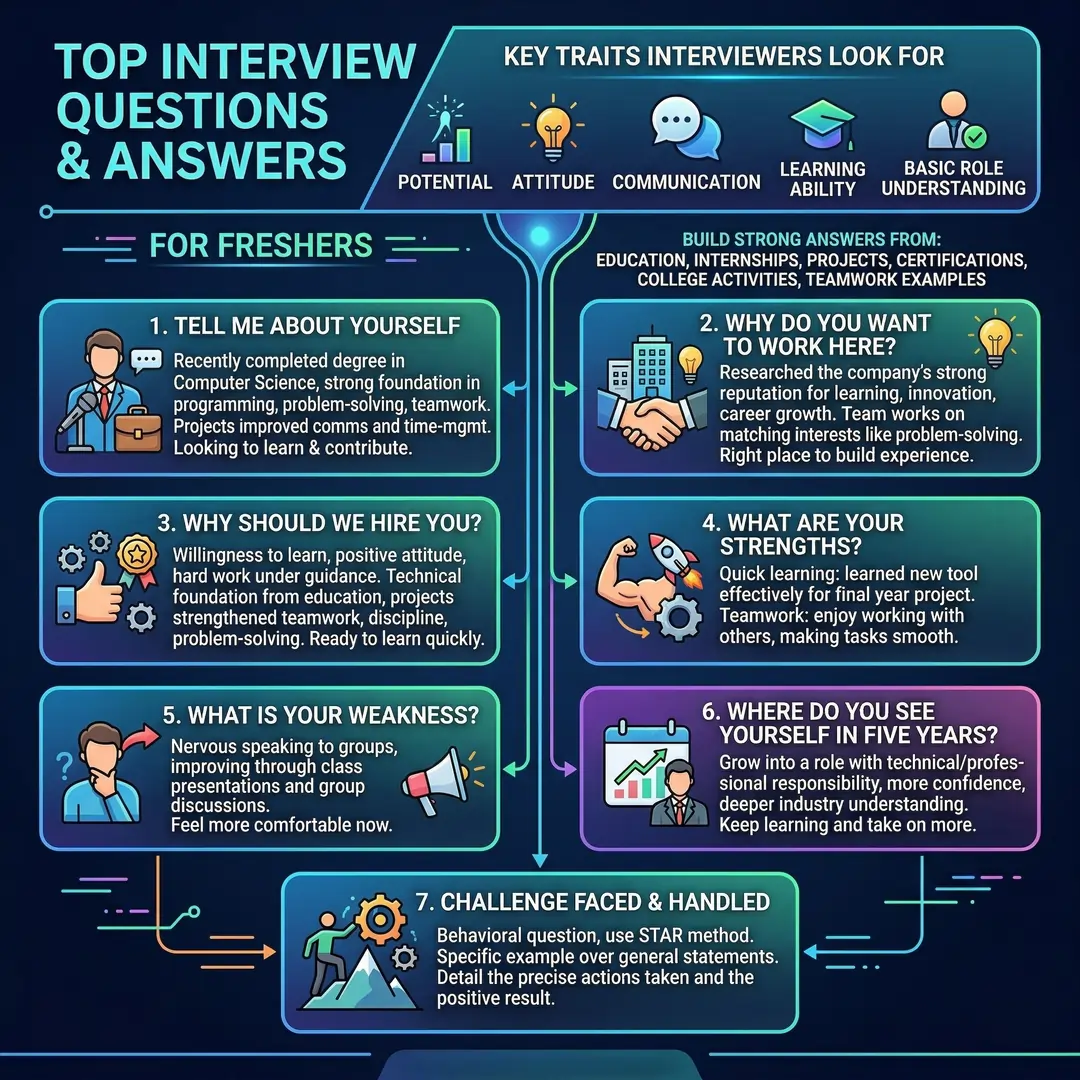
1. Tell me about yourself
This is often the first question because it helps the interviewer understand your background. Indeed’s interview guidance describes this as a common opening question, and BLS recommends focusing on professional characteristics rather than personal life. A fresher should keep the answer short, structured, and relevant to the job.
Sample fresher answer idea:
“I recently completed my degree in Computer Science, where I built a strong foundation in programming, problem-solving, and teamwork. I also worked on academic projects that helped me improve my communication skills and time management. I am now looking for an opportunity where I can learn from experienced professionals and contribute positively to the team.”
This kind of answer works because it shows education, relevant skills, and career intent without sounding too long or too casual.
2. Why do you want to work here?
Interviewers ask this to see whether you have researched the company and whether your goals match what they offer. BLS says company research is essential, and Indeed notes that employers want to know you have done your homework and understand what interests you about the company.
Sample fresher answer idea:
“I want to work here because the company has a strong reputation for learning opportunities, innovation, and career growth. I also noticed that your team works on projects that match my interests, especially in problem-solving and process improvement. This feels like the right place to build experience and contribute meaningfully.”
3. Why should we hire you?
This question checks your confidence and your fit for the role. Indeed includes it among the most common interview questions, and career guidance from multiple universities suggests tying your answer directly to the employer’s needs.
Sample fresher answer idea:
“You should hire me because I bring a strong willingness to learn, a positive attitude, and the ability to work hard under guidance. My education gave me the technical foundation, and my projects helped me strengthen teamwork, discipline, and problem-solving. I am ready to learn quickly and contribute from day one.”
4. What are your strengths?
A fresher should choose strengths that are useful for the role and then support them with examples. BLS recommends practicing answers to common questions, like strengths and weaknesses, before the interview.
Sample fresher answer idea:
“One of my strengths is quick learning. During my final year project, I had to learn a new tool in a short time, and I was able to apply it effectively. Another strength is teamwork, because I enjoy working with others and making sure tasks move smoothly.”
5. What is your weakness?
This question is not about perfection. It is about self-awareness and improvement. A good answer names a real but manageable weakness and then shows the steps you are taking to improve. That approach fits the behavioral interview advice from Harvard and MIT, which emphasizes honest, specific, and focused answers.
Sample fresher answer idea:
“I used to feel nervous speaking in front of groups, but I have been improving by taking part in class presentations and group discussions. I still prepare carefully, and I now feel much more comfortable explaining my ideas clearly.”
6. Where do you see yourself in five years?
This question checks ambition and direction. Indeed lists it among the common interview questions, and BLS notes that goals are one of the questions you should practice in advance.
Sample fresher answer idea:
“In five years, I hope to have grown into a role where I have strong technical or professional responsibility, more confidence, and a deeper understanding of the industry. I want to keep learning, take on more responsibility, and contribute to meaningful outcomes.”
7. Tell me about a challenge you faced and how you handled it
This is a behavior-based question, so use STAR. Harvard Law School says behavioral questions help employers assess past and future performance, and MIT recommends specific examples rather than general statements.
Sample fresher answer idea:
“In one of my projects, our team had trouble dividing work clearly. I took the initiative to organize tasks, set deadlines, and track progress. As a result, we improved coordination and completed the work more smoothly.”
Top interview questions and answers for experienced candidates
Experienced candidates are usually expected to speak more about impact, leadership, decision-making, problem-solving, and results. Universities and career centers consistently recommend specific examples, clear ownership, and concise answers. MIT specifically notes that you should use “I” statements when describing your role, even in team settings, so the interviewer understands your individual contribution.
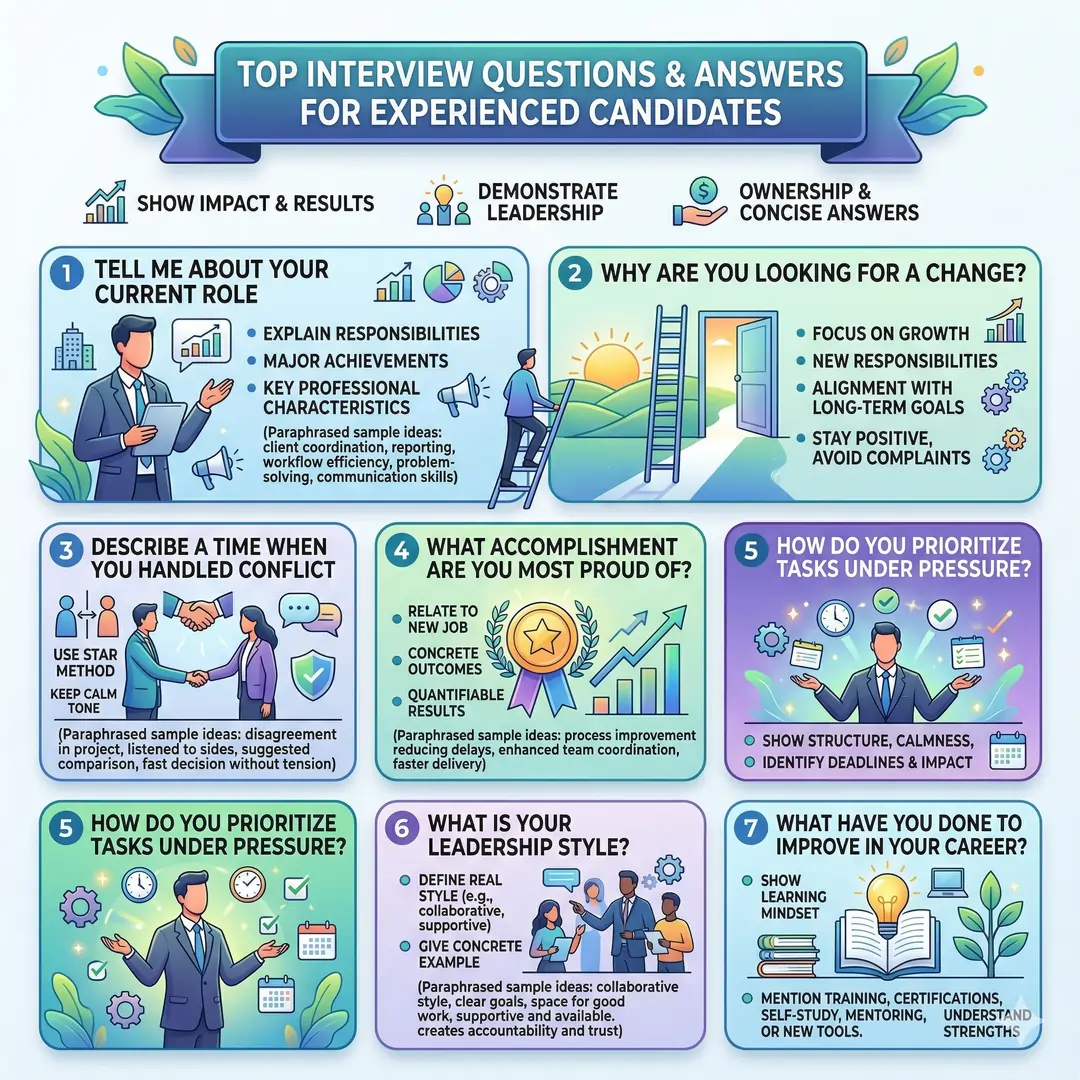
1. Tell me about your current role
An experienced candidate should explain the role, major responsibilities, and a few achievements. Keep it business-focused. BLS advises candidates to talk about professional characteristics and achievements that relate to the position.
Sample answer idea:
“In my current role, I handle client coordination, reporting, and process support. Over time, I have also contributed to improving workflow efficiency and solving issues before they affect deadlines. The role has strengthened my communication, planning, and ownership skills.”
2. Why are you looking for a change?
This question is common, and it is important to stay positive. The answer should focus on growth, new responsibilities, or better role alignment, not complaints. Indeed’s common interview questions list includes why you are leaving your current job.
Sample answer idea:
“I am looking for a role that gives me more responsibility and better matches my long-term career goals. I have learned a great deal in my current position, and now I want to apply that experience in a new environment where I can contribute at a higher level.”
3. Describe a time when you handled conflict
This is a classic behavioral question. Harvard Law School lists examples such as difficult coworkers, challenging situations, and mistakes as common behavioral prompts. Use the STAR method and keep the tone calm and professional.
Sample answer idea:
“In one project, two team members disagreed on the best approach. I listened to both sides, clarified the project goal, and suggested a short comparison of the options. That helped us make a faster decision and move ahead without tension.”
4. What accomplishment are you most proud of?
The best response is not just a proud moment. It should show relevance to the job. University guidance recommends highlighting concrete outcomes and quantifiable results wherever possible.
Sample answer idea:
“I am most proud of a process improvement I helped implement that reduced delays and improved team coordination. It was satisfying because the change made daily work smoother for everyone and improved delivery speed.”
5. How do you prioritize tasks under pressure?
Interviewers often ask this to test judgment and planning. Harvard Law School includes prioritization and fast decision-making among common behavioral scenarios. A strong answer should show structure, calmness, and ownership.
Sample answer idea:
“I first identify deadlines and business impact, then I break the work into priorities. I communicate early if there is a risk, and I stay flexible when urgent tasks appear. This helps me keep control of the workload without losing quality.”
6. What is your leadership style?
This question is common in interviews for experienced professionals. You should answer with a real style, such as supportive, collaborative, or data-driven, and then give an example. Indeed includes leadership experience among common interview topics.
Sample answer idea:
“My leadership style is collaborative. I like to be clear about goals, give people space to do good work, and stay available for support. In my experience, that creates accountability and trust.”
7. What have you done to improve in your career?
This question checks the learning mindset. A good answer may mention certification, training, self-study, mentoring, or exposure to new tools. BLS recommends showing you understand your own strengths and that you have practiced discussing them.
Sample answer idea:
“I regularly look for ways to improve my skills, especially in communication and process efficiency. I also try to learn from feedback and take on projects that stretch my ability.”
Common technical interview questions
Technical interviews are often used in fields such as technology and finance, though they can appear in other industries as well. Harvard’s interviewing guide explains that technical interviews are usually designed to assess both fit and technical or job-specific knowledge.
Examples of technical questions may include:
- Explain a concept you have worked with.
- Walk me through how you would solve this problem.
- Describe a project where you used this skill.
- Why did you choose this approach?
- What would you do differently next time?
How to answer technical questions well
- Start with the basic concept.
- Explain your logic step by step.
- Use an example from a project or job.
- Stay calm if you do not know the full answer.
- Show how you think, not just what you remember.
Mini table for technical interview response style
| Good answer behavior | Why it works |
|---|---|
| Explains the concept clearly | Shows understanding |
| Uses a real example | Proves practical use |
| Mentions trade-offs | Shows judgment |
| Admits limits honestly | Builds trust |
| Connects answer to role | Shows relevance |
For technical interviews, the interviewer is not only checking whether you know the right answer. They are also checking how you think, how you explain your reasoning, and how you respond when the question becomes difficult. That is why clear thinking matters as much as content.
Behavioral interview questions you should prepare for
Behavioral interview questions often begin with phrases like Tell me about a time when…, Describe a situation where…, or What did you do when… Harvard Law School lists several examples, including mistakes, deadlines, difficult people, and teamwork across differences. MIT and Duke also recommend using the STAR method to structure these answers.
Common behavioral questions
- Tell me about a time you handled a difficult situation.
- Tell me about a time you worked on a team.
- Tell me about a time you missed a deadline or made a mistake.
- Tell me about a time you solved a problem creatively.
- Tell me about a time you had to learn something quickly.
- Tell me about a time you had to work with someone difficult.
- Tell me about a time you received feedback and improved.
Tips for behavioral answers
- Pick one real example.
- Keep the story focused.
- Emphasize your personal contribution.
- Show the result clearly.
- Finish with a lesson learned when appropriate.
Smart questions to ask the interviewer
An interview is a two-way conversation. UCLA career guidance says the interview helps both sides determine mutual fit, and Duke and MIT both recommend preparing thoughtful questions for the interviewer. Asking good questions shows interest, preparation, and maturity.
Strong questions to ask at the end
- What does success look like in this role during the first six months?
- What are the most important skills for someone to succeed here?
- How is performance measured in this position?
- Can you tell me about the team I would work with?
- What opportunities for learning and growth does this role offer?
- What do you enjoy most about working here?
Questions better to avoid in the first interview
University career centers often suggest avoiding questions that are already answered on the company website and avoiding salary or benefits questions too early, unless the interviewer brings them up. It is usually better to focus first on the work itself, the team, and the expectations of the role.
Body language and communication tips that matter
Good interview answers matter, but so does how you present them. BLS recommends professional demeanor, while Cornell, Rutgers, and UNC career guidance emphasize eye contact, enthusiasm, confidence, and listening carefully. In video interviews, Harvard recommends looking into the camera, using a quiet private space, and dressing appropriately.
Useful habits during the interview
- Sit straight and stay relaxed.
- Smile naturally.
- Listen fully before answering.
- Pause briefly if you need time to think.
- Keep answers focused and concise.
- Use examples when possible.
- Show interest in the role and company.
Communication mistakes to avoid
- Giving very long answers
- Speaking too vaguely
- Criticizing past employers
- Pretending to know everything
- Talking only about yourself without linking to the role
- Answering in a robotic, memorized way
Large comparison table: fresher vs experienced candidate answers
| Interview topic | Freshers should focus on | Experienced candidates should focus on |
|---|---|---|
| Tell me about yourself | Education, projects, internship, goals | Role history, major achievements, leadership |
| Why should we hire you? | Learning attitude, fresh energy, adaptability | Proven results, judgment, impact, responsibility |
| Strengths | Quick learning, teamwork, discipline, communication | Ownership, strategic thinking, mentoring, delivery |
| Weaknesses | A manageable gap with an improvement plan | A real but controlled development area with evidence of growth |
| Behavioral answers | College projects, internships, group work, volunteering | Work examples, team leadership, conflict resolution, process improvement |
| Career goals | Skill growth, first strong role, learning culture | Bigger responsibility, leadership path, business impact |
| Technical confidence | Fundamentals, coursework, lab work, project logic | Systems, tools, implementation, optimization, measurable results |
| Questions to ask | Training, learning, expectations, team support | Impact, KPIs, collaboration, roadmap, growth path |
This comparison is useful because the interviewer is often evaluating the same traits in both groups, but with different expectations. Freshers are usually assessed for potential. Experienced candidates are usually assessed for execution, consistency, and leadership. That idea is consistent across university and career center guidance on interviewing.
Sample answers you can adapt
Here are a few answer patterns that work well across many roles.
Sample answer pattern for “Tell me about yourself”
Start with your background, add 2 or 3 relevant strengths, and end with your current career goal. Keep it short, clear, and job-focused. This approach matches BLS advice to focus on professional characteristics rather than personal details.
Sample answer pattern for “Why do you want this job?”
Mention one reason related to the company, one reason related to the role, and one reason related to your own development. That aligns with advice from BLS and Indeed about showing company research and genuine interest.
Sample answer pattern for behavioral questions
Use STAR. Describe the context, your role, what you did, and what happened. Keep the answer specific and focused, just as MIT and Harvard recommend.
A practical interview success formula
If you want a simple formula, use this:
Research + Practice + Relevance + Confidence + Examples
- Research the company and role.
- Practice your answers out loud.
- Make every answer relevant to the position.
- Speak with calm confidence.
- Use examples instead of vague claims.
That formula is simple, but it works because it matches the core advice repeated by credible career resources. Preparation helps, examples help, and strong communication helps even more.
Final interview checklist
Before you walk into the interview, make sure you can check off these items.
- You know the company and the job description.
- You have prepared answers for common questions.
- You have one or two strong examples for behavioral questions.
- You can explain your strengths clearly.
- You can discuss a weakness honestly and positively.
- You have questions ready for the interviewer.
- Your clothes, documents, and interview setup are ready.
- You are calm, polite, and focused.
Conclusion
Whether you are a fresher or an experienced professional, interview success comes from the same foundation: preparation, clarity, honesty, and relevance. The best answers are not the fanciest ones. They are the answers that show you understand the role, can explain your value, and can speak with confidence about your past work and future goals. Career guidance from the BLS, Harvard, MIT, and university career centers all point in the same direction. Research the company, practice your stories, answer with structure, and ask thoughtful questions at the end.
If you prepare in that way, interview questions stop feeling like traps and start feeling like opportunities. That change in mindset alone can make a huge difference.
Article References And Sources
- U.S. Bureau of Labor Statistics (BLS) – Employment Interviewing Guide
https://www.bls.gov/careeroutlook/2016/article/employment-interviewing.htm - Harvard Law School – Interview Questions and Preparation Guide
https://hls.harvard.edu/bernard-koteen-office-of-public-interest-advising/opia-job-search-toolkit/interview-questions/ - MIT Career Advising & Professional Development – STAR Method for Behavioral Interviews
https://capd.mit.edu/resources/the-star-method-for-behavioral-interviews/ - Harvard Extension School – Interviewing Guide (PDF Resource)
https://cdn-careerservices.fas.harvard.edu/wp-content/uploads/sites/161/2024/08/2024-HES-interviewing-edited-1.pdf - Indeed Career Guide – Top Interview Questions and Answers
https://in.indeed.com/career-advice/interviewing/top-interview-questions-and-answers - Cornell University – Interview Preparation Tips
https://www.ilr.cornell.edu/current-students/career-services/prepare-interviews - Rutgers University Career Center – Interviewing Tips
https://careercenter.camden.rutgers.edu/interviewing-tips/ - UCLA Career Center – Successful Interviewing Guide
https://career.ucla.edu/resources/successful-interviewing/ - University of Alabama Career Center – Questions to Ask Interviewers
https://career.sa.ua.edu/develop/interview-skills/questions-to-ask-the-interviewers/ - MIT Career Development – Questions to Ask Interviewers
https://capd.mit.edu/resources/questions-to-ask-interviewer/
Frequently Asked Questions
FAQ 1: What is the best way to prepare for an interview?
The best way to prepare for an interview is to study the job description, understand the company, and practice answers to the most common questions. A strong candidate does not walk into an interview and hope for the best. Instead, they spend time learning what the employer wants and then connect their own skills, experience, and goals to that role.
It also helps to prepare short examples from your past work, studies, internships, or projects. These examples should show how you handled a challenge, worked in a team, solved a problem, or learned something quickly. When you prepare in advance, your answers sound more natural, more confident, and more professional.
A good interview preparation routine also includes practicing your voice, improving your body language, and deciding what to wear. Even simple details like arriving on time, keeping documents ready, and staying calm can make a very strong impression. Preparation is not about memorizing answers. It is about being ready to speak clearly and honestly about your values.
FAQ 2: How should freshers answer interview questions without work experience?
Freshers should answer interview questions by focusing on education, projects, internships, certifications, college activities, and personal strengths. Even if you do not have full-time work experience, you still have examples that show your ability to learn, adapt, and contribute. Interviewers understand that freshers are early in their careers, so they are often more interested in your potential than your past job history.
A fresher should avoid saying, “I have no experience,” and stop there. Instead, it is better to talk about what you have done in your academic life and how it helped you develop useful skills. For example, you can mention a class project that required teamwork, a presentation that improved your confidence, or an internship that taught you discipline and time management. These examples help the interviewer see your practical side.
The most important thing for freshers is to sound willing to learn. A positive attitude, clear communication, and a genuine interest in the role can often matter as much as technical knowledge. If you show curiosity and responsibility, you can create a very strong impression even without long work experience.
FAQ 3: What should experienced candidates highlight during an interview?
Experienced candidates should highlight achievements, responsibilities, leadership, problem-solving ability, and the results they have delivered in past roles. Unlike freshers, experienced professionals are usually expected to show not just knowledge, but also impact. Interviewers want to know how your past work has helped teams, projects, customers, or business goals.
It is important to speak in a structured way. You can explain your current role, mention the kinds of tasks you handle, and then share examples of improvements you have made. For example, you might describe how you reduced delays, improved a process, handled a difficult situation, or supported a team during a busy period. These details make your experience feel real and valuable.
Experienced candidates should also show growth. It is not enough to say what you have done. You should also explain what you learned, how you improved, and what kind of role you want next. This helps the interviewer see that you are not only qualified but also ready for the next step in your career.
FAQ 4: What is the STAR method, and why is it important in interviews?
The STAR method is a simple way to answer behavioral interview questions in a clear and organized manner. STAR stands for Situation, Task, Action, and Result. It helps you tell a complete story without becoming confusing or too long. Many interviewers use behavioral questions to understand how you act in real situations, and STAR is one of the best ways to respond.
In the Situation part, you explain the background. In the Task part, you say what needs to be done. In the Action part, you describe exactly what you did. In the Result part, you share the outcome and, if possible, what you learned. This structure keeps your answer focused and easy to follow.
The STAR method is useful because it stops you from giving vague or generic answers. Instead of saying, “I am a good team player,” you can describe a real time when you worked with others to complete a project successfully. That kind of answer feels more believable, more professional, and more memorable to the interviewer.
FAQ 5: How should I answer the question “Tell me about yourself”?
The question “Tell me about yourself” should be answered like a short professional introduction, not like a full life story. A strong answer begins with your background, moves to your key skills or experience, and ends with your current career goal. The purpose is to give the interviewer a quick summary of who you are and why you are a good fit for the role.
For freshers, this answer can include your education, projects, internships, and career interests. For experienced candidates, it can include your current role, major responsibilities, achievements, and the type of opportunity you are looking for next. In both cases, the answer should stay relevant to the job.
A good answer should sound natural and confident. It should not be too long, and it should not include unnecessary personal details. The best version of this answer helps the interviewer understand your professional identity right away and sets the tone for the rest of the interview.
FAQ 6: What is the best way to answer “What are your strengths and weaknesses?”
When answering strengths, you should choose qualities that match the job and then support them with a real example. For example, if you say your strength is teamwork, explain a time when you worked with others to complete a goal. If you say your strength is quick learning, mention a situation where you had to understand something new in a short time. This makes your answer more believable and useful.
For weaknesses, the best approach is to be honest but careful. Do not choose a weakness that creates serious doubt about your ability to do the job. Instead, choose a real but manageable weakness and then explain how you are improving it. For example, you might say you used to feel nervous when speaking in public, but you have been practicing presentations and becoming more confident.
This question is really about self-awareness. Interviewers want to see that you understand your own growth areas and are willing to improve. A thoughtful answer shows maturity, honesty, and a positive attitude toward learning.
FAQ 7: Why do interviewers ask behavioral questions?
Interviewers ask behavioral questions because past behavior often gives clues about future performance. These questions help them understand how you handle pressure, solve problems, work in a team, deal with conflict, and respond to feedback. Instead of asking only theoretical questions, they want real examples that show your actions and decision-making.
Behavioral questions often begin with phrases like “Tell me about a time when…” or “Describe a situation where…”. These questions are designed to move beyond simple yes or no answers. They help the interviewer learn how you think and how you behave in real workplace situations.
The best way to handle behavioral questions is to stay calm and use a clear structure like the STAR method. Choose one specific example, explain what happened, describe what you did, and finish with the result. A strong behavioral answer shows not only what you did, but also what kind of person and professional you are.
FAQ 8: What should I ask the interviewer at the end of the interview?
At the end of an interview, it is a good idea to ask thoughtful questions about the role, the team, the company culture, and the growth opportunities. This shows that you are genuinely interested in the position and that you are thinking seriously about how you can contribute. It also helps you decide whether the job is the right fit for you.
You can ask questions like what success looks like in the role, how performance is measured, what kind of training is offered, or what the first few months in the job would look like. These are useful because they show maturity and preparation. They also help you understand the expectations more clearly.
Try to avoid asking only about salary, leave, or benefits in the very first interview unless the interviewer brings it up. It is usually better to focus first on learning about the work itself. Good questions can leave a strong final impression and help the interviewer remember you as someone thoughtful and serious about the opportunity.
FAQ 9: How important is body language in an interview?
Body language is very important in an interview because it affects how confident, attentive, and professional you appear. Even if your answers are strong, poor body language can create a weaker impression. Interviewers notice whether you make eye contact, sit properly, listen carefully, and speak with calm energy.
Good body language includes sitting straight, smiling naturally, nodding when appropriate, and avoiding nervous habits like fidgeting or looking away too often. It also means being attentive when the interviewer speaks and responding in a clear, respectful manner. These small signals help build trust and show that you are engaged in the conversation.
In virtual interviews, body language still matters. You should look at the camera, sit in a clean and quiet space, and avoid distractions. A professional presentation is not only about clothes. It is also about the way you carry yourself from start to finish.
FAQ 10: How can I make my interview answers sound natural and professional?
The best way to make your interview answers sound natural and professional is to avoid sounding too rehearsed. Many people try to memorize long answers, but that often makes them sound robotic. Instead, it is better to understand the main idea of your answer and then speak in a relaxed, clear way.
A natural answer usually has a simple structure. It starts with a direct response, includes one relevant example, and ends with a positive point or result. This helps your answer stay focused while still sounding human. You do not need very fancy words to impress the interviewer. Clear and honest language is usually much stronger.
Professional answers also stay relevant to the role. They do not wander into unrelated stories or personal details. The goal is to show that you can communicate well, think clearly, and connect your background to the job. When your answers are natural, structured, and honest, they become much more powerful.
