Hiring bias can quietly shape who gets interviewed, who gets shortlisted, and who gets hired. It can show up as a preference for candidates who feel familiar, as an overreliance on gut feeling, or as a process that rewards confidence over competence. Research and official guidance both point to the same conclusion. When hiring is less structured and less transparent, bias has more room to influence decisions. When hiring is job-related, standardized, and well-documented, decisions become fairer and easier to defend.
This matters for more than compliance. It affects talent quality, workforce diversity, candidate experience, and even the long-term credibility of a brand. Studies of discrimination in hiring have found clear disadvantages for applicants whose identities signal race or age, while blind or age-blind procedures can improve fairness at specific stages of the process. At the same time, structured interviews and pre-defined scoring systems help reduce the influence of personal bias and make comparisons between candidates more consistent.
Table of Contents
What Hiring Bias Really Means
Hiring bias is any systematic tendency that causes a recruiter, interviewer, or hiring manager to judge one candidate more favorably or less favorably than another for reasons that are not tied to the actual requirements of the role. Bias can be conscious or unconscious. It can come from stereotypes, first impressions, similarity bias, cultural assumptions, or weak hiring systems that leave too much room for subjective judgment. The EEOC describes one common pattern as the “like me” syndrome, where people may favor candidates who feel similar to themselves in race, age, gender, disability, religion, or background.
Bias is not always loud or obvious. Sometimes it is hidden in the questions asked during interviews, the wording of job ads, the order in which candidates are reviewed, or the way one candidate’s confidence is interpreted as competence while another candidate’s calmness is interpreted as lack of leadership. That is why reducing bias is not just about training people to “be fair.” It is also about redesigning the hiring process so that fairness is built in from the start.

Why Reducing Hiring Bias Matters
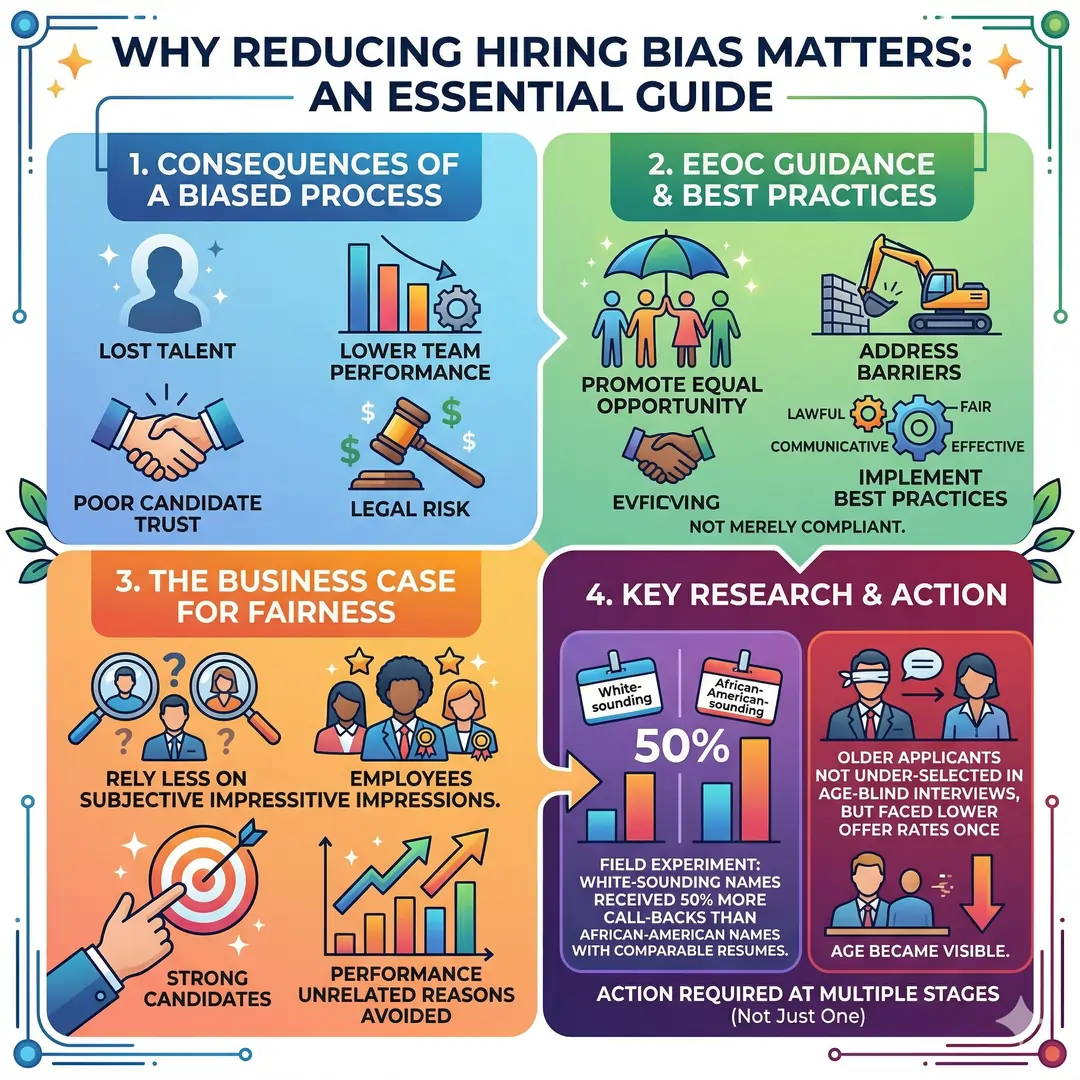
A biased hiring process can lead to lost talent, lower team performance, poor candidate trust, and legal risk. The EEOC explains that practices should promote equal employment opportunity and address barriers that limit it. It also notes that a “best practice” should be lawful, fair, communicative, and effective, not merely compliant in a minimal sense.
There is also a business case. When hiring relies too much on subjective impressions, strong candidates can be missed for reasons unrelated to performance. Research on labor market discrimination has repeatedly found that applicants can receive different treatment based on signals such as race or age. In one well-known field experiment, White-sounding names received 50 percent more interview callbacks than African-American-sounding names with comparable resumes. In another study, older applicants did not get under-selected when the interview selection step was age-blind, but they still faced lower offer rates once age became visible later in the process. Those findings show that reducing bias requires action at multiple stages, not just one.
Common Types of Hiring Bias
Below is a practical look at some of the most common forms of bias that affect recruiting.
| Type of Bias | How It Appears in Hiring | Why It Hurts | Better Approach | Research or Guidance Basis |
|---|---|---|---|---|
| Similarity bias or like me syndrome | Favoring candidates who share a background, style, school, accent, or personality with the interviewer | Narrows the talent pool and reduces diversity of thought | Use structured interviews, scoring rubrics, and panel review | EEOC identifies like me syndrome as a barrier to equal opportunity. |
| Gender bias | Assuming leadership style, confidence, or availability based on gender stereotypes | Can exclude qualified women or men from roles and promotions | Use job-related questions and standardized criteria | Structured interviews can help reduce bias and unfair comparisons. |
| Racial bias | Interpreting names, accents, or schools as signals of ability | Causes qualified applicants to be screened out early | Blind screening where feasible, plus consistent evaluation rules | Resume callback experiments show racial discrimination can affect interview access. |
| Age bias | Assuming older candidates are less adaptable or younger candidates are less experienced | Weakens access to opportunities across age groups | Use age-blind screening for early stages and interview based on competencies | Age-blind procedures improved interview selection fairness in one study, though bias persisted later when age became visible. |
| Disability bias | Treating disability as a weakness rather than focusing on ability to perform the job | Can unfairly exclude strong candidates | Follow ADA-aligned practices and focus on essential functions | EEOC guidance warns against questions that may reveal protected traits and influence decisions. |
| Confirmation bias | Looking for evidence that supports a first impression while ignoring other information | Leads to snap judgments and unfair scoring | Use behavior-based questions and score answers immediately | Structured interviews reduce opportunities for casual assumption-making. |
| Halo or horn effect | Letting one strong or weak trait distort the full evaluation | Distorts the overall picture of a candidate | Score each competency separately | Structured assessment criteria improve fairness and comparability. |
| Unstructured interview bias | Casual conversations, different questions for different people, no scoring system | Makes decisions less reliable and more personal | Use a fixed interview guide with pre-defined scoring | Unstructured interviews give more room for unconscious assumptions. |
The Best Way to Reduce Hiring Bias Is to Fix the Process
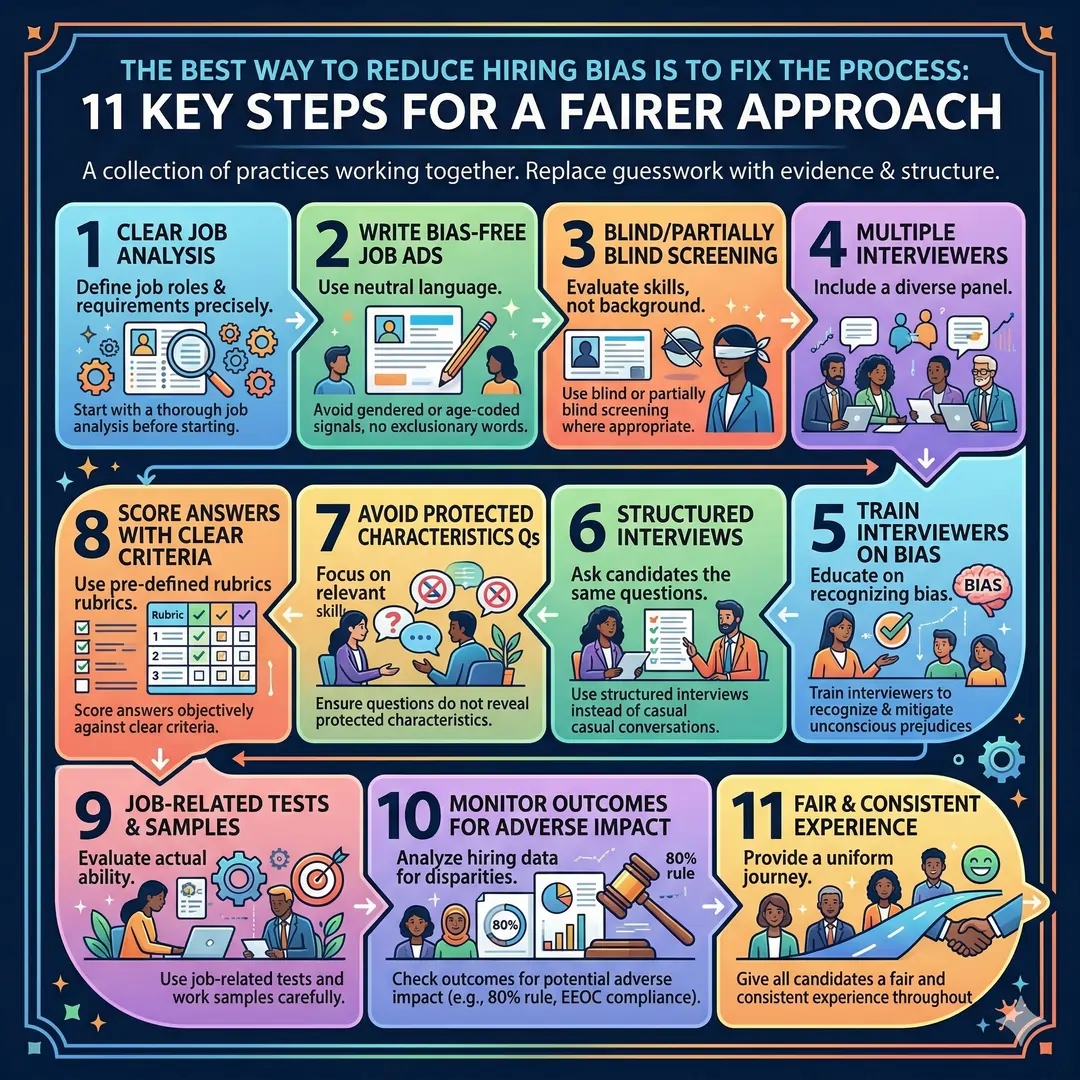
A fairer hiring process is usually not one single tactic. It is a collection of practices that work together. The strongest pattern across the evidence is this. First, define the job clearly. Then ask candidates the same job-related questions. Then score answers against a pre-defined rubric. Then review outcomes over time to check for adverse impact. The Uniform Guidelines explain that selection procedures should not create an adverse impact unless they are justified by job-relatedness and business necessity. They also note the often-cited 80 percent rule, which can be used as a screening tool for possible disparities.
That is the core idea behind modern bias reduction. Do not rely on memory, instinct, or chemistry alone. Replace vague judgment with evidence. Replace improvisation with structure. Replace hidden preferences with visible criteria.
Step 1: Start with a Clear Job Analysis
Before interviews begin, the organization should know exactly what the role requires. That means identifying the essential functions, the core competencies, and the behaviors that predict success in the job. The Behavioral Insights Team recommends planning interview questions around the knowledge, skills, and competencies that are relevant to the role, rather than asking broad or convenient questions that do not reflect the work itself.
This step matters because many hiring problems begin long before the interview. If the job description is vague, the interview becomes vague. If the competencies are not defined, interviewers fill the gap with assumptions. If the role is written in a way that overvalues personality cues, the process may reward style over substance. A good job analysis keeps the hiring team anchored to what the role actually needs. This is an inference from the guidance on role-relevant questioning and pre-planned criteria.
Good practice examples
- Define the must-have skills and separate them from nice-to-have skills
- List the performance outcomes expected in the first 6 to 12 months
- Use the same job analysis to shape the interview, assessment task, and final scoring sheet
- Review the job requirements with multiple stakeholders to avoid one person’s preferences dominating the role design
Step 2: Use Structured Interviews Instead of Casual Conversations
One of the strongest tools for reducing hiring bias is the structured interview. In a structured interview, candidates are asked the same or very similar questions, the questions are planned ahead of time, and responses are scored using clear criteria. The BIT guide says this makes it easier for panels to make direct and fair comparisons, and it gives hiring managers a chance to identify questions that may unintentionally disadvantage women or minority groups. It also notes that structured interviews can be combined with other assessment methods to minimize bias.
By contrast, unstructured interviews behave more like casual conversations. Interviewers may ask different questions, wander off topic, and rely on first impressions. That creates more room for unconscious assumptions and personal preferences. The result is often less consistency and weaker fairness.
Structured interview checklist
- Ask all candidates the same core questions
- Create a scoring rubric before interviews begin
- Score each answer against the same standards
- Train interviewers on what a strong answer looks like
- Record notes during the interview rather than relying on memory later
- Discuss candidates only after individual scoring is complete
Research summaries and reviews continue to support structured interviewing as a strong tool for reducing bias. A major review of the structured employment interview literature concluded that the field had accumulated substantial evidence on how structure affects bias and evaluation quality, while other summaries note that structured interviews are among the more valid selection methods and can have lower racial impact than several other predictors.
Step 3: Score Answers With Clear Criteria
A structured interview is only as strong as its scoring system. If scoring is vague, interviewers still end up guessing. That is why pre-defined rating criteria matter so much. The BIT guide recommends deciding in advance what an appropriate answer should include, then scoring all responses against those criteria. This keeps candidates on the same scale and reduces the influence of personal style or the interviewer’s mood.
A good scoring system usually includes:
- Behaviorally anchored rating scales
- A separate score for each competency
- A short explanation of what a high, medium, or low answer looks like
- Rules for how to weigh each competency
- Clear instructions for handling incomplete answers or unusual but valid responses
This approach is especially useful because two candidates can present information differently while still showing the same ability. A structured scoring model helps the interviewer focus on evidence, not presentation style. That is an inference grounded in the guidance about fair comparison and consistent criteria.
Step 4: Avoid Questions That Reveal Protected Characteristics
The EEOC recommends avoiding questions about personal characteristics protected by law, including race, color, religion, sex, national origin, and age, unless they are directly tied to a lawful job requirement. It specifically warns against questions about pregnancy, religion, ethnicity, and plans to have children. These questions can discourage applicants, create suspicion, and become evidence of intent to discriminate.
That means hiring teams should think carefully about every question they ask. A question may sound harmless, but if it does not help assess job ability, it may still create bias or legal risk. The safest questions are the ones directly connected to the work. Ask about experience, problem-solving, job-specific decisions, and relevant competencies. Do not ask for personal information just because the conversation feels easier that way.
Examples of safer interview questions
- Tell me about a time you handled a difficult customer situation.
- How do you prioritize multiple urgent deadlines?
- What process would you use to check the accuracy of a report?
- Describe a project where you had to coordinate with different teams.
Step 5: Use Blind or Partially Blind Screening Where Appropriate
One practical way to reduce bias is to hide information that should not matter at early stages. In hiring, this can mean removing names, photos, graduation years, or other identifiers during initial screening when feasible. Research on labor market discrimination shows why this matters. In the famous resume experiment, African-American-sounding names received fewer callbacks than White-sounding names, even when resumes were otherwise comparable.
Another study found that an age-blind hiring stage improved interview selection for older applicants. Older candidates were not under-selected for interviews when age was hidden, but offer rates still dropped once age became visible later in the process. That means blind screening helps, but it is not a complete solution on its own. Bias can reappear at later stages if those stages are not also structured.
Blind hiring has also worked in other settings. In the well-known study of symphony orchestras, blind auditions increased the probability that women advanced through preliminary rounds and fostered more impartial hiring overall. The evidence suggests that hiding identity during evaluation can help decision makers focus on performance rather than assumptions. This is a useful analogy for hiring because it shows the power of reducing identity signals when they are not relevant to the task.
Blind screening can include
- Removing names from resumes
- Removing photos
- Hiding graduation years
- Masking addresses where possible
- Screening initial work samples without identity information
Step 6: Use More Than One Interviewer
A single interviewer brings a single perspective. A panel brings more than one. The BIT guide says multiple interviewers can be closer to the wisdom of crowds, because several viewpoints can lead to a fairer result on average. It also recommends that interviewers score independently before discussing the candidate together. This helps prevent the first or most senior voice from dominating the outcome.
This practice matters because group discussions can accidentally turn into group bias. One strong opinion can shape the room. One confident speaker can influence the panel. Independent scoring before discussion makes it easier to preserve individual judgment and compare it later in a more disciplined way.
Step 7: Train Interviewers to Recognize Bias
Training by itself does not remove bias, but it helps people notice where bias can enter. Interviewers should be trained to understand confirmation bias, similarity bias, halo effect, and the risks of unstructured judgment. They should also be trained on how to use the scoring rubric, how to take notes, and how to keep the interview anchored to the role. The EEOC’s best-practice guidance explicitly notes that barriers such as stereotypes and prejudice can interfere with equal employment opportunity.
Training works best when it is specific. It should not be a generic lecture about being nice. It should show interviewers exactly where bias can creep in and exactly how the process prevents it. That includes avoiding casual questions, keeping the same criteria for all candidates, and documenting the reason behind decisions.
Step 8: Monitor Outcomes for Adverse Impact
Reducing bias is not a one-time project. It is an ongoing measurement process. The Uniform Guidelines explain that adverse impact occurs when a selection procedure produces substantially different selection rates for race, sex, or ethnic groups. They also note the common 80% rule as a practical indicator, while warning that sample size and statistical testing matter too.
This is important because a hiring team may believe it is being fair while the numbers tell a different story. Monitoring lets organizations check whether disparities appear at the application stage, the interview stage, the test stage, or the final offer stage. The BIT guide also recommends tracking who applies, who passes the sift, who passes tests or interviews, and who is ultimately hired. That level of data makes it much easier to find where bias is entering the process.
Metrics worth tracking
- Applicant pool diversity
- Interview pass rates by group
- Offer rates by group
- Time to hire
- Drop-off at each stage
- Candidate feedback by demographic group was lawful and appropriate
Step 9: Use Job-Related Tests and Work Samples Carefully
The Uniform Guidelines say that selection procedures that create an adverse impact may continue only if they are job-related and justified by business necessity. They also note that employers are strongly encouraged to use only job-related assessment tools even when adverse impact is not charged. That means any test, exercise, or sample task should be directly tied to actual performance on the job.
This is where work samples can be very useful. Instead of asking a candidate whether they are “strategic,” ask them to solve a realistic job problem. Instead of asking whether they are “detail-oriented,” have them review a short case with errors. The point is to measure behavior that resembles the work itself. That produces better evidence and reduces the temptation to rely on stereotypes. This is an inference based on the emphasis on job-related tools and structured evaluation.
Step 10: Write Job Ads That Do Not Signal Bias
Hiring bias starts before the first resume arrives. Job ads can contain language that signals who belongs and who does not. They can overuse masculine-coded words, exaggerate unrealistic requirements, or list preferences that are not actually necessary. The safer route is to keep the language clear, specific, and skill-focused. The goal is to invite qualified people in, not quietly push them away. This recommendation is consistent with the EEOC’s concern that questions and practices should not discourage applicants or imply discriminatory intent.
A well-written job ad should:
- Focus on essential responsibilities
- Separate must-haves from preferences
- Avoid unnecessary physical or cultural assumptions
- Use inclusive, plain language
- State how candidates will be evaluated
Step 11: Give Candidates a Fair and Consistent Experience
Candidate experience is part of bias reduction, too. When one applicant gets more time, more warmth, or more explanation than another, fairness can suffer even if nobody intended discrimination. The BIT guide notes that asking all candidates the same questions makes direct comparisons easier and that candidates should be treated in a way that supports fair assessment. It also recommends collecting data and providing candidates with feedback.
A respectful process signals that the organization is serious about quality. Clear scheduling, shared question formats, consistent time limits, and simple communication all help reduce noise in the process. People perform better when they know what to expect, and interviewers make better decisions when the process itself is calm and repeatable. That is an inference supported by the structured interview guidance.
Large Table: Bias Reduction Methods and How They Work
| Method | What It Looks Like in Practice | Main Bias Reduced | Best Used At | Key Advantage | Source Basis |
|---|---|---|---|---|---|
| Job analysis | Define competencies, outcomes, and essential functions before hiring begins | Assumption-based bias | Before posting the role | Keeps the process aligned to real work | BIT recommends planning around job-relevant competencies. |
| Structured interviews | Same core questions for everyone, with a scoring rubric | Similarity bias, confirmation bias, halo effect | Interview stage | Improves comparability and fairness | BIT and review literature support structure as a bias-reduction tool. |
| Independent scoring | Interviewers score separately before discussion | Group influence bias | After each interview | Prevents one opinion from dominating | BIT recommends scoring before discussion. |
| Blind screening | Hide names or photos during resume review | Racial or gender cues | Early screening | Reduces identity-based assumptions | Resume experiments and blind audition evidence support this logic. |
| Age-blind screening | Remove age signals early in the process | Age bias | Initial application review | Prevents early age-based exclusion | Age-blind procedure improved interview selection for older applicants. |
| Work samples | Candidate completes a realistic task | Style bias, educational prestige bias | Before final selection | Measures actual performance | Uniform Guidelines emphasize job-related assessment tools. |
| Panel interviews | More than one interviewer participates | Individual preference bias | Interview stage | Adds perspective and reduces one-person bias | BIT recommends multiple interviewers. |
| Adverse impact monitoring | Track selection rates by group at each stage | Hidden systemic bias | Ongoing | Shows where the process is failing | Uniform Guidelines define adverse impact and the 80% rule. |
| Lawful question design | Avoid protected-characteristic questions | Direct discriminatory bias | All stages | Reduces legal and ethical risk | EEOC guidance warns against such questions. |
| Candidate feedback loops | Review questions and score trends over time | Repeated process flaws | After hiring cycles | Helps refine weak questions | BIT recommends reviewing trends and improving over time. |
Example 1: How Structured Interviews Improve Fairness
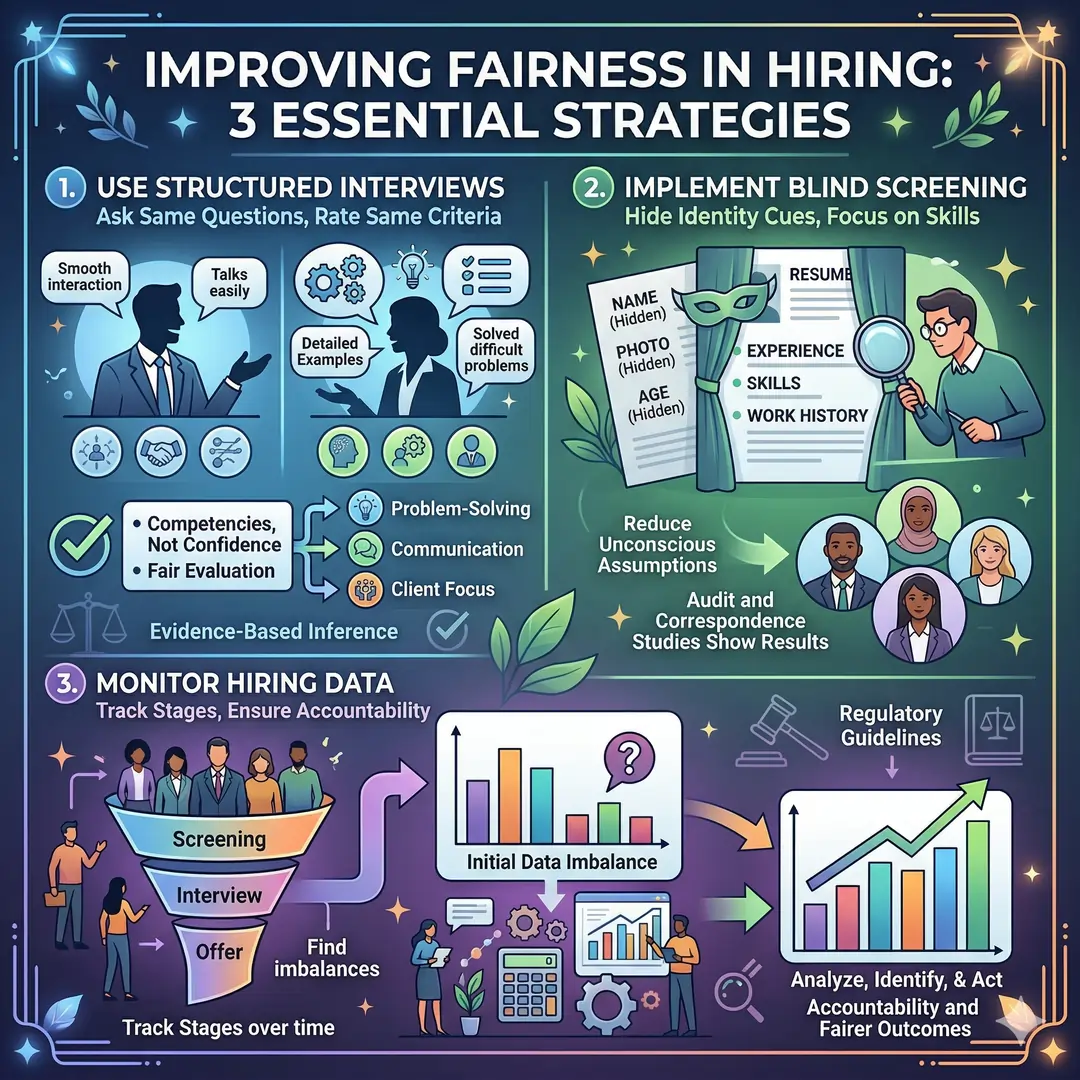
Imagine two candidates for a customer success role. One is extremely confident and talks easily. The other speaks more slowly but gives detailed examples of solving difficult client problems. In an unstructured interview, the confident candidate may appear stronger simply because the interaction feels smoother. In a structured interview, both candidates answer the same questions and are rated against the same criteria. That makes it easier to see who actually demonstrated the competencies needed for the role. This is an inference grounded in the structured interview evidence and guidance.
Example 2: How Blind Screening Helps
A hiring team reviews resumes for an entry-level role. If names, photos, and age cues are visible, interviewers may be influenced by unconscious assumptions. If those identity cues are hidden in the first round, the team can focus on experience, skills, and work history. That matters because audit and correspondence studies show that resumes associated with some identities receive fewer callbacks even when qualifications are similar.
Example 3: Why Monitoring Matters
A company may believe its hiring is fair because each interviewer is well-intentioned. But once the data are reviewed, the company might see that one demographic group is passing screening at a much lower rate than others. The Uniform Guidelines and the BIT guide both support tracking hiring stages over time so organizations can find where the imbalance begins. This is how companies move from good intentions to real accountability.
Common Mistakes That Keep Hiring Bias Alive
Even well-meaning employers can make mistakes that let bias survive.
- Relying on gut feel instead of criteria
- Asking different questions to different candidates
- Scoring after the discussion instead of before it
- Writing job ads with hidden assumptions
- Overvaluing school prestige or charm
- Ignoring interview data after the hiring round ends
- Using tests that are not clearly tied to the job
- Asking questions that touch on protected traits without a lawful reason
These mistakes are common because they feel natural. But natural does not always mean fair. Hiring systems need design, not just good intentions. That is one of the clearest lessons from both the EEOC guidance and the structured interview literature.
A Simple Bias-Reduction Hiring Framework
Here is a practical framework that any organization can adapt.
Before hiring
- Write a clean job analysis
- Define must-have competencies
- Build a scorecard
- Create legal, job-related questions
- Decide how success will be measured
During screening
- Remove unnecessary identity signals where possible
- Use consistent filters
- Review resumes against the same criteria
- Document why candidates move forward or not
During interviews
- Ask the same core questions
- Score independently
- Use multiple interviewers when possible
- Avoid protected-characteristic questions
- Keep detailed notes
After hiring
- Review selection rates
- Check for adverse impact
- Compare candidate sources and outcomes
- Improve the questions and scorecards for the next round
Why Bias Reduction Should Be Ongoing
Bias reduction is not a one-and-done policy. Every hiring cycle teaches you something. Maybe one question is too vague. Maybe one interviewer scores too generously. Maybe one stage loses too many qualified candidates. Maybe one role attracts a narrower applicant pool because the job ad is too restrictive. The best organizations study these patterns and adjust. The EEOC’s best-practice guidance and the BIT guide both emphasize accountability, communication, and review over time.
That continuous improvement mindset is important because bias changes form. If one barrier is removed, another may appear. If resumes are blinded, interview bias may remain. If interviews are structured, the job ad may still be exclusionary. If the hiring panel is diverse, the scoring criteria may still be vague. Real fairness comes from working on the whole system, not just one part of it. This is an inference grounded in the evidence that bias can appear at different stages of the process.
Conclusion
Reducing hiring bias is one of the smartest investments an organization can make. It helps uncover better talent, improves fairness, strengthens trust, and lowers legal risk. The strongest approach is also the simplest to understand. Define the job clearly. Ask job-related questions. Use structured interviews. Score candidates with a rubric. Avoid questions about protected characteristics. Monitor outcomes for adverse impact. And keep improving the process with data.
When hiring is built on evidence instead of instinct, organizations do more than avoid bias. They make better decisions. They give more people a fair chance. And they create a recruitment process that feels professional, transparent, and worthy of trust. That is what modern hiring should look like.
Read These Articles in Detail
- Importance of Recruitment Strategy
- How to Write a Job Description
- Structured Interview Techniques
- How to Improve Candidate Experience
- Employee Onboarding Process
- Recruitment Metrics and KPIs
- Best Recruitment Channels
Article References and Sources
- Equal Employment Opportunity Commission (EEOC)
Title: Best Practices for Private Sector Employers - Equal Employment Opportunity Commission (EEOC)
Title: What You Shouldn’t Ask When Hiring - National Bureau of Economic Research (NBER)
Authors: Marianne Bertrand and Sendhil Mullainathan
Title: Are Emily and Greg More Employable Than Lakisha and Jamal? A Field Experiment on Labor Market Discrimination - National Bureau of Economic Research (NBER)
Authors: David Neumark, Ian Burn, and Patrick Button
Title: Is It Harder for Older Workers to Find Jobs? New and Improved Evidence from a Field Experiment - Behavioral Insights Team (BIT)
Title: How to Improve Gender Equality in Hiring: A Guide to Using Behavioral Science - Uniform Guidelines on Employee Selection Procedures (1978)
Organizations: EEOC, Civil Service Commission, Department of Labor, Department of Justice
Title: Uniform Guidelines on Employee Selection Procedures - American Economic Association (AEA)
Authors: Claudia Goldin and Cecilia Rouse
Title: Orchestrating Impartiality: The Impact of Blind Auditions on Female Musicians - Levashina, Hartwell, Morgeson, and Campion (2014)
Title: The Structured Employment Interview: Narrative and Quantitative Review of the Research Literature
Frequently Asked Questions
FAQ 1: What does reducing hiring bias actually mean?
Reducing hiring bias means making the recruitment process fairer, more consistent, and focused on job-related factors instead of personal preferences, assumptions, or stereotypes. In simple words, it means giving every candidate a fair chance based on skills, experience, and performance rather than name, gender, age, accent, background, school, or appearance. A bias-free hiring process is not about removing human judgment completely. It is about making sure human judgment is guided by clear rules and evidence.
This matters because hiring bias can quietly affect every stage of recruitment, from the job ad to the final offer. When a company reduces bias, it is more likely to choose the right person for the role, improve team diversity, and build a stronger reputation as a fair employer. A fair hiring process also helps candidates trust the organization more, because they feel they were evaluated on merit rather than on hidden preferences.
FAQ 2: Why is hiring bias such a serious problem in recruitment?
Hiring bias is a serious problem because it can cause organizations to miss out on talented people who could do the job well. When decisions are influenced by unconscious habits or personal comfort, the process becomes less fair and less accurate. A recruiter may think they are choosing the best candidate, but if they are relying too much on first impressions or similarity, they may be filtering out excellent people for the wrong reasons.
It also affects the wider business in a very practical way. Biased hiring can reduce workplace diversity, weaken innovation, and create a workplace culture where some people feel excluded before they even join. It can also damage the employer’s brand and make job seekers less likely to trust the company. In the long run, a biased process can cost more than a fair one because it leads to poor hiring decisions, repeated turnover, and weak team performance.
FAQ 3: What are the most common types of bias in hiring?
There are several common forms of bias in hiring, and many of them appear quietly during everyday decisions. One of the most common is similarity bias, where interviewers prefer candidates who seem familiar or similar to themselves. Another is confirmation bias, where a recruiter notices only the information that supports an early opinion. There is also the halo effect, where one positive trait makes the whole candidate seem stronger than they really are, and the horn effect, where one weak point unfairly lowers the full evaluation.
Other common forms include gender bias, racial bias, age bias, and disability bias. These can show up when a job ad uses language that discourages certain applicants, when interviewers ask different questions to different people, or when someone is judged on personal appearance instead of actual skills. The key thing to understand is that bias is not always intentional. Even well-meaning people can make unfair decisions if the hiring process is not structured properly.
FAQ 4: How do structured interviews help reduce hiring bias?
Structured interviews help reduce hiring bias because they make the process more consistent for every candidate. In a structured interview, each applicant is asked the same core questions, the answers are scored using the same criteria, and the hiring team compares candidates using a clear system. This removes a lot of the guesswork that comes with casual, unplanned interviews.
They also make it easier to judge performance in a fair way. Instead of relying on whether a candidate seemed confident, likable, or polished, the interviewer focuses on how well the person answered job-related questions. That is important because confidence is not always the same as competence. A structured interview gives more room for real evidence and less room for personal preference. It is one of the strongest tools for building a fair and reliable hiring process.
FAQ 5: What is blind screening, and why is it useful?
Blind screening is a hiring method where identity details such as name, photo, age, or other personal signals are hidden during the early stages of resume review. The purpose is to help hiring teams focus on the candidate’s qualifications, skills, and experience instead of unconscious assumptions. This can be especially useful when the first review stage is very fast and decisions are made in a short amount of time.
Blind screening works well because people often make instant judgments without realizing it. If a resume shows a familiar school, a certain name, or an age indicator, the reviewer may form an opinion before reading the full profile. By hiding those details, the company gives the candidate a fairer starting point. Blind screening is not a perfect solution by itself, but it is a strong step toward reducing bias in the earliest part of recruitment.
FAQ 6: What kind of questions should employers avoid during hiring?
Employers should avoid asking questions that reveal protected characteristics or have no direct connection to the job. This includes questions about race, religion, gender, age, marital status, pregnancy, children, disability status, or personal life choices. Even when these questions are asked casually, they can create legal risk and may make candidates feel uncomfortable or excluded.
A better approach is to ask questions that are clearly tied to the role. For example, instead of asking personal questions, employers should ask about work experience, problem-solving, communication, teamwork, and task-specific skills. The goal is to learn whether the person can do the job well, not to explore private information. Keeping job-related interviews helps reduce bias and makes the hiring process more professional and respectful.
FAQ 7: Why should companies use scorecards in recruitment?
Scorecards are useful because they create a clear and repeatable way to compare candidates. Instead of depending on memory or gut feeling, the interviewer scores each person against defined criteria such as skills, communication, problem-solving, or leadership potential. This makes it much easier to evaluate candidates fairly and consistently.
Scorecards also help teams explain why a decision was made. If a candidate is selected or rejected, the hiring team can point to specific evidence instead of vague impressions. This reduces the chances of bias slipping into the process after interviews are over. A good scorecard is simple, job-focused, and created before interviews begin. It helps the team stay organized and keeps attention on what really matters for the role.
FAQ 8: How can employers check whether their hiring process is biased?
Employers can check for bias by tracking hiring data at each stage of the recruitment process. This means looking at how many people apply, how many are screened in, how many are interviewed, and how many receive offers. If one group consistently passes through the process at a much lower rate than others, that may be a sign that something in the system needs to be reviewed.
It is also helpful to look at the hiring experience more closely. Employers can review interview questions, test results, job ad language, and panel decisions to see whether any part of the process is unfair or inconsistent. The most important thing is not just collecting data, but actually using it to improve the process. Bias reduction becomes much easier when organizations treat hiring as something that should be measured and refined over time.
FAQ 9: Can bias-free hiring really improve business performance?
Yes, bias-free hiring can improve business performance in many ways. When companies hire based on actual ability instead of assumptions, they are more likely to bring in people who can solve problems, work well with others, and contribute to long-term growth. A fair process also helps organizations reach a wider talent pool, which can lead to stronger teams and more creative thinking.
There is also a cultural benefit. Employees are more likely to trust leadership when they see that hiring is done fairly. That trust can improve morale, retention, and collaboration. Candidates also notice when a company is organized, respectful, and transparent during recruitment. So reducing bias is not only the right thing to do, but it is also a smart way to build a stronger and more competitive organization.
FAQ 10: What is the best way to start reducing hiring bias right away?
The best way to start is by making the process more structured. Begin with a clear job description that lists the essential skills and responsibilities. Then create interview questions that directly measure those skills. Use a scorecard, ask the same core questions to every candidate, and avoid personal questions that do not relate to the role. These small changes can make a big difference very quickly.
After that, review the process regularly. Look at where candidates are being filtered out, how interviewers are scoring answers, and whether any patterns suggest unfair treatment. Reducing hiring bias is not a one-time fix. It is an ongoing improvement process. The more a company relies on job-related criteria, structured interviews, and consistent scoring, the fairer and more effective its hiring becomes.
