Finding great people is not only about posting a job and waiting. The strongest hiring teams use a smart mix of recruitment channels so they can reach both active candidates and passive candidates, build a stronger talent pipeline, and see which sources actually lead to quality hires. Tracking the source of hire helps employers understand where their best candidates come from, whether that is job boards, referrals, career pages, social media, or other channels.
This matters because different channels do different jobs. Some channels are great for speed, some for reach, some for niche skills, and some for long-term hiring strength. For example, LinkedIn notes that passive candidates are often reached through proactive sourcing and social channels, while employee referrals are especially useful for uncovering people already connected to your team. SHRM also reports that social media is widely used in recruiting, but not necessarily among the most effective methods, which is a useful reminder that popularity and performance are not the same thing.
The best recruitment strategy is usually not one channel. It is a balanced mix. A company hiring entry-level talent may lean more on campus recruiting and internships, while a business hiring specialized professionals may rely more on referrals, external recruiters, professional networks, and a strong career site. The right blend depends on the role, the market, the budget, and the kind of candidate experience you want to create.
Table of Contents
Why recruitment channels matter
A recruitment channel is simply the path a candidate takes to find and apply for your open role. That path may begin on a career page, a job board, a social platform, a referral link, a campus event, or through an ATS that distributes the opening across multiple sources. Modern recruiting platforms often publish roles to company pages and external boards, then collect applications from referrals, recruiting events, direct sourcing, and job boards in one pipeline.
That is important for three reasons.
First, it helps you reach different kinds of candidates. Some people are actively searching every day. Others are not applying anywhere, but they may still be open to a strong opportunity if they hear about it the right way. LinkedIn describes this split clearly and explains that passive candidates are often best reached through proactive sourcing methods such as Boolean search, social media, and referral networks.
Second, it improves hiring efficiency. Workable defines source of hire as the percentage of hires that entered the pipeline from each recruiting source, and says it helps companies allocate recruiting resources more effectively. That means a team can stop guessing and start investing more in channels that actually work.
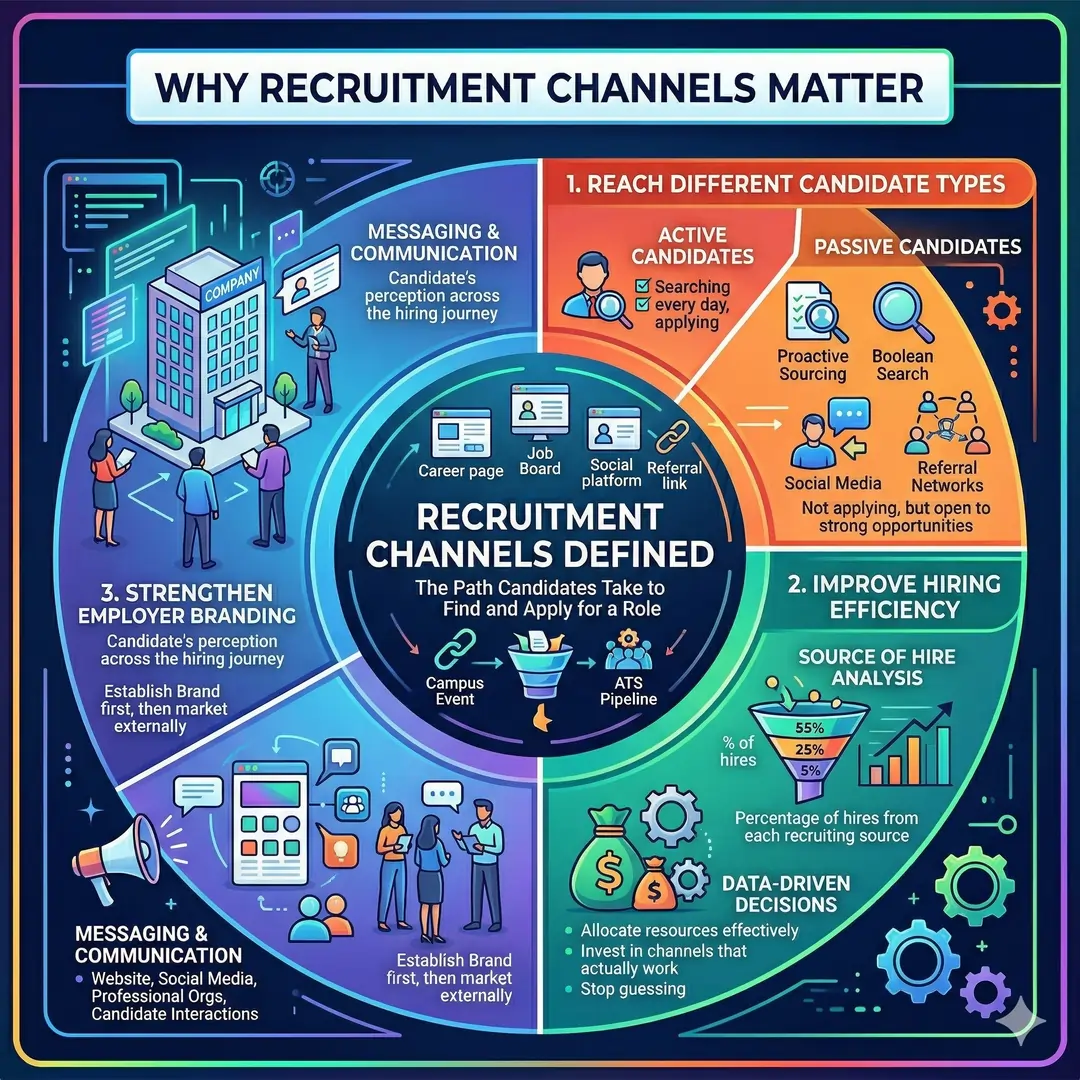
Third, it strengthens employer branding. Candidates do not just respond to a vacancy. They respond to the way your company looks, sounds, and feels across the whole hiring journey. Indeed explains that recruitment branding is shaped by the messages sent through websites, social media, professional organizations, and candidate interactions, while Greenhouse notes that the employer brand should be established before external recruitment marketing begins.
Best recruitment channels at a glance
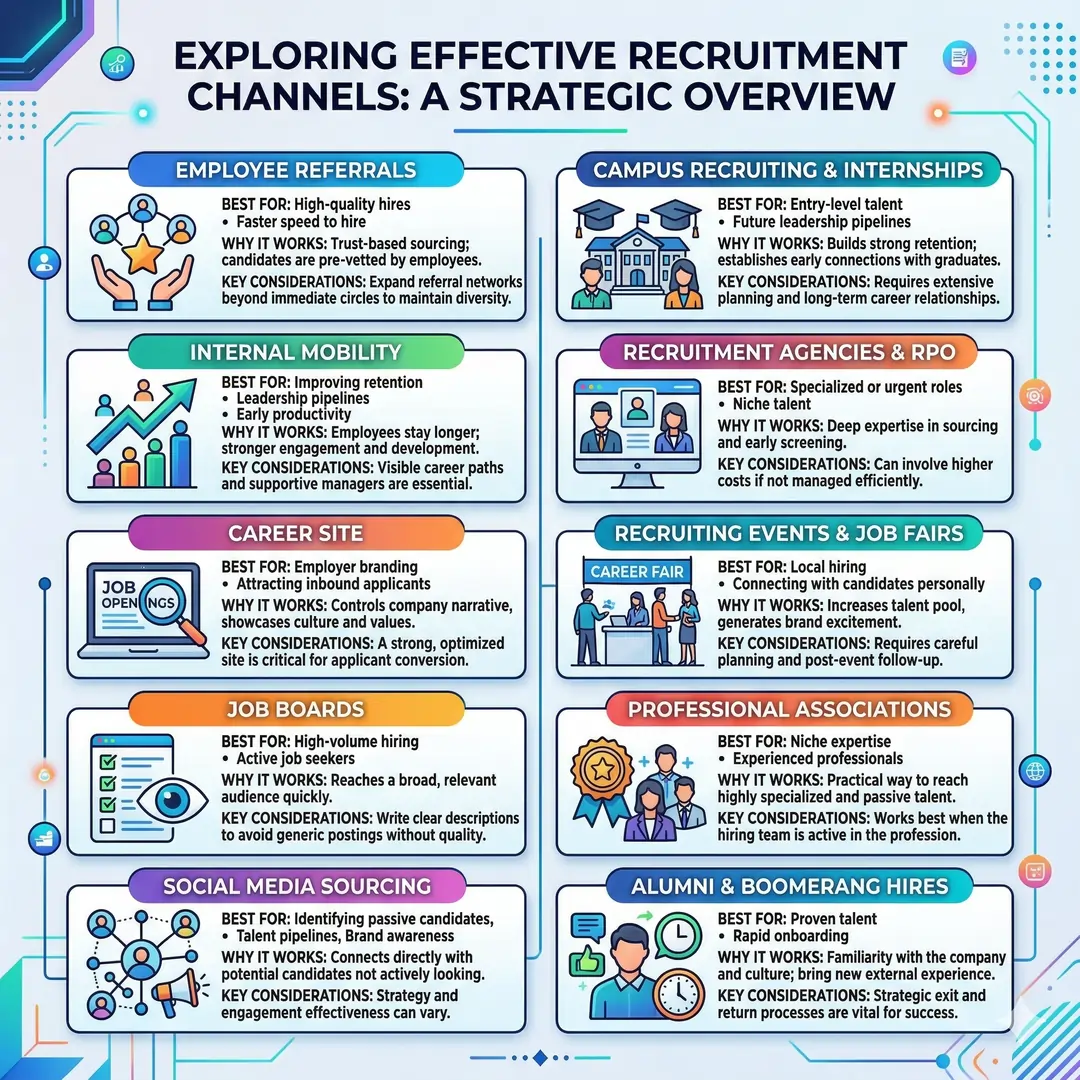
| Recruitment channel | Best for | Why it works | Watch-outs |
|---|---|---|---|
| Employee referrals | Quality hires, faster hiring, trust-based sourcing | Referred candidates are often easier to engage, can be faster to hire, and may stay longer. Referrals are also widely treated as a key source of quality hires. | Referral pools can become too similar if the program is not designed carefully. Greenhouse recommends expanding referral networks beyond immediate employee circles to improve diversity. |
| Internal mobility | Retention, leadership pipelines, faster productivity | LinkedIn says leading on internal mobility is linked to longer tenure, stronger leadership development, and greater learner engagement. SHRM also highlights the value of internal hiring for engagement and retention. | Internal mobility works best when career paths are visible and managers support movement across roles. |
| Career site | Employer branding, inbound applicants | Career sites let companies showcase culture, roles, and values in a controlled way. Workable specifically highlights branded career sites as a way to showcase culture and open positions. | A weak career site can hurt conversion, even if the job itself is strong. |
| Job boards | High-volume hiring, active job seekers | Indeed describes job posting websites as one of the most significant recruiting platforms, and Workable tracks job boards as a major source category. | Generic postings can bring volume without quality if the job description is unclear. |
| Social media | Passive candidates, brand visibility, reach | Social media sourcing helps identify, attract, engage, and hire candidates, especially people who have not applied yet. It is also useful for employer branding and talent pipelines. | SHRM notes social media is widely used, but not among the most effective recruitment strategies in its 2025 findings. |
| Campus recruiting and internships | Entry-level talent, future pipelines | NACE says internships are one of the most effective recruiting techniques and can improve retention for new college hires. NACE also stresses relationships with career services. | Campus hiring takes planning, time, and a long-term relationship approach. |
| Recruitment agencies and RPO | Specialised roles, urgent hiring, niche talent | Workable says agencies help with early stages like screening and first interviews, and SHRM describes RPO as a way to manage part or all of the recruiting process. | External support can be expensive if the role could have been filled more efficiently in-house. |
| Recruiting events and job fairs | Local hiring, employer visibility, candidate connection | Indeed says recruiting events can expand the talent pool, create excitement, and give employers a chance to meet candidates before the process goes too far. | Events take planning and follow-up. Without that, good leads go cold. |
| Professional associations | Niche expertise, experienced professionals | LinkedIn recommends professional associations, events, directories, and communities as practical ways to reach passive talent. | This channel works best when the hiring team is already active in the profession. |
| Alumni and boomerang hires | Proven talent, faster onboarding | LinkedIn recommends former employees as potential boomerang hires because they already know the company and bring fresh experience back with them. | Rehiring works best when the exit and return experience is handled respectfully and strategically. |
1. Employee referrals
If there is one channel that almost every hiring team should take seriously, it is employee referrals. Referred candidates often come with a built-in layer of trust because someone inside the company already understands both the person and the role. Indeed says referral programs can improve retention, save time, save money, and strengthen reputation. LinkedIn also identifies referrals as a key source of quality hires, especially for smaller and mid-sized businesses.
A good referral program is not just “please send us names.” It usually includes a clear incentive, an easy submission process, timely communication, and strong visibility across the company. Workable describes referral programs that use internal job boards and gamified rewards, which make participation easier and more consistent.
Here is why referrals work so well in practice:
- They often speed up the first stage of hiring because the referred person already has some context about the company.
- They can improve retention when the match between person, role, and culture is strong.
- They can turn employees into active brand ambassadors.
- They can also be used to reach passive candidates through employee networks and social sharing.
One important thought, though, is that referral systems should be designed carefully. Greenhouse warns that referral networks can become homogeneous if they only rely on immediate employee circles. A smarter approach is to widen the network through broader communities and structured incentives that encourage more inclusive referrals.
2. Internal mobility and internal hiring
Many companies search outside while forgetting the talent already inside the organization. Internal mobility means letting employees move into new roles or functions, and LinkedIn says companies that lead on internal mobility can see longer tenure, more leadership development, and stronger learner engagement. SHRM also notes that internal recruitment can increase engagement and retention while shortening time to productivity.
This channel deserves more attention because it is often the fastest way to fill important roles with people who already understand the culture, systems, and expectations. It also sends a strong message that growth is possible inside the company, which can boost morale.
A strong internal mobility strategy usually includes these pieces:
- Visible internal job postings
- Skill mapping and career path communication
- Support from managers
- Learning and development opportunities
- A fair process for comparing internal and external candidates
The biggest mistake here is treating internal hiring as an afterthought. When employees do not know which roles are open or how to grow into them, internal mobility becomes a slogan instead of a working system. LinkedIn and SHRM both point to visibility and support as critical parts of a healthy internal talent market.
3. Career site and employer branding
A company’s career site is often the first true impression a candidate gets of the employer. It is the digital front door of recruitment. Workable says branded career sites can showcase culture and open positions, while Greenhouse explains that employer brand should be established internally before it is promoted externally. Indeed also notes that companies often recruit through websites and social media, and that branding shapes how candidates perceive the company.
A strong career site does more than list jobs. It answers the question, “Why should I work here?” That means it should include:
- Clear role descriptions
- Honest values and mission
- Team stories
- Benefits and growth opportunities
- A clean application flow
- Mobile-friendly design
This channel is especially powerful because it supports all other channels. Referrals, job ads, social posts, and campus events often drive candidates back to the career site before they apply. Greenhouse notes that ATS systems often publish openings to the company’s career page and then distribute them to external boards and sourcing channels, which makes the career site a central part of the hiring ecosystem.
A useful thought for blog readers is this. A career site should not look like a file cabinet. It should feel like a story. When candidates can see real people, real work, and real growth, the site becomes a recruiting asset rather than just a job list. That aligns closely with employer branding guidance from Indeed and Greenhouse.
4. Job boards
Job boards remain one of the most practical recruitment channels because they serve people who are actively looking for work. Indeed describes professional job boards as one of the most significant recruiting platforms, and Workable treats job boards as a core source in both candidate-source and source-of-hire tracking.
Job boards are especially useful when you need volume, speed, or broad visibility. They can work well for operational roles, entry-level positions, and jobs where the labor market is wide and the job requirements are easy to communicate. Workable also notes that some ATS platforms can push listings to many boards at once, which saves time and helps teams manage performance from one place.
The biggest advantage of job boards is reach. The biggest risk is noise. A posting can attract a lot of applicants who are not truly aligned with the role, so a clear title, a sharp job description, and a good screening process matter a lot. Indeed’s guidance on recruitment branding reinforces that candidate experience and clear messaging influence whether applicants proceed.
A practical rule is simple. Use job boards for visibility, but use your screening process for precision. The board gets people in the door. Your process decides whether they are the right fit. That is exactly why source-of-hire tracking is so useful. It helps you see whether job boards are producing quality or just quantity.
5. Social media recruiting
Social media is one of the most common recruitment channels today, but that does not automatically make it the best one for every role. SHRM’s 2025 talent trends say social media is the most used recruiting strategy, yet it is absent from the list of most effective strategies in that survey. That is a very useful insight for hiring teams that assume “more posts” always means better hiring.
Still, social media is valuable because it helps with employer branding, passive candidate outreach, and talent community building. Workable defines social media sourcing as using social networks to identify, attract, engage, and hire candidates, especially those who have not applied for current openings. LinkedIn also says social media platforms can help identify and engage talent, and that passive candidates are often found through proactive sourcing methods such as social media and Boolean search.
Social recruiting is best when it is not treated like a one-way advertisement. It works better when companies:
- Share real employee stories
- Show the work culture honestly
- Post open roles consistently
- Encourage employee sharing
- Reply to interested candidates quickly
Workable also reports that many companies use social recruiting to build employer brand, save money, source by location, and improve candidate diversity. That makes social media especially useful for companies that want broader awareness, not just a quick application spike.
6. Campus recruiting and internships
For companies hiring early-career talent, campus recruiting is still one of the best channels available. NACE says employers should build relationships with career services to maximize campus recruiting efforts. NACE also calls internships one of the most effective recruiting techniques because they let employers build relationships early and judge fit before graduates enter the job market.
Internships are especially powerful because they create a long runway for hiring. A strong internship program gives employers time to evaluate performance, attitude, communication, and team fit in a real setting. NACE also notes that new college hires who completed internships are more likely to stay with the employer.
For companies, campus recruiting works best when it is consistent, not random. That means:
- Building relationships with career centers
- Sending the right people to campus
- Attending fairs and events regularly
- Running internships with meaningful work
- Following up quickly after interactions
This channel is not only for large companies. Smaller businesses can also use campuses to build future pipelines, especially when they need entry-level talent with room to grow. The key is to think long term. Campus recruiting is less about immediate pressure and more about future workforce strength.
7. Recruitment agencies and RPO
When a company needs specialised skills, urgent hiring, or support for a large hiring push, recruitment agencies and Recruitment Process Outsourcing (RPO) can be powerful options. Workable says recruitment agencies can handle early stages like resume screening, phone screens, and first interviews. SHRM describes RPO as a way to manage all or part of recruiting, from sourcing to onboarding.
This channel is especially useful when internal recruiters are overloaded or when the role is too niche to fill efficiently through broad advertising alone. Indeed also notes that recruiters can be a good choice for highly specialized qualifications because they screen potential employees and send the most qualified candidates forward.
The real value of agencies and RPO is focus. They can reduce the time your internal team spends on early-stage sorting so that hiring managers spend more time with better-matched candidates. Workable and SHRM both frame these services as tools for efficiency and process streamlining.
At the same time, companies should use these channels strategically. External support is best when it solves a real problem, not when it replaces a recruiting strategy that should have been handled internally. The smartest hiring teams treat agencies and RPO as part of a broader channel mix, not as the only answer.
8. Recruiting events and job fairs
Recruiting events, open houses, and job fairs can be a very effective way to meet candidates quickly and create a stronger sense of connection. Indeed says recruitment events can expand the talent pool, generate excitement, and give employers a chance to meet applicants before the process goes too far. It also notes that events can be lower pressure for candidates, which makes the first interaction easier.
This channel works particularly well when the company wants local visibility or when it is hiring multiple people for similar roles. It can also be especially useful for shift-based work, campus recruiting, and community hiring. Indeed recommends planning event type, timing, promotion, and staffing carefully so the event attracts the right kind of applicants.
A simple event can include:
- A company overview
- Short conversations with recruiters
- Meet-and-greet time with current employees
- Light screening or application help
- A follow-up email or interview invitation
The most important point is follow-up. Events create energy, but the energy fades fast if nobody responds. The channel is only as good as the follow-up process that supports it.
9. Professional associations and alumni networks
Two channels that are often underused are professional associations and alumni networks. LinkedIn says professional associations, events, directories, and communities can help recruiters reach passive candidates, and that company alumni can return as boomerang hires with new skills and experience.
These channels matter because they are trust-based. People who join professional communities often care deeply about their craft, which makes them valuable for specialised hiring. Alumni networks are similarly useful because former employees already know the culture and may be easier to bring back into the business at the right time.
This channel becomes even more useful when paired with strong employer branding and thoughtful outreach. LinkedIn recommends personalized outreach and notes that candidates are more likely to respond when there is already some connection to your company. That suggests a simple but powerful strategy. Stay visible in your profession even when you are not actively hiring.
How to choose the best recruitment channels
The best recruitment channel depends on the kind of role you are filling. There is no universal winner. Instead, the strongest approach is a channel mix guided by source-of-hire data and business goals. Workable says source-of-hire tracking helps companies allocate resources effectively, and Greenhouse shows that source metrics can include job boards, career pages, referrals, and social media.
Here is a simple way to think about channel selection.
| Hiring need | Best channels to start with | Why |
|---|---|---|
| Fast hiring for common roles | Job boards, referrals, recruiting events | These channels can produce volume quickly and create early candidate flow. |
| Specialized or hard-to-fill roles | Agencies, professional associations, proactive sourcing, LinkedIn | These channels help reach targeted talent pools and passive candidates. |
| Entry-level or graduate hiring | Campus recruiting, internships, career services | These channels build early relationships and support future retention. |
| Retention and succession planning | Internal mobility, boomerang hires | These channels strengthen development and reduce loss of institutional knowledge. |
| Brand-led hiring | Career site, social media, employee advocacy | These channels shape how candidates perceive the company before they apply. |
A practical strategy is to choose one primary channel, two supporting channels, and one experimental channel. For example, a company hiring software engineers might use referrals as the primary channel, LinkedIn and the career site as support, and university partnerships or events as an experiment. That keeps the process focused while still allowing learning and improvement. The logic fits well with source-of-hire tracking and broader talent acquisition guidance from Workable, LinkedIn, SHRM, and NACE.
The metrics that matter most
If you want to know whether your recruitment channels are working, you need to measure more than applications. Workable says source-of-hire tells you where hires come from, while Greenhouse explains that source metrics show where candidates enter the pipeline from and help you compare channels. That is the foundation.
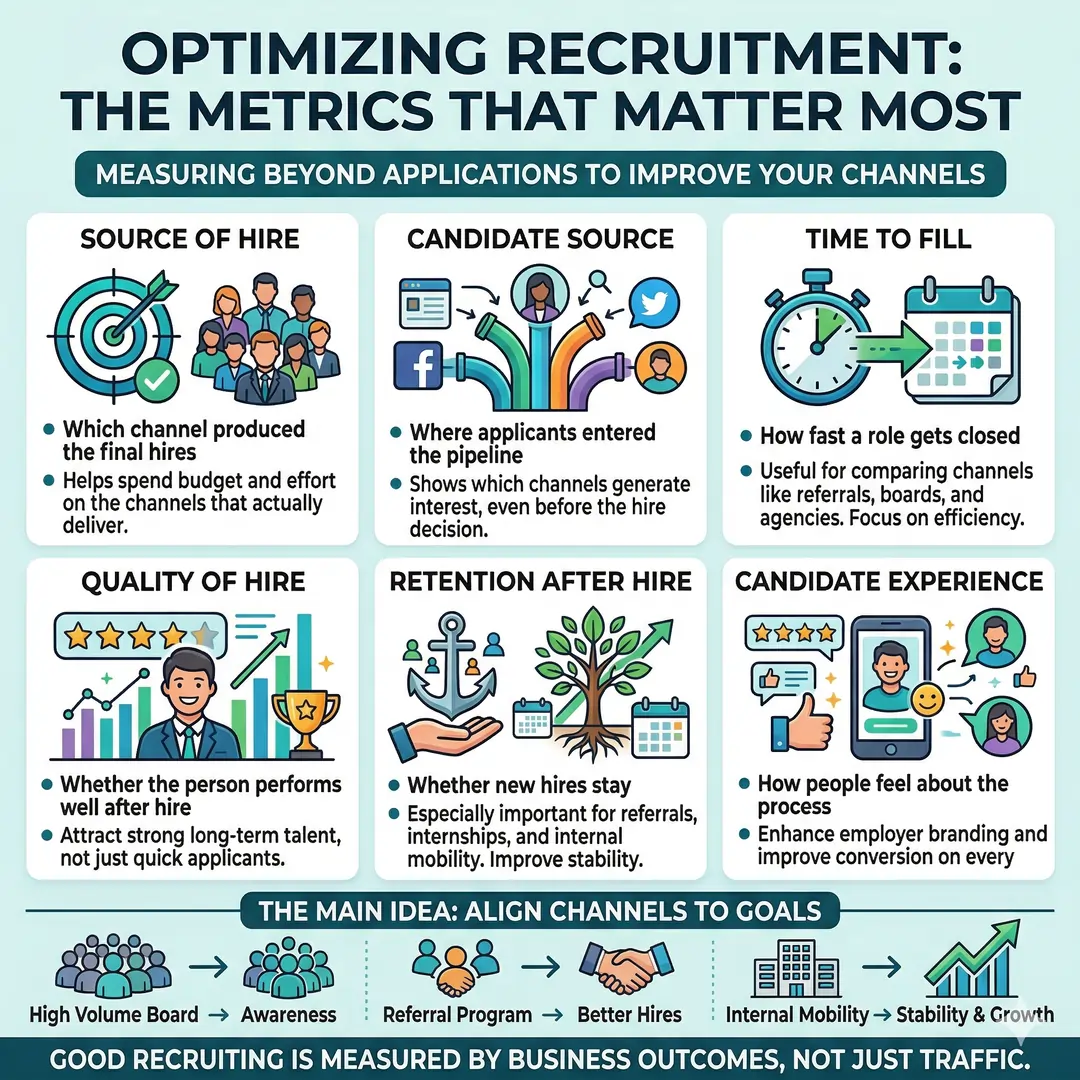
Here is a useful metrics table.
| Metric | What does it tell you | Why it matters |
|---|---|---|
| Source of hire | Which channel produced the final hires | Helps you spend your budget and effort on the channels that actually deliver. |
| Candidate source | Where applicants entered the pipeline | Shows which channels generate interest, even before the hire decision. |
| Time to fill | How fast a role gets closed | Useful for comparing channels like referrals, boards, and agencies. This aligns with the efficiency focus of agencies, internal mobility, and ATS-driven workflows. |
| Quality of hire | Whether the person performs well after hire | Helps you see whether a channel is bringing in strong long-term talent, not just quick applicants. |
| Retention after hire | Whether new hires stay | Especially important for referrals, internships, and internal mobility. |
| Candidate experience | How people feel about the process | Important for employer branding and conversion on every channel. |
The main idea is simple. A channel is only great if it fits your goal. A high-volume board may be excellent for awareness but weak for retention. A referral program may produce fewer applicants but better hires. Internal mobility may not add external reach, but it can improve stability and growth. Good recruiting is measured by business outcomes, not just traffic.
Common mistakes to avoid
Even good recruitment channels fail when the process around them is weak. A few mistakes show up again and again.
- Relying on only one channel. This limits reach and makes hiring vulnerable to market shifts. SHRM and Workable both stress the value of using multiple channels and tracking what works.
- Treating social media as a complete strategy. Social is useful, but SHRM says it is not the most effective recruiting strategy, even though it is the most used.
- Ignoring internal talent. Internal mobility can improve retention and leadership development, yet many companies overlook it.
- Using referrals without diversity safeguards. Referral programs should be designed to expand, not narrow, the talent pool.
- Failing to track the source of hire. Without data, teams end up guessing where the best candidates come from.
- Sending candidates to a weak career site. If the site is confusing or flat, it can weaken every other channel.
A smart modern recruitment mix
The most effective companies usually combine referrals, career sites, job boards, social recruiting, internal mobility, and, when needed, campus recruiting, events, and external recruiters. Greenhouse, LinkedIn, Workable, Indeed, NACE, and SHRM all point in the same broad direction. Modern recruitment works best when it is multi-channel, measurable, and aligned with the type of candidate you want to attract.
The best hiring teams think like marketers and analysts at the same time. They tell a clear story, choose channels with intention, and keep improving based on data. They do not ask only, “Where can we post this job?” They ask, “Where will the right people actually notice, trust, and respond to this opportunity?” That is the heart of a strong recruitment channel strategy.
Final thoughts
If you are building a hiring strategy from scratch, start with the channels that are most likely to bring you quality candidates fast. For many organizations, that means employee referrals, a strong career site, job boards, and a clear ATS workflow. Then add social media, internal mobility, campus recruiting, events, and professional networks where they make sense.
If you are already recruiting, the smartest next step is not adding more noise. It is measuring what actually works. Use the source of hire, compare quality and retention, and keep the channels that bring the best results. A recruitment channel is valuable only when it helps you hire the right person, at the right time, for the right role.
Read These Articles in Detail
- Importance of Recruitment Strategy
- How to Write a Job Description
- Structured Interview Techniques
- How to Improve Candidate Experience
- Employee Onboarding Process
- Recruitment Metrics and KPIs
Key Citations and Article References
- Workable. “Source of Hire: What It Is and Why It Matters.”
Available at: https://resources.workable.com/tutorial/source-of-hire - LinkedIn Talent Solutions. “Active vs Passive Candidates: What Recruiters Need to Know.”
Available at: https://www.linkedin.com/business/talent/blog/talent-acquisition/recruiting-active-vs-passive-candidates - National Association of Colleges and Employers (NACE). “Best Practices for Recruiting New College Graduates.”
Available at: https://www.naceweb.org/talent-acquisition/best-practices/best-practices-for-recruiting-new-college-graduates/ - Greenhouse. “What Is an Applicant Tracking System (ATS)?”
Available at: https://www.greenhouse.com/resources/glossary/what-is-an-applicant-tracking-system-ats - Indeed Career Guide. “Employer Recruitment: Strategies and Tips.”
Available at: https://www.indeed.com/career-advice/finding-a-job/employer-recruitment - LinkedIn Talent Solutions. “How Internal Mobility Benefits Employers.”
Available at: https://www.linkedin.com/business/talent/blog/talent-acquisition/how-internal-mobility-benefits-employers - Society for Human Resource Management (SHRM). “Encouraging Internal Mobility to Retain Top Talent.”
Available at: https://www.shrm.org/topics-tools/news/talent-acquisition/staples-encourages-internal-mobility-to-retain-top-talent - Indeed Hiring Resources. “How to Create an Effective Employee Referral Program.”
Available at: https://www.indeed.com/hire/c/info/5-ways-to-create-an-effective-employee-referral-program - Greenhouse. “Improving Diversity in Recruiting Through Better Referral Strategies.”
Available at: https://www.greenhouse.com/guidance/dei-tech-stack-improve-recruiting - Workable. “Social Media Recruiting: Strategy and Best Practices.”
Available at: https://resources.workable.com/tutorial/faq-social-media-recruitment-strategy - Society for Human Resource Management (SHRM). “2025 Talent Trends: Recruiting Strategies.”
Available at: https://www.shrm.org/topics-tools/research/2025-talent-trends/recruiting-strategies - Workable. “Recruiting Methods: What Works Best for Hiring.”
Available at: https://resources.workable.com/tutorial/faq-recruiting-methods - Indeed Hiring Resources. “How to Run Successful Recruiting Events.”
Available at: https://www.indeed.com/hire/c/info/running-recruiting-events - LinkedIn Talent Solutions. “How to Recruit Passive Candidates.”
Available at: https://www.linkedin.com/business/talent/blog/talent-acquisition/how-to-recruit-passive-candidates - Workable. “Candidate Source vs Source of Hire Explained.”
Available at: https://resources.workable.com/hiring-with-workable/recruitment-source-candidates - Greenhouse. “Recruiting Metrics: The Ultimate List That Matters.”
Available at: https://www.greenhouse.com/guidance/recruiting-metrics-abcs-the-ultimate-list-of-the-recruiting-metrics-that-matter - Greenhouse. “Employer Branding in Recruitment: A Practical Guide.”
Available at: https://www.greenhouse.com/guidance/the-recruiters-cheat-sheet-for-employer-branding-in-recruitment - Workable. Official Website – Hiring Software and Recruitment Solutions.
Available at: https://www.workable.com/ - SHRM Vendor Directory. “Recruitment Process Outsourcing (RPO) Overview.”
Available at: https://vendordirectory.shrm.org/category/consulting-hr/recruitment-process-outsourcing-rpo
Frequently Asked Questions (FAQs)
FAQ 1: What are the best recruitment channels for hiring good candidates?
The best recruitment channels are the ones that help you reach the right people for the right job at the right time. In most cases, the strongest hiring strategy does not depend on only one channel. It combines several sources such as employee referrals, job boards, career sites, social media, internal hiring, campus recruiting, and recruitment agencies. Each channel serves a different purpose, so the best choice depends on the role you are hiring for, the level of urgency, and the kind of talent you want to attract.
For example, employee referrals are often very effective when you want quality candidates who may fit the company culture well. Job boards are useful when you need a larger number of applicants quickly. Social media recruiting can help you reach both active and passive candidates, while internal mobility is useful when you want to fill a role with someone who already understands the business. A smart hiring team usually uses a mix of these channels instead of relying on just one.
The most important idea is that the “best” recruitment channel is not always the most popular one. It is the channel that gives you the strongest results for your hiring goals. That is why good recruiters study source of hire, candidate quality, and retention before deciding where to spend time and money.
FAQ 2: Why is it important to use multiple recruitment channels?
Using multiple recruitment channels is important because every channel reaches a different kind of candidate. Some people are actively looking for jobs and checking job boards every day. Others are not applying anywhere but may still be open to a good opportunity if they see it through social media, a referral, or a professional network. When you use more than one channel, you increase your chances of finding skilled people who may otherwise never see your opening.
Another reason to use multiple channels is risk reduction. If you depend too much on one source, your hiring can become slow or weak when that source stops working well. For example, if one job board stops bringing quality applicants, your hiring pipeline may suffer. But if you also have referrals, a strong career page, and internal candidates, you are much less likely to face gaps in hiring.
A multi-channel strategy also improves the overall candidate experience. Different people prefer different ways of discovering jobs, and a broad recruitment approach makes your company easier to find. It also helps build a stronger employer brand because candidates see your company in several places, not just in one job post. Over time, this creates more trust and better visibility.
FAQ 3: How do employee referrals help in recruitment?
Employee referrals are one of the most trusted recruitment channels because they come from people who already know your company. When an employee recommends someone, there is often already some level of trust, understanding, and connection. This can make the hiring process faster and more efficient, especially when you are looking for dependable people who are likely to fit in well.
Referral hiring often leads to stronger matches because employees usually suggest people they believe will do well in the role and adapt to the workplace. It can also improve retention, since referred candidates may come in with a better understanding of the company culture and expectations. In many organizations, referral hires also move through the early stages of hiring more smoothly because they are already somewhat familiar with the company through the referring employee.
Still, referrals should be managed carefully. A strong referral program should be easy to use, fair, and open to a wide range of people. If not handled properly, it can become too narrow and limit diversity. A thoughtful program encourages employees to recommend qualified people from different backgrounds and networks so the company can benefit from both trust and variety in talent.
FAQ 4: Are job boards still effective for hiring today?
Yes, job boards are still very effective, especially when you need to reach active job seekers. Many candidates still search these platforms when they are ready to apply for new roles. For businesses that need to hire quickly, job boards can bring in a large number of applicants in a short time. This makes them especially useful for entry-level roles, general hiring, and positions with broad appeal.
Job boards also work well because they make jobs easy to find. A candidate can search by title, location, salary, and other filters, which makes the process simple and direct. For employers, this can mean more visibility and a wider talent pool. When a job description is clear and the title is accurate, job boards can become a steady source of candidates.
The challenge is that job boards often bring quantity as well as variety. That means not every applicant will be a perfect fit. A company may receive many resumes, but some may not match the requirements well. That is why it is important to combine job boards with strong screening, a clear job description, and other channels such as referrals or a career site to improve the quality of applications.
FAQ 5: How does social media recruiting work?
Social media recruiting works by using platforms where people already spend time online to promote jobs, share employer content, and connect with candidates. It is useful for both active candidates and passive candidates. Active candidates may notice a post and apply right away, while passive candidates may first become interested in your company after seeing your content several times.
This channel is powerful because it supports both hiring and branding. A company can post open roles, highlight employee stories, show workplace culture, and build trust with future applicants. Social media also makes it easier to reach people by interests, communities, industries, and locations. That gives hiring teams a flexible way to promote opportunities and build awareness over time.
However, social media recruiting works best when it is consistent and real. People respond better to honest content than to polished but empty messages. Sharing the voices of current employees, showing team moments, and explaining the role clearly can make a big difference. Social media should be seen as a long-term relationship tool, not just a place to post job ads.
FAQ 6: Why is internal hiring important for a recruitment strategy?
Internal hiring is important because it allows companies to fill roles with people who already know the organization. These employees understand the culture, systems, and expectations, which often means they can become productive more quickly than a new external hire. Internal hiring can also improve employee morale because it shows that growth is possible inside the company.
Another major benefit of internal mobility is retention. When employees see clear career paths and know that they can move into new roles, they are more likely to stay engaged and committed. This can help reduce turnover and strengthen leadership pipelines over time. It also creates a culture of learning, where employees feel encouraged to develop new skills and take on new challenges.
Internal hiring is especially valuable for businesses that want to grow without losing stability. It can support succession planning, faster onboarding, and better knowledge sharing. At the same time, it should be handled fairly so that employees and external candidates both feel the process is transparent and professional. A strong internal hiring system works best when career opportunities are visible, and managers support movement across teams.
FAQ 7: When should a company use recruitment agencies or RPO?
A company should consider recruitment agencies or Recruitment Process Outsourcing (RPO) when it needs extra hiring support, specialised knowledge, or faster results. These options are useful when the internal recruiting team is overloaded, when the role is hard to fill, or when the company needs to scale hiring quickly. They can also be helpful for niche positions that require a focused search strategy.
Recruitment agencies often take on early parts of the process, such as sourcing, screening, and shortlisting candidates. This saves time for the internal team and allows hiring managers to focus on the strongest applicants. RPO can go even further by managing part or all of the hiring process, which can be helpful for companies with large or ongoing recruitment needs.
These channels are not the right answer for every role, but they can be highly valuable when used at the right time. The key is to treat them as part of a larger hiring plan. A company should still track the source of hire, candidate quality, and hiring outcomes to make sure the external support is truly adding value.
FAQ 8: How can campus recruiting help attract early-career talent?
Campus recruiting is one of the best ways to attract students and recent graduates who are just starting their careers. This channel helps companies build relationships early, before candidates enter the general job market. It is especially useful when a business wants to create a strong pipeline of future employees who are eager to learn and grow.
Internships are a major part of campus recruiting. They give companies a chance to see how students work in a real environment and help students understand the company from the inside. A good internship program often leads to better hiring decisions later because both the employer and the candidate already have some experience working together. That makes the transition into a full-time role smoother.
Campus recruiting also helps employers build long-term brand awareness among younger talent. By working with colleges, attending events, and creating meaningful internship experiences, companies can become more familiar and trusted by future candidates. This channel may take time to show results, but it can be very powerful for building a lasting talent pipeline.
FAQ 9: What is the source of hire, and why does it matter?
Source of hire means identifying which recruitment channel brought in the person who was actually hired. It is one of the most useful metrics in hiring because it helps companies understand which channels produce real results. A company may get many applicants from different places, but the source of hire shows which channel actually led to a successful hire.
This matters because it helps teams make smarter decisions about hiring time, budget, and effort. If employee referrals are bringing in the best candidates, the company may want to invest more in that program. If job boards are producing many applicants but few strong hires, the team may need to improve job descriptions or shift some budget elsewhere. Without this data, hiring decisions are often based on guesswork.
Tracking the source of hire also helps improve the long-term recruitment strategy. Over time, companies can see patterns in which channels lead to better performance, stronger retention, and faster hiring. That makes the whole process more efficient and more strategic. It turns recruitment from a reactive task into a data-driven business function.
FAQ 10: What is the best way to choose the right recruitment channel for a job opening?
The best way to choose a recruitment channel is to start with the role itself. Ask what kind of person you need, how quickly you need to hire, and where that kind of candidate is most likely to be found. A technical role may require specialist sourcing, professional networks, or recruitment agencies, while a general position may do well through job boards, referrals, and a strong career site.
It also helps to think about candidate behavior. Active job seekers are more likely to respond to job boards and application links. Passive candidates may respond better to direct outreach, social media, referrals, or professional communities. Entry-level candidates may be easier to reach through campuses and internships, while current employees may be the best fit for internal openings.
The strongest strategy is usually a balanced one. Start with a main channel that fits the role, then support it with a few additional channels to widen the pool. After that, measure the results using source of hire, candidate quality, and retention. That way, each hiring decision becomes smarter than the last, and your recruitment strategy keeps improving over time.
