Structured interview techniques are one of the most practical ways to make hiring more consistent, fair, and predictive of real job performance. In a structured interview, every candidate is asked the same core questions in the same order, and their answers are scored with a clear rating system. That simple shift changes the whole quality of the hiring process because it reduces guesswork and keeps interviewers focused on job-related evidence rather than instinct alone. Official guidance from the U.S. Office of Personnel Management (OPM), the CIPD, and Google’s hiring resources all point in the same direction. Structured interviews improve consistency, support better comparisons between candidates, and help reduce bias.
At a time when organizations want to hire people who can truly perform well, not just people who interview well, structured interview techniques matter more than ever. Research has repeatedly found that structured interviews are more reliable and valid than unstructured interviews, and that interview quality improves when questions, scoring, and interviewer behavior are standardized. In simple terms, when every candidate is measured with the same yardstick, hiring decisions become easier to defend and easier to trust.
Table of Contents
What Is a Structured Interview?
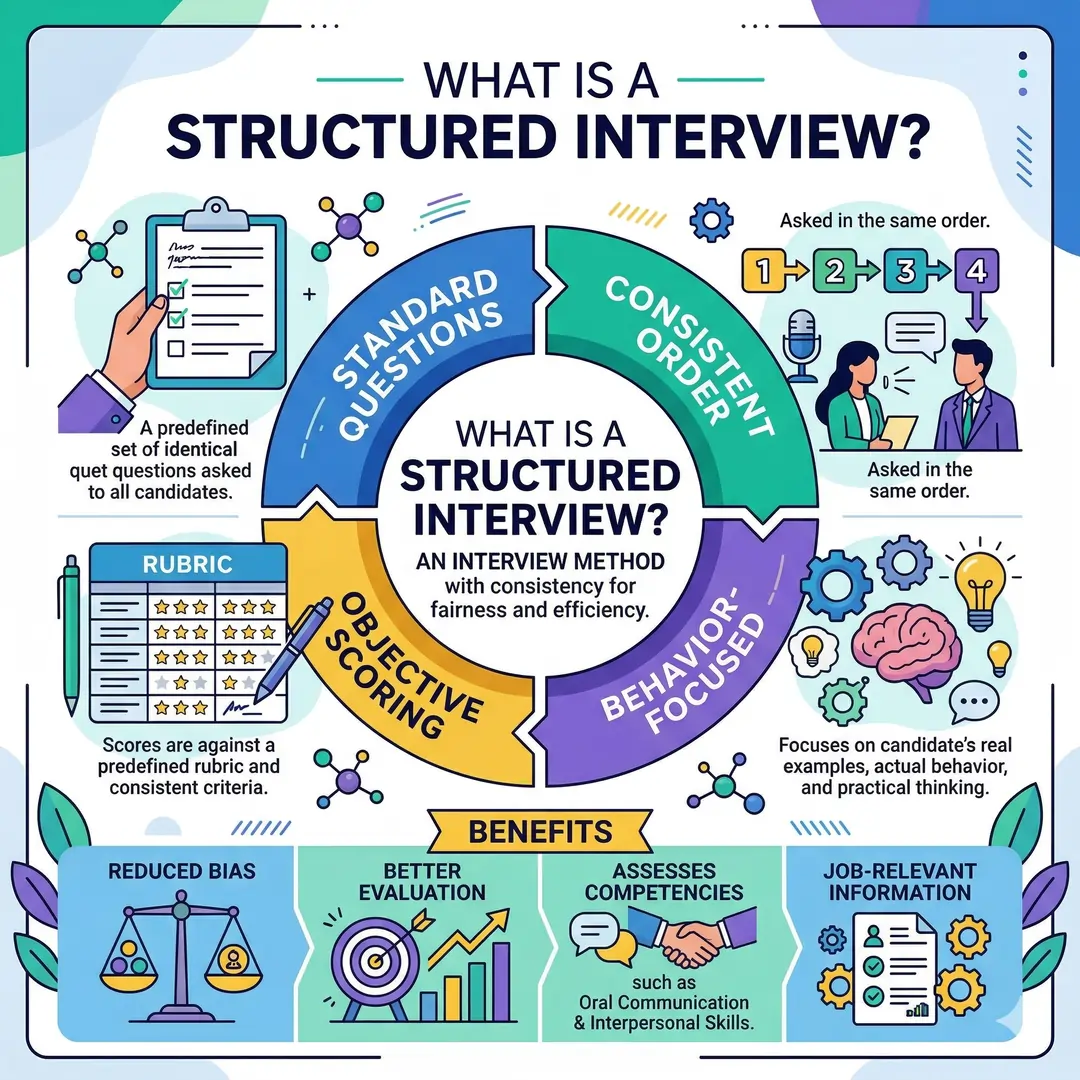
A structured interview is an interview method where the employer prepares a defined set of questions, asks them in a consistent way, and scores answers against a predefined rubric. OPM describes structured interviews as interviews that use rules for eliciting, observing, and evaluating responses. The same questions are asked in the same order, and responses are rated using the same standards. The CIPD similarly explains that structured interviews ask all candidates the same questions in the same order and score answers using consistent criteria. Google’s hiring guidance also describes structured interviewing as a process where candidates get a consistent set of questions and are assessed using clear criteria.
Also, Read this in Detail: How to Write a Job Description
This may sound formal, but it is actually very human-friendly once it is set up well. It lets interviewers focus on the candidate’s real examples, actual behavior, and practical thinking instead of drifting into casual conversation that may favor confident speakers over strong performers. OPM’s guide notes that structured interviews are especially useful for evaluating competencies that are difficult to measure in other ways, such as oral communication and interpersonal skills.
Why Structured Interview Techniques Matter
The biggest reason organizations use structured interviews is that they lead to better hiring decisions. OPM notes that unstructured interviews tend to have low reliability and low to moderate validity, while structured interviews improve agreement among interviewers by limiting discretion. Research summaries and meta-analytic findings have long shown that structured interviews outperform unstructured ones in both validity and fairness.
There is also a strong fairness argument. The CIPD says structured interviews help minimize bias and create a level playing field for candidates from marginalized groups. Google’s guidance warns that interviewers can fall into confirmation bias, where first impressions shape the rest of the conversation. Structured interviewing is designed to reduce that problem by keeping the conversation anchored to the role and the scoring rubric.
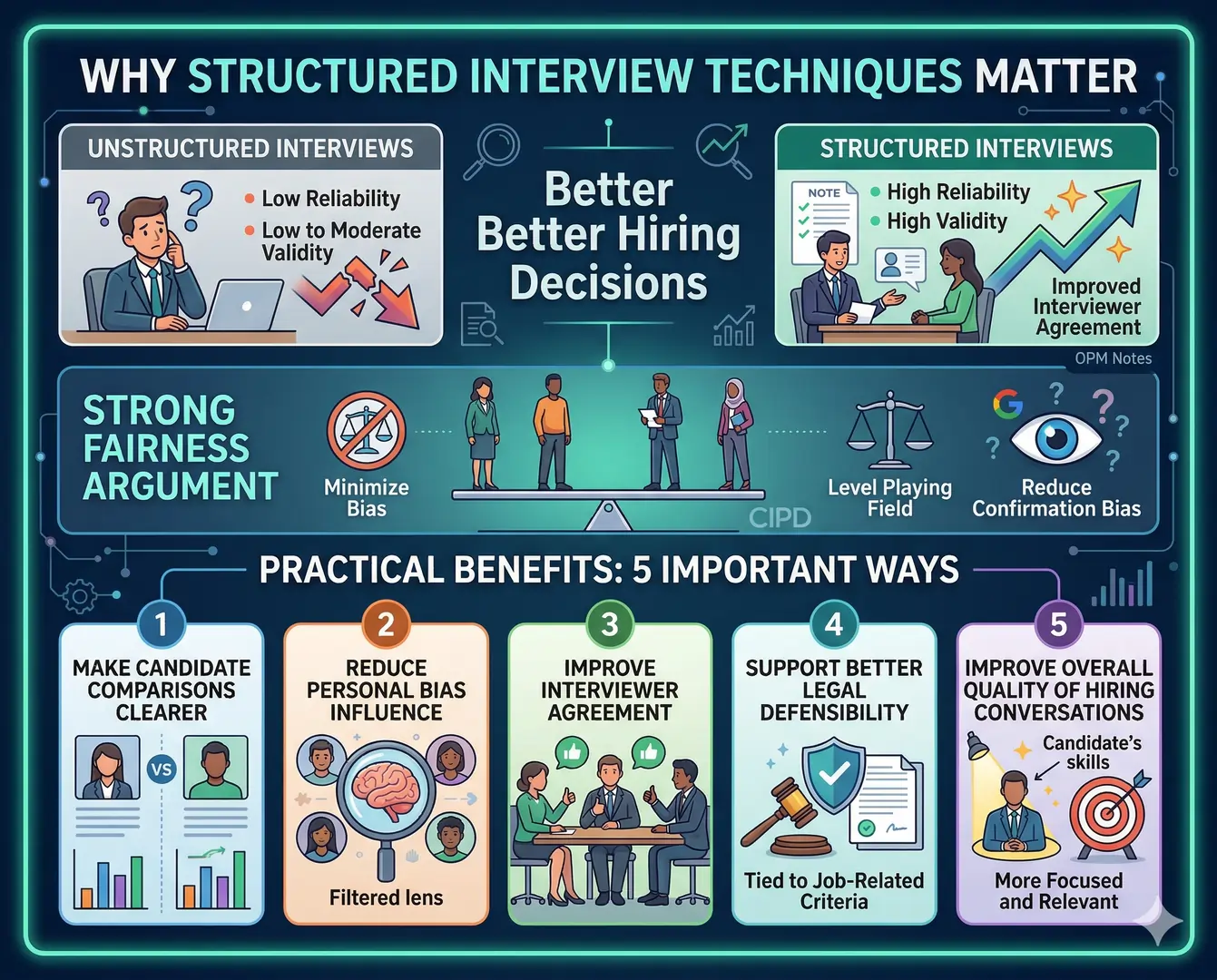
In practical terms, structured interview techniques help organizations in five important ways:
- They make candidate comparisons clearer.
- They reduce the influence of personal bias.
- They improve interviewer agreement.
- They support better legal defensibility because decisions are tied to job-related criteria.
- They improve the overall quality of hiring conversations by making them more focused and relevant.
The Core Principles of Structured Interview Techniques
A strong structured interview does not happen by accident. It is built on a few essential principles that make the process fair and effective. OPM’s guide lays out a clear process that begins with job analysis, followed by identifying competencies, choosing the interview format, creating rating scales, writing probes, pilot testing questions, and documenting the whole process.
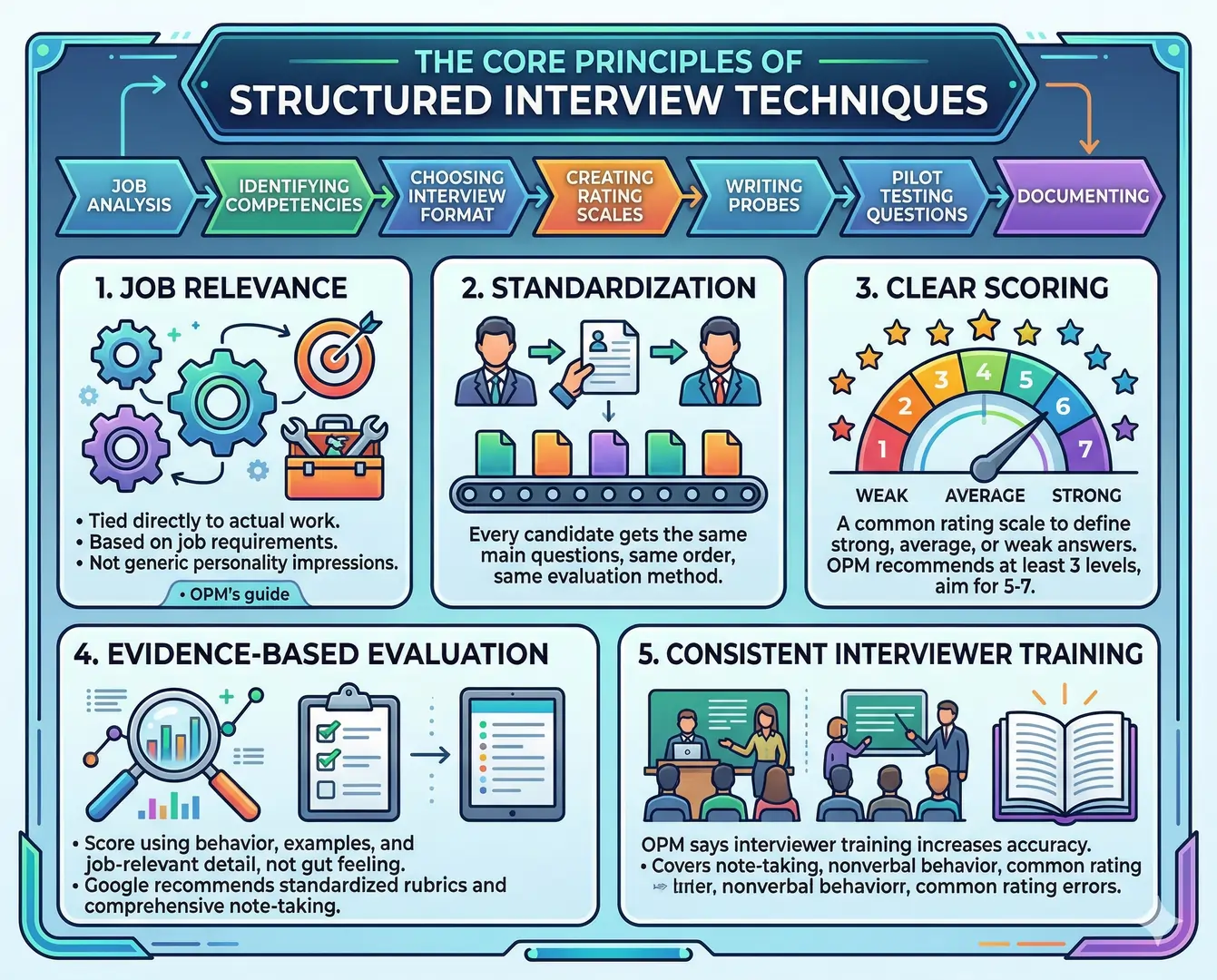
The core principles are:
1. Job relevance
Questions should be tied directly to the actual work. OPM says the interview should be based on the requirements of the job, not generic personality impressions.
2. Standardization
Every candidate should get the same main questions, the same order, and the same evaluation method.
3. Clear scoring
A common rating scale should be used so interviewers know what a strong, average, or weak answer looks like. OPM recommends at least three rating levels and suggests aiming for five to seven.
4. Evidence-based evaluation
Interviewers should score answers using behavior, examples, and job-relevant detail, not gut feeling. Google recommends standardized rubrics and comprehensive note-taking for this reason.
5. Consistent interviewer training
OPM says interviewer training increases accuracy. Training should cover note-taking, nonverbal behavior, and common rating errors.
Also, Read this in Detail: Importance of Recruitment Strategy
Structured Interview vs Unstructured Interview
The difference between structured and unstructured interviews is bigger than many employers realize. OPM explains that structured interviews use the same questions and common rating scales, while unstructured interviews may vary from candidate to candidate and may not use standardized scoring. OPM also warns that unstructured interviews are highly subjective and can invite legal challenges.
Table 1. Structured Interview vs Unstructured Interview
| Feature | Structured Interview | Unstructured Interview | Practical impact |
|---|---|---|---|
| Questions | Same main questions for all candidates | Questions may vary | Structured interviews make comparisons fairer. |
| Order | Same order | Flexible order | Consistency improves reliability. |
| Scoring | Standard rating scale | Often informal judgment | Standard scoring improves objectivity. |
| Bias risk | Lower | Higher | Structure helps reduce confirmation bias. |
| Interviewer agreement | Higher | Lower | OPM says structure increases agreement. |
| Legal defensibility | Stronger | Weaker | OPM notes that unstructured interviews can be more vulnerable to legal challenge. |
| Candidate experience | More consistent | Can feel uneven | Google reports structured interviews are often perceived as fairer. |
Main Types of Structured Interview Questions
OPM explains that structured interviews can be built around past behavior, hypothetical situations, or a combination of both. The guide names these as the behavioral description interview and the situational interview. Research also identifies other common structured question types, such as background and job knowledge questions.
Table 2. Types of Structured Interview Questions
| Question type | What it asks | Best used for | Example | Source basis |
|---|---|---|---|---|
| Behavioral | What the candidate did in a real past situation | Communication, teamwork, problem-solving, leadership | “Tell me about a time you handled a difficult stakeholder.” | OPM and structured interview research. |
| Situational | What the candidate would do in a future scenario | Judgment, decision making, customer handling | “A client is angry about a missing payment. What would you do?” | OPM guide. |
| Background | Experience-based details about roles, tasks, or exposure | Career depth, role fit, domain exposure | “What type of budgets have you managed?” | Research on structured interview question types. |
| Job knowledge | Knowledge tied directly to the role | Technical roles and specialist positions | “How would you inspect a safety issue in this process?” | Research on structured interview question types. |
A helpful detail from the research is that background, situational, and past behavioral questions have all shown predictive value for job performance in real hiring contexts. That means structured interviewing should not be limited to one style only. A well-designed interview can mix question types, as long as the format stays standardized.
How to Build a Structured Interview Step by Step
OPM’s guide gives a practical eight-step process for building a structured interview. That sequence is especially useful for employers who want a repeatable system rather than a one-off conversation.
Table 3. Eight-Step Process for Building a Structured Interview
| Step | What to do | Why it matters |
|---|---|---|
| 1. Conduct job analysis | Identify the real requirements of the job. | Questions must reflect actual work, not assumptions. |
| 2. Select competencies | Decide which competencies will be assessed in the interview. | Keeps the interview focused on the most important traits. |
| 3. Choose the format | Decide whether to use behavioral, situational, or mixed questions. | Different formats measure different aspects of performance. |
| 4. Develop questions | Write questions linked to the competencies. | Makes the interview job-related. |
| 5. Create rating scales | Build a scoring system with clear standards. | Supports fairness and consistency. |
| 6. Write probes | Prepare follow-up prompts that stay consistent across candidates. | Helps get complete answers without changing the meaning of the question. |
| 7. Pilot test | Try the questions before using them live. | Reveals unclear wording and weak questions. |
| 8. Document everything | Keep records of development, scoring, and training. | Supports accountability and defensibility. |
This process may sound formal, but it is one of the easiest ways to turn interviewing into a repeatable hiring tool. The more clearly the job is analyzed, the easier it becomes to create questions that truly predict whether a person can do the work.
How to Write Strong Structured Interview Questions
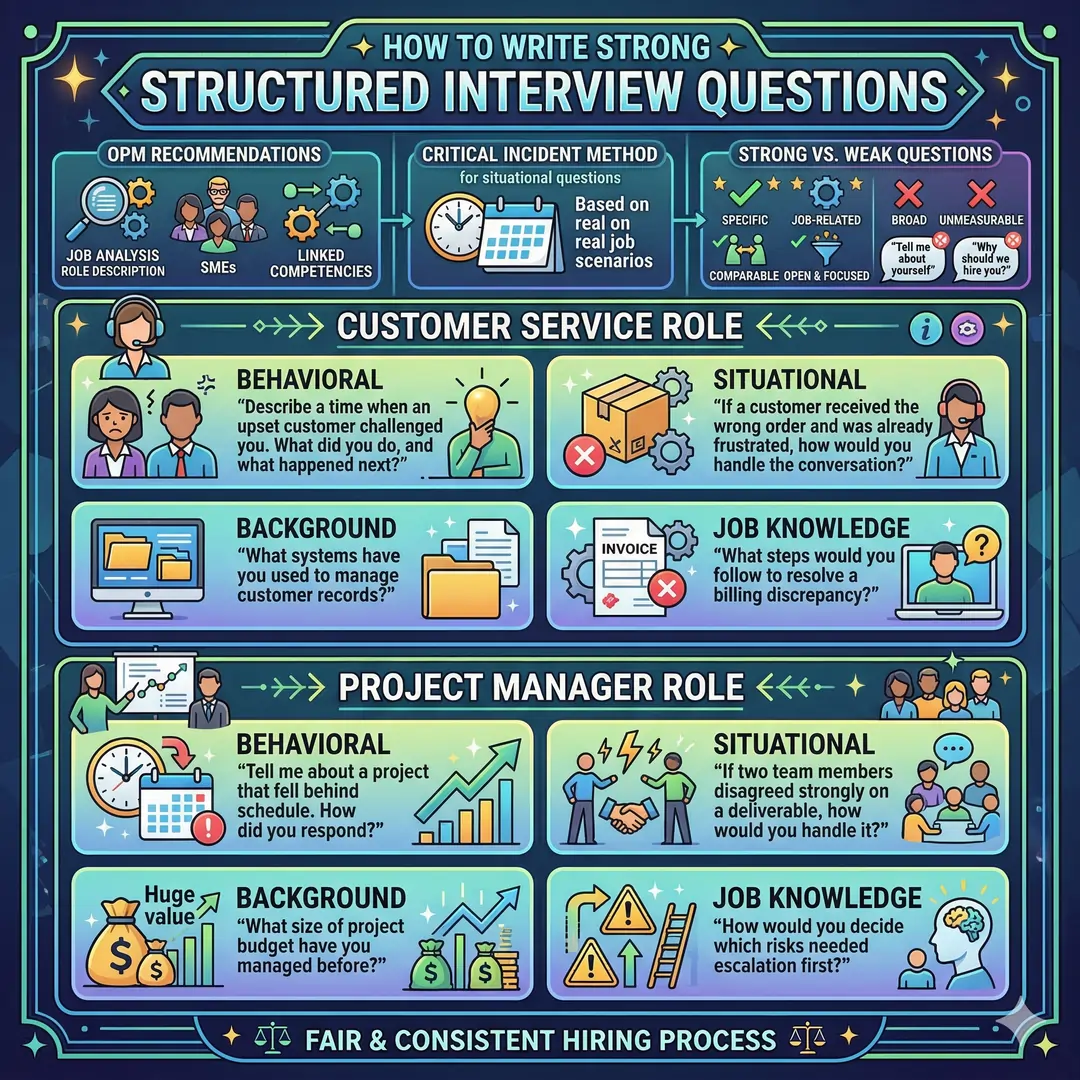
The quality of the questions determines the quality of the interview. OPM recommends using job analysis and subject matter experts to create questions that are closely linked to the competencies being measured. For situational questions, the guide suggests using the critical incident method, which relies on real job-related situations.
Good structured interview questions are:
- Specific, not vague.
- Job-related, not personality-based.
- Comparable, so they work across candidates.
- Open enough to reveal thinking, but focused enough to score fairly.
Weak questions usually sound broad and unmeasurable, such as “Tell me about yourself” or “Why should we hire you?” Those questions may feel friendly, but they do not consistently reveal the competencies that matter most. Research and official guidance both emphasize that structured interviewing works best when the questions are designed to elicit evidence tied to the role.
Examples of Better Structured Questions
For a customer service role, you might ask:
- Behavioral: “Describe a time when an upset customer challenged you. What did you do, and what happened next?”
- Situational: “If a customer received the wrong order and was already frustrated, how would you handle the conversation?”
- Background: “What systems have you used to manage customer records?”
- Job knowledge: “What steps would you follow to resolve a billing discrepancy?”
For a project manager role, you might ask:
- “Tell me about a project that fell behind schedule. How did you respond?”
- “If two team members disagreed strongly on a deliverable, how would you handle it?”
- “What size of project budget have you managed before?”
- “How would you decide which risks needed escalation first?”
Scoring Structured Interviews the Right Way
A structured interview is only as strong as its scoring rubric. OPM says a common rating scale is a key component of the process. The guide recommends at least three proficiency levels, though five to seven is better, and it encourages clear labels such as unsatisfactory, satisfactory, and superior.
A scorecard should define what good evidence looks like for each question. Google also recommends standardized rubrics so all reviewers share the same understanding of a strong, mediocre, or weak answer. The CIPD adds that interviewers should score independently before group discussion to reduce influence from more senior panel members.
Table 4. Example Interview Scorecard for One Competency
| Score | What the answer sounds like | Example indicators |
|---|---|---|
| 5, Excellent | Clear, detailed, highly relevant, and strongly job-related | Gives a specific example, explains actions, shows judgment, and describes measurable results. |
| 4, Strong | Good example with minor gaps | Shows solid competency, though the outcome or reasoning may not be fully developed. |
| 3, Acceptable | Adequate but not outstanding | Answers the question and shows some relevant behavior, but the evidence is limited. |
| 2, Weak | Partial or unclear evidence | Example is vague, indirect, or only loosely connected to the competency. |
| 1, Poor | Little useful evidence | The response does not address the competency or lacks a real example. |
A well-built scorecard turns hiring into a more thoughtful decision process. Instead of saying, “I just liked this candidate,” the panel can say, “This candidate scored higher because they gave better evidence of the exact competency we needed.” That is a much stronger hiring habit.
What Makes Structured Interview Techniques More Reliable
Research consistently shows that structured interviews are more reliable and valid than unstructured interviews. OPM explains that structure increases agreement on overall evaluations because interviewer discretion is limited. The PMC article cited here also notes that structured interviews are among the most consistent findings in the interview literature.
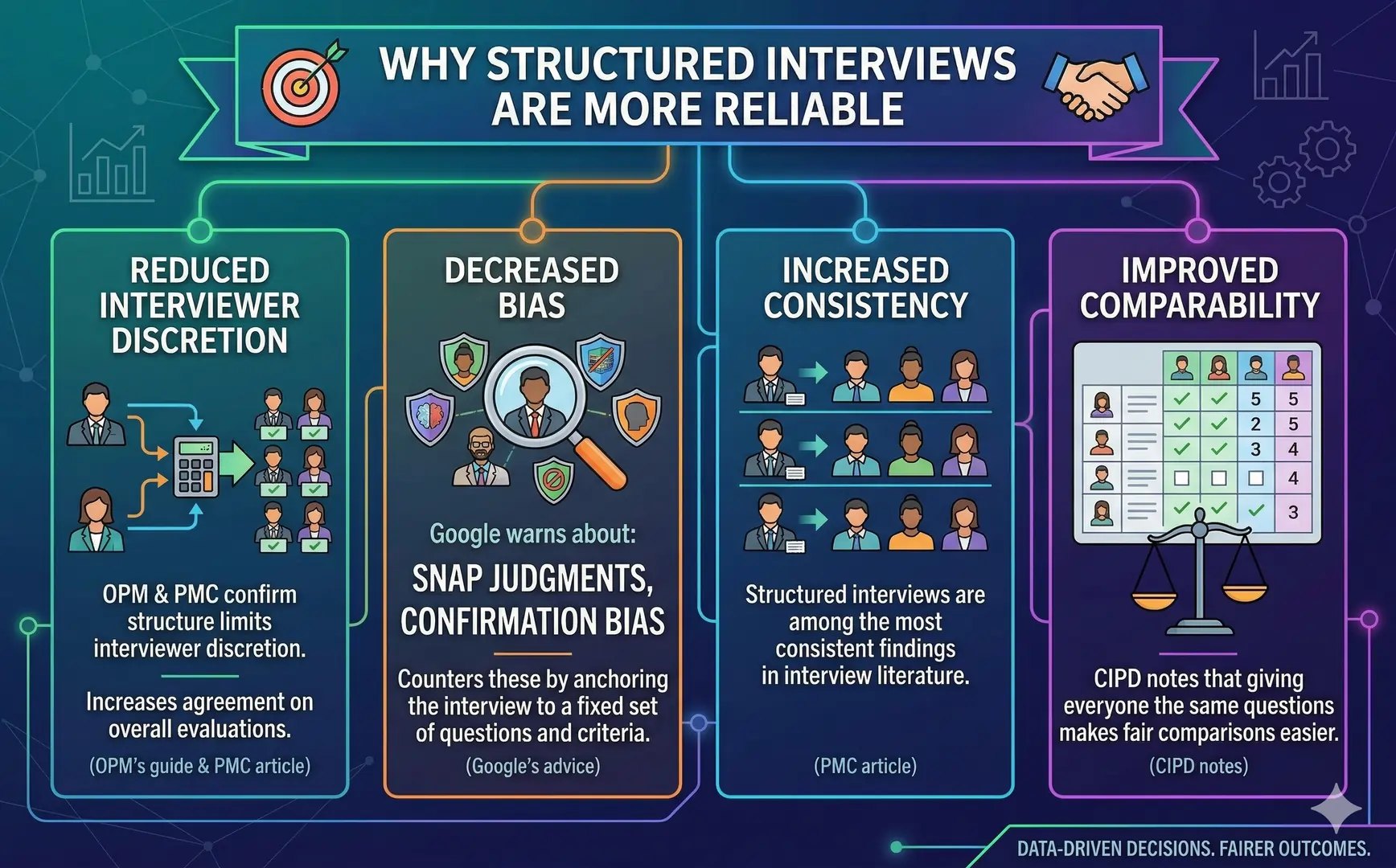
A major reason is that structured interviews reduce the influence of irrelevant factors. Google warns about snap judgments and confirmation bias, which can happen when interviewers trust their first impression too much. Structured interviews help counter that by anchoring the interview to a fixed set of questions and criteria.
Another reason is comparability. When every person gets the same questions, interviewers can compare answers directly. The CIPD notes that this makes direct and fair comparisons easier and reduces the chance that a decision is based on personal bias.
There is also evidence that structured interviews can perform well across multiple question formats. A study in the Journal of Business and Psychology found that background, situational, and past behavioral questions predicted job performance. That suggests the format is not about forcing all questions into one mold. It is about using the right structure for the right competency.
How Panel Interviews Fit Into Structured Interview Techniques
A panel interview can be an excellent companion to a structured interview when it is managed carefully. The CIPD recommends panel interviews as part of a well-structured process and says multiple interviewers can lead to fairer and more accurate results than multiple interviews conducted by a single interviewer. OPM also notes that panel interviews can reduce bias and improve documentation and interpretation.
A good panel interview should still be structured. That means:
- The panel uses the same questions for each candidate.
- Each panelist takes notes independently.
- Scoring happens independently before discussion.
- Final ratings are based on evidence, not the loudest opinion in the room.
This matters because panels can easily become overly social or overly hierarchical if they are not disciplined. A structured panel keeps the benefits of multiple viewpoints without letting the process become chaotic.
Common Mistakes to Avoid
Even a good structure can be weakened by poor execution. OPM lists several common interview mistakes, including relying on first impressions. Google also highlights the danger of confirmation bias, and the CIPD warns against letting candidate comparisons become subjective rather than criteria-based.
Table 5. Common Mistakes and Better Alternatives
| Common mistake | Why does it hurt hiring | Better alternative |
|---|---|---|
| Asking different questions to different candidates | Makes comparisons unfair and inconsistent. | Use the same core questions in the same order. |
| Relying on first impressions | Let’s bias shape the rest of the interview. | Score each answer against a rubric. |
| Using vague questions | Produces vague answers that are hard to compare. | Ask job-specific behavioral or situational questions. |
| Changing probes from candidate to candidate | Changes the level of support and makes responses less comparable. | Prepare similar probes in advance. |
| Discussing candidates before individual scoring | Increases group influence and bias. | Score independently first, then discuss. |
| Skipping documentation | Weakens accountability and consistency. | Keep interview questions, scores, notes, and training records. |
Avoiding these errors can make a dramatic difference. Many hiring problems are not caused by bad intentions. They are caused by a weak process. Structured interview techniques fix the process first, which gives good hiring habits a better chance to succeed.
Best Practices for Interviewers
Interviewers need more than a question sheet. They need a clear method. OPM says interviewer training is essential and should cover note-taking, nonverbal behavior, and common rating errors. Google similarly recommends interviewer training and calibration. The CIPD also emphasizes that interviewers should be briefed about the job and its requirements.
Best practices to follow
- Read the job analysis before the interview.
- Use the same opening script for every candidate.
- Take notes during the interview and rate immediately afterward.
- Keep probes consistent and job-related.
- Score each competency separately before combining ratings.
- Review the rubric before every hiring cycle so everyone uses the same standards.
These habits sound small, but they are what make structured interviews work in real life. A great interview process is often a series of disciplined small decisions rather than one dramatic moment.
A Simple Example of a Structured Interview Flow
Here is what a polished, structured interview can look like in practice.
First, the employer identifies the core competencies for the role, such as communication, problem-solving, customer focus, and teamwork. Then the interviewer prepares two or three behavioral questions and one or two situational questions for each key competency. Each question gets a scoring rubric with defined performance levels. The interviewer introduces the process in a standard way, asks the questions in order, uses the same probes if needed, takes notes, and scores each answer immediately after the interview.
For example, imagine a hiring manager interviewing for an operations coordinator role:
Question 1, behavioral
“Tell me about a time when you had to manage several urgent tasks at once. How did you decide what to do first?”
Question 2, situational
“Suppose two departments both need the same resource on the same day. How would you decide what to prioritize?”
Question 3, background
“What tools or systems have you used to track workflow or deadlines?”
Question 4, job knowledge
“What would you check first if a daily report showed a major mismatch in counts?”
This structure allows the interviewer to measure the same core competencies across every candidate. That makes the hiring process much easier to compare and much easier to explain later.
How Structured Interviews Improve Candidate Experience
A good structured interview is not only better for employers. It is often better for candidates too. Google says structured interviews can create a better experience and are perceived as fairer based on feedback surveys and user studies. The CIPD also notes that structured interviews give candidates a more level playing field.
Candidates usually appreciate clarity. When the questions are relevant and the process is predictable, the interview feels more professional. It also signals that the employer values fairness, preparation, and accountability. That can strengthen the organization’s reputation even before a hire is made.
Where Structured Interview Techniques Work Best
Structured interviews can work for organizations of many sizes, from small teams to government systems. Google explicitly says they can work for organizations of any size, and OPM provides free resources for developing them. They are particularly useful when the role requires a mix of technical skill, communication skill, and behavioral judgment.
They are especially valuable when:
- A role gets many applicants, and comparison is difficult.
- The organization wants to reduce bias and improve fairness.
- Hiring decisions need to be documented clearly.
- Multiple interviewers are involved.
- The company wants to evaluate competencies that are hard to measure with tests alone.
Final Thoughts
Structured interview techniques are not about turning hiring into a cold, robotic process. They are about making interviews more honest, more consistent, and more useful. The strongest sources on the topic agree on the big picture. Ask the same job-related questions. Score with a clear rubric. Train interviewers. Document the process. Use evidence instead of instinct alone.
When done well, structured interviews help organizations make better hiring decisions and help candidates experience a fairer process. They are simple in concept, but powerful in effect. That is why they remain one of the most recommended interview methods in modern hiring practice.
Key Citations And Article References
- U.S. Office of Personnel Management (OPM). Structured Interviews.
https://www.opm.gov/policy-data-oversight/assessment-and-selection/structured-interviews/ - U.S. Office of Personnel Management (OPM). Structured Interviews: A Practical Guide.
https://www.opm.gov/policy-data-oversight/assessment-and-selection/structured-interviews/guide.pdf - U.S. Office of Personnel Management (OPM). Structured Interviews Overview.
https://www.opm.gov/policy-data-oversight/assessment-and-selection/other-assessment-methods/structured-interviews/ - CIPD. Selection Methods Factsheet.
https://www.cipd.org/en/knowledge/factsheets/selection-factsheet/ - Google rework. Use Structured Interviewing.
https://rework.withgoogle.com/intl/en/guides/hiring-use-structured-interviewing/ - Levashina, J. et al. Structured Employment Interview Research.
https://www.sciencedirect.com/science/article/abs/pii/S0148296319301985 - NCBI. Structured Interview Research Database.
https://www.ncbi.nlm.nih.gov/pmc/
Frequently Asked Questions (FAQs)
FAQ 1: What are structured interview techniques?
Structured interview techniques are a hiring method where every candidate is asked the same core questions in the same order and is scored using the same rating system. This makes the interview process more fair, more consistent, and easier to compare across applicants. Instead of relying on casual conversation or first impressions, the interviewer focuses on job-related evidence, behavioral examples, and clear scoring criteria. These techniques are widely used because they help hiring teams make better decisions and reduce bias in the selection process.
FAQ 2: Why are structured interview techniques important in hiring?
Structured interview techniques are important because they improve the quality of hiring decisions. When interviews are unstructured, different candidates may be asked different questions, which makes comparison difficult. Structured interviews solve this problem by using a standard method for every applicant. They also help reduce bias, improve fairness, and support more reliable evaluation. For employers, this means better hiring outcomes. For candidates, it means a more transparent and professional experience.
FAQ 3: How do structured interviews reduce bias?
Structured interviews reduce bias by keeping the process focused on the same job-related questions and the same scoring criteria for all candidates. This lowers the chance that an interviewer will be influenced by a candidate’s personality, appearance, confidence, or first impression. It also helps prevent confirmation bias, where interviewers look for answers that match their early opinion of the candidate. Because the process is more standardized, decisions are based more on evidence and less on personal judgment.
FAQ 4: What is the difference between a structured interview and an unstructured interview?
The main difference is consistency. In a structured interview, all candidates get the same questions, the same order, and the same scoring method. In an unstructured interview, the conversation is more informal and can vary from one candidate to another. That may feel flexible, but it often creates unfair comparisons and weaker hiring decisions. A structured interview is more reliable because it uses a clear format, while an unstructured interview depends more on the interviewer’s personal style and instincts.
FAQ 5: What types of questions are used in structured interviews?
Structured interviews usually include behavioral questions, situational questions, background questions, and sometimes job knowledge questions. Behavioral questions ask candidates to describe real past experiences, such as handling conflict or solving a problem. Situational questions ask what they would do in a future work situation. Background questions focus on work history and experience. Job knowledge questions test whether the candidate understands the tasks or skills needed for the role. Using a mix of these questions helps employers get a fuller picture of the candidate.
FAQ 6: How should a company score a structured interview?
A company should score a structured interview using a clear rating rubric. This means each question has defined score levels, such as excellent, good, average, or weak, with written descriptions of what each level means. Interviewers should score each answer based on the evidence given, not on how much they liked the candidate personally. A good scoring system makes it easier to compare candidates fairly and helps the hiring team explain its decisions with confidence.
FAQ 7: What are the best practices for conducting a structured interview?
The best practices for a structured interview include doing a proper job analysis, writing questions that match the role, using the same questions for every candidate, and preparing a clear scoring guide. Interviewers should also take notes, stay focused on the competencies being measured, and avoid changing the process midway. It is also important to train interviewers so they understand how to ask questions, listen carefully, and rate responses fairly. These steps make the interview more accurate and more professional.
FAQ 8: Can structured interview techniques work for small businesses?
Yes, structured interview techniques can work very well for small businesses. In fact, they can be especially helpful when a small team wants to avoid hiring mistakes. A small business may not have a large HR department, but it can still create a simple interview framework with a few key questions and a basic scoring sheet. Even a lightweight structure can improve hiring quality, save time, and reduce confusion when comparing candidates. Small businesses benefit because they can make smarter decisions without needing a complicated system.
FAQ 9: Do structured interviews improve the candidate experience?
Yes, structured interviews often improve the candidate experience because they feel more organized, fair, and professional. Candidates usually appreciate knowing that everyone is being evaluated in the same way. The process also feels more respectful because the questions are relevant to the job instead of random or overly personal. When candidates see that the company has a clear hiring method, they are more likely to trust the process and view the organization positively.
FAQ 10: How can a company create its own structured interview process?
A company can create its own structured interview process by following a few simple steps. First, it should identify the most important skills and competencies for the role. Next, it should write a set of job-related questions that measure those skills. Then it should build a scoring rubric so each answer can be rated consistently. After that, interviewers should be trained on how to use the questions and score responses. Finally, the company should review and improve the process over time based on results and feedback. This creates a hiring system that is both practical and reliable.
FAQ 11: What is the main goal of a structured interview?
The main goal of a structured interview is to make hiring more fair, consistent, and accurate. Instead of allowing each interviewer to ask random questions or rely on personal impressions, the process uses the samejob-related questions and the same scoring method for every candidate. This helps employers compare applicants in a clearer way and makes it easier to choose the person who is most likely to succeed in the role. A structured interview is designed to focus on skills, behavior, and competencies that truly matter for the job.
FAQ 12: Why are behavioral questions so useful in structured interviews?
Behavioral questions are useful because they help interviewers understand what a candidate has actually done in the past. Past behavior is often one of the best signs of future performance. When a candidate explains how they handled a difficult situation, solved a problem, or worked with a team, the interviewer gets real evidence instead of just a polished opinion. These questions are especially helpful in a structured interview because they are easy to score against a clear rubric and they keep the conversation focused on real work experience.
FAQ 13: How do situational questions help evaluate candidates?
Situational questions ask candidates how they would respond to a future work problem. This helps employers see the candidate’s judgment, decision-making ability, and problem-solving skills. For example, a candidate may be asked what they would do if a customer became angry or if two deadlines overlapped. In a structured interview, these questions are useful because every candidate can be given the same situation and judged by the same standard. That makes the comparison much fairer and more practical.
FAQ 14: What makes a structured interview question strong and effective?
A strong structured interview question is clear, specific, and connected to the job. It should measure a skill or behavior that the role actually requires. Good questions are easy to understand, encourage real examples, and help the interviewer gather useful evidence. Weak questions are too broad, too personal, or too casual to evaluate properly. A well-written question in a structured interview should always support the larger goal of measuring job fit, competence, and professional judgment.
FAQ 15: How does a rating scale improve the interview process?
A rating scale improves the interview process by giving interviewers a consistent way to judge answers. Instead of deciding based on feeling alone, they can compare each response with defined levels such as excellent, good, average, or poor. This makes the interview more objective and easier to defend. A clear scoring system also helps interviewers stay focused on evidence from the answer rather than being influenced by confidence, personality, or first impressions. That is one of the biggest strengths of a structured interview.
FAQ 16: Can structured interviews be used for leadership roles?
Yes, structured interviews work very well for leadership roles. In fact, they are often even more useful for senior positions because leadership jobs require strong communication, decision-making, conflict resolution, and team management skills. A structured approach helps employers ask every leadership candidate the same high-level questions and compare their answers using the same standards. This is especially important when the role involves strategic thinking, handling people issues, and making difficult business decisions. A good structured interview can reveal whether a candidate has both the experience and the mindset needed for leadership.
FAQ 17: What is the role of interviewer training in structured interviews?
Interviewer training is very important because even a strong interview system can fail if interviewers do not use it correctly. Training helps interviewers learn how to ask questions properly, take useful notes, avoid bias, and score answers consistently. It also helps them understand how to listen for evidence, not just polished speaking skills. In a structured interview, training makes sure that all interviewers follow the same method, which improves reliability and fairness. Without training, one interviewer may be strict while another is too lenient, and that can weaken the whole process.
FAQ 18: How do structured interviews support fair hiring?
Structured interviews support fair hiring by treating each candidate in the same way. Everyone gets the same core questions, the same evaluation method, and the same chance to show their ability. This reduces the risk that hiring decisions will be influenced by bias, favoritism, or personality matching. Fair hiring is not only better for candidates, it is also better for employers because it increases trust in the process and improves the quality of selection. A fair, structured interview gives the company a better chance of hiring based on merit rather than guesswork.
FAQ 19: What are some common mistakes companies make when using structured interviews?
Some common mistakes include asking different questions to different candidates, using vague or unclear questions, skipping the scoring rubric, and failing to train interviewers. Another mistake is letting the conversation become too informal, which weakens the structure and makes comparison harder. Some companies also forget to take notes or discuss candidates too early before individual scoring is complete. These mistakes reduce the value of a structured interview. To get the best results, the process must stay consistent, job-focused, and evidence-based from beginning to end.
FAQ 20: Why is a structured interview better for long-term hiring success?
A structured interview is better for long-term hiring success because it helps companies make smarter and more repeatable decisions over time. When a company uses the same framework again and again, it learns which questions, competencies, and scoring patterns lead to strong hires. This creates a more stable hiring system and reduces costly mistakes. It also helps the organization build a stronger reputation because candidates see the process as professional and fair. Over time, structured interview techniques can improve not just one hiring decision, but the entire recruitment process.
