Finding the right employees is one of the most important parts of building a successful business. Employees are the people who keep daily operations moving, serve customers, support growth, and help a company adapt to change. For small and mid-sized businesses, every hire matters even more because each team member often plays several roles at once. A strong hiring process can improve productivity, reduce turnover, strengthen company culture, and save a business a great deal of time and money in the long run. The source material behind this guide highlights just how central hiring is to business success, especially when companies are trying to grow without losing efficiency or quality.
Hiring, however, is rarely simple. It takes planning, patience, and a clear process. Many businesses struggle with questions like: Where do we start? How do we write a strong job description? How do we attract qualified candidates? How do we move quickly without making a bad hire? These are practical questions, and they matter because the wrong hire can slow a business down, while the right hire can move it forward in a big way.
This article walks through the hiring process in a simple, structured, and practical way. It expands on the main ideas in the source material and adds useful guidance, examples, and tables that can help employers build a better hiring strategy. The goal is to make the process feel less overwhelming and more manageable.
Table of Contents
Why Hiring the Right Employees Matters So Much
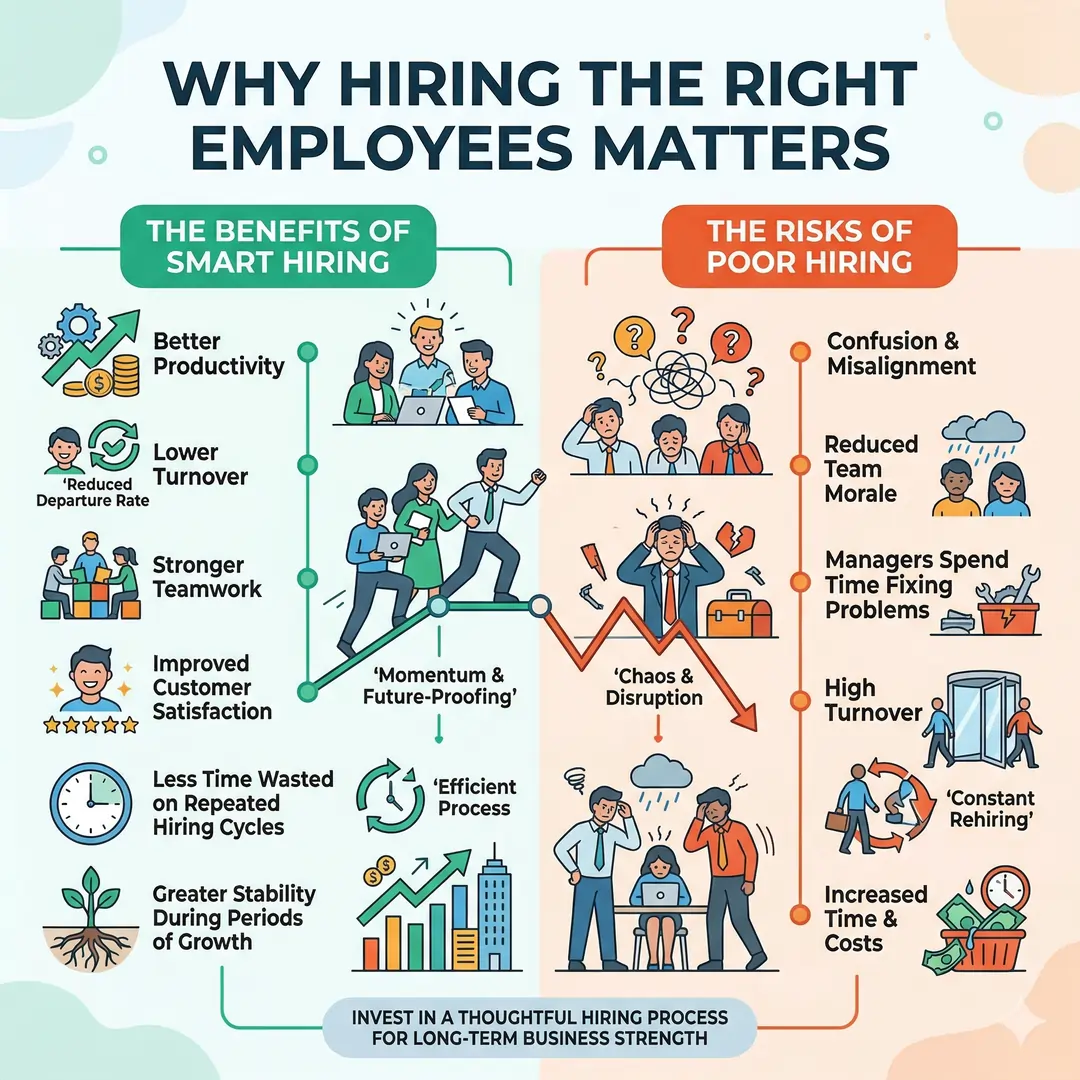
A business is only as strong as the people behind it. Skilled, reliable, and motivated employees create momentum. They help solve problems, support customers, and protect a company from the chaos that comes with poor organization or high turnover. Good hiring is not just about filling open roles. It is about building a team that can support the future of the business.
When hiring is done well, businesses often see:
- Better productivity
- Lower turnover
- Stronger teamwork
- Improved customer satisfaction
- Less time wasted on repeated hiring cycles
- Greater stability during periods of growth
When hiring is done poorly, the opposite can happen. A weak hire can create confusion, reduce morale, and force managers to spend more time fixing problems than growing the business. That is why it is worth taking the time to build a thoughtful hiring process from the beginning.
Start with the Right Hiring Platform
One of the first major decisions in the hiring process is choosing the right hiring platform. In today’s market, most businesses use digital tools to post jobs, collect applications, and screen candidates. The source material explains that hiring platforms are not all the same. Some offer a full-service experience with job posting, candidate matching, and screening tools. Others are more basic and leave most of the work to the employer.
A strong hiring platform can improve both the quality of applicants and the speed of hiring. A weak one can do the opposite. If a platform does not have enough reach, your job posting may not be seen by enough qualified people. That can leave a company waiting longer than necessary or forced to post the role in multiple places to get enough applicants. The source material also notes that an AI-powered platform can help automate job description writing and match candidates more effectively, which can save time and improve fit.
What to Look for in a Hiring Platform
Before choosing a platform, employers should ask several important questions.
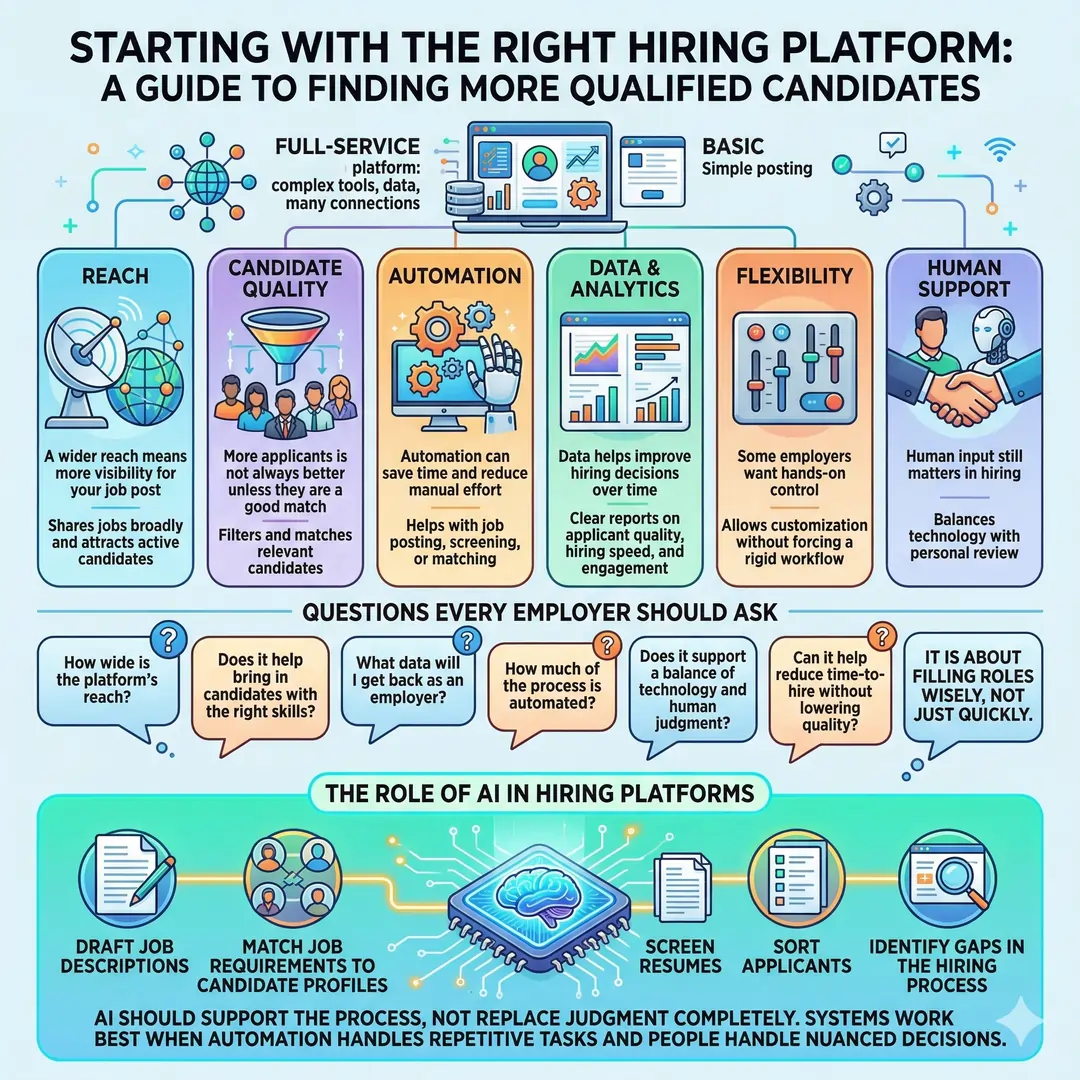
Table: Choosing a Hiring Platform
| What to Check | Why It Matters | What Good Looks Like |
|---|---|---|
| Reach | A wider reach means more visibility for your job post | The platform shares jobs broadly and attracts active candidates |
| Candidate quality | More applicants is not always better unless they are a good match | The platform filters and matches relevant candidates |
| Automation | Automation can save time and reduce manual effort | The platform helps with job posting, screening, or matching |
| Data and analytics | Data helps improve hiring decisions over time | Clear reports on applicant quality, hiring speed, and engagement |
| Flexibility | Some employers want hands-on control | The platform allows customization without forcing a rigid workflow |
| Human support | Human input still matters in hiring | The platform balances technology with personal review |
Questions Every Employer Should Ask
- How wide is the platform’s reach?
- Does it help bring in candidates with the right skills?
- What data will I get back as an employer?
- How much of the process is automated?
- Does it support a balance of technology and human judgment?
- Can it help reduce time-to-hire without lowering quality?
These questions matter because hiring is not just about filling roles quickly. It is about filling them wisely.
The Role of AI in Hiring Platforms
AI can be a major advantage when used properly. It can help employers:
- Draft job descriptions
- Match job requirements to candidate profiles
- Screen resumes
- Sort applicants more efficiently
- Identify potential gaps in the hiring process
The source material explains that AI can help narrow a large pool of candidates and improve the targeting of job postings. It also notes that some platforms can distribute job listings to a very large number of other boards, which can significantly improve visibility.
Still, AI should support the process, not replace judgment completely. A hiring system works best when automation handles repetitive tasks and people handle the more nuanced decisions.
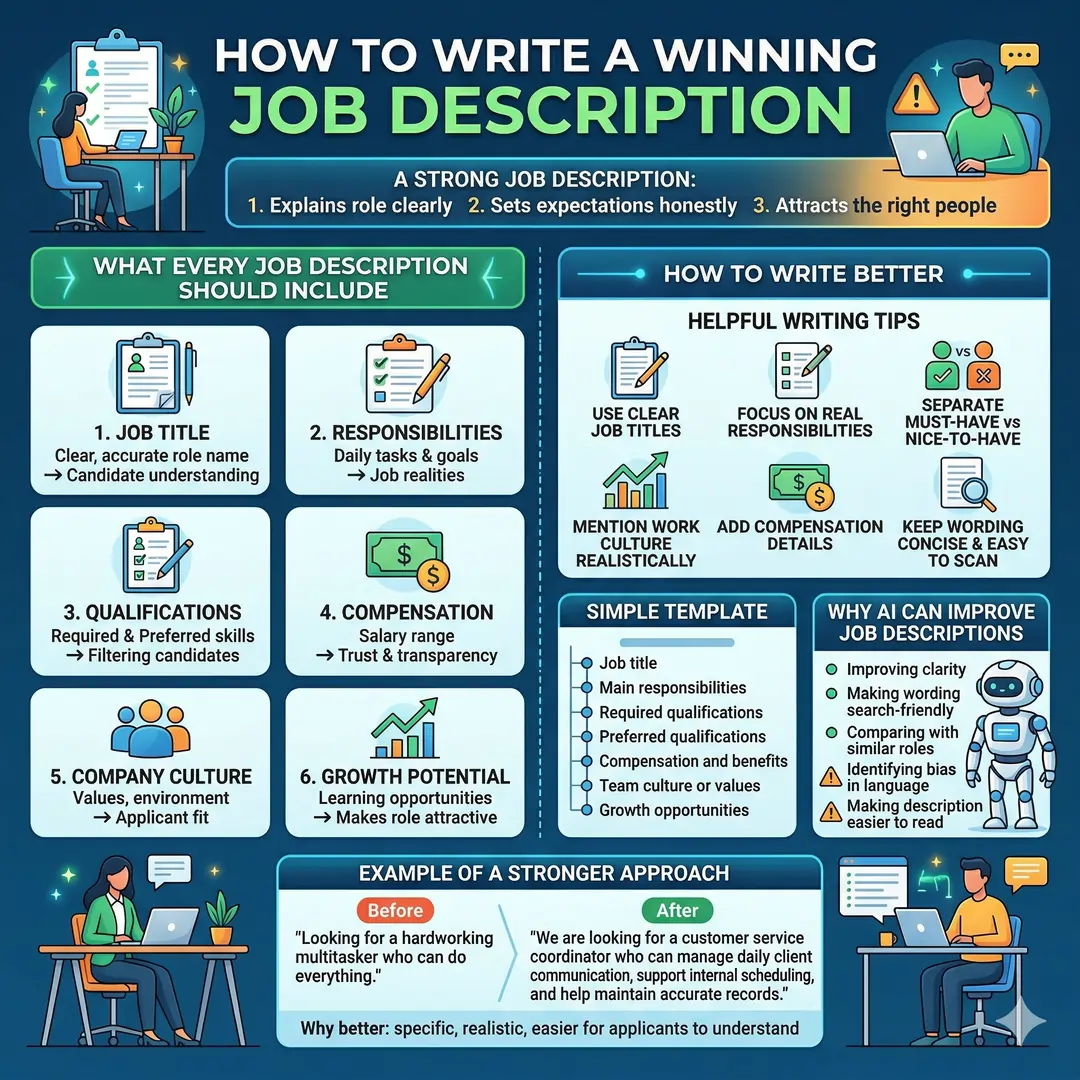
How to Write a Winning Job Description
A job description is often the first real impression a candidate gets of your business. It should be clear, specific, and realistic. Many employers make the mistake of writing vague or overly long postings that confuse good candidates or attract people who are not a fit. The source material emphasizes that clarity and specificity tend to attract better candidates in any industry.
A strong job description does three things at once:
- Explains the role clearly
- Sets expectations honestly
- Attracts the right people
What Every Job Description Should Include
Table: Core Parts of a Strong Job Description
| Section | What to Include | Why It Helps |
|---|---|---|
| Job title | Clear, accurate role name | Helps candidates understand the role immediately |
| Responsibilities | Daily tasks and long-term goals | Shows what the job actually involves |
| Qualifications | Required and preferred skills or experience | Helps filter candidates early |
| Compensation | Salary range or pay details, if possible | Builds trust and transparency |
| Company culture | Values, work style, and team environment | Helps applicants judge fit |
| Growth potential | Learning opportunities or career path | Makes the role more attractive |
How to Write Better Job Descriptions
A job description should feel informative, not inflated. Use language that is direct and friendly. Avoid overuse of buzzwords. Candidates usually respond best when the posting sounds practical and honest.
Helpful writing tips
- Use clear job titles instead of clever ones
- Focus on real responsibilities
- Separate must-have qualifications from nice-to-have qualifications
- Mention work culture in a realistic way
- Add compensation details when possible
- Keep the wording concise and easy to scan
A Simple Job Description Template
You can use a structure like this:
- Job title
- Main responsibilities
- Required qualifications
- Preferred qualifications
- Compensation and benefits
- Team culture or company values
- Growth opportunities
This format works well because it gives candidates enough information to decide whether they should apply, while also helping employers avoid mismatched applications.
Why AI Can Improve Job Descriptions
AI tools can be very useful in this stage. They may help with:
- Improving clarity
- Making wording more search-friendly
- Comparing the posting with similar roles
- Identifying bias in language
- Making the description easier to read
The source material also warns that job descriptions can accidentally include bias, which may discourage qualified candidates or create legal risk in serious cases. That is an important reminder. Even small wording choices can affect who applies.
Example of a Stronger Job Description Approach
Instead of writing:
- “Looking for a hardworking multitasker who can do everything.”
Try writing:
- “We are looking for a customer service coordinator who can manage daily client communication, support internal scheduling, and help maintain accurate records.”
The second version is much better because it is specific, realistic, and easier for applicants to understand.
Attracting Better Candidates
Once the job description is ready, the next challenge is attracting the right people. Good candidates usually have options, which means businesses need to present themselves well. This includes the job post itself, the company’s reputation, and the way the hiring process feels from the outside.
A strong candidate experience starts the moment someone sees the posting.
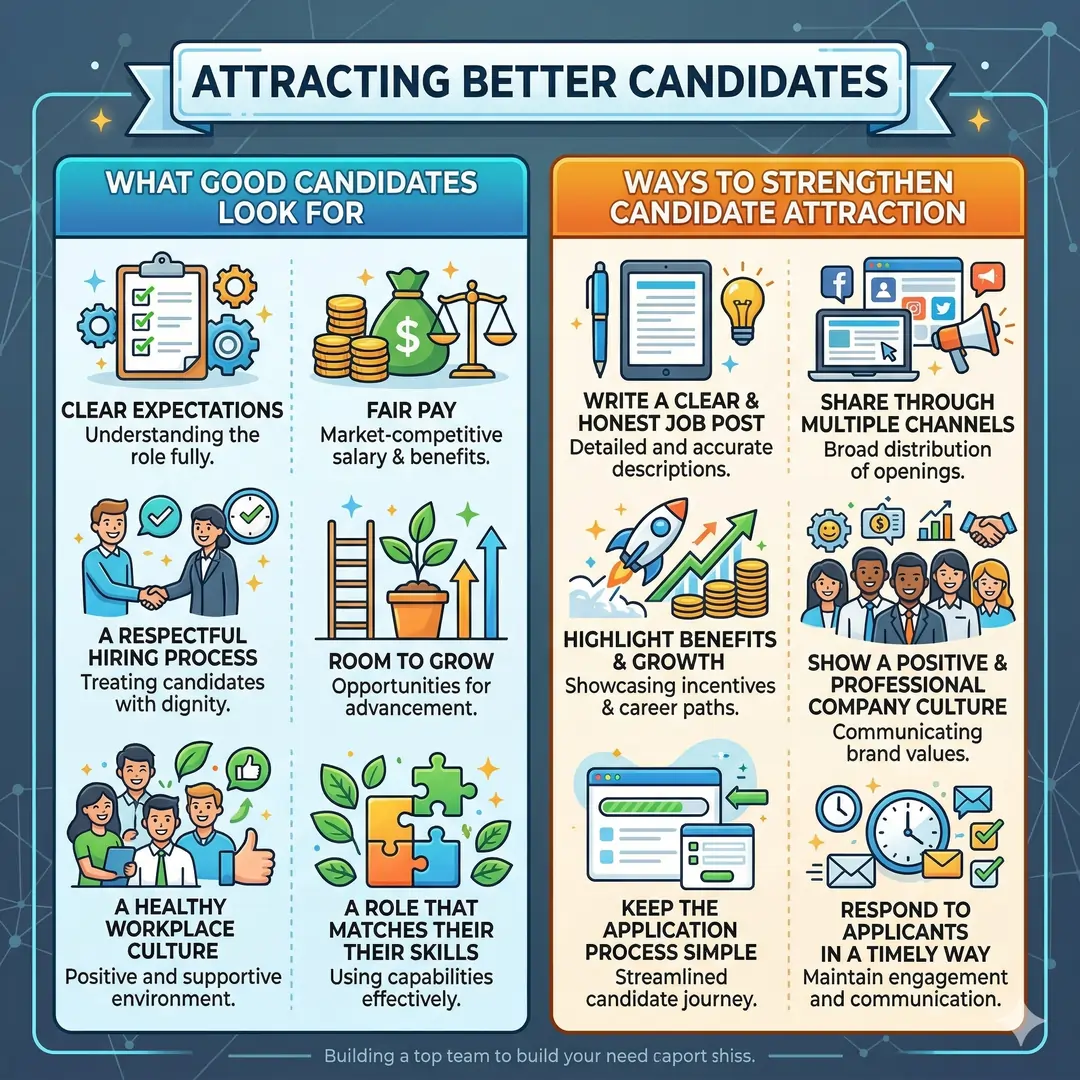
What Good Candidates Usually Look For
- Clear expectations
- Fair pay
- A respectful hiring process
- Room to grow
- A healthy workplace culture
- A role that matches their skills
Ways to Strengthen Candidate Attraction
- Write a clear and honest job post
- Share the role through more than one channel
- Highlight benefits and growth opportunities
- Show a positive and professional company culture
- Keep the application process simple
- Respond to applicants in a timely way
Table: Candidate Attraction Methods
| Method | Why It Works | Best Use Case |
|---|---|---|
| Job platforms | Reaches active job seekers | General hiring needs |
| Employee referrals | Candidates often trust referrals | Cultural fit and reliable hires |
| Company careers page | Builds direct interest in the brand | Long-term employer branding |
| Social media | Expands visibility | Outreach to broader audiences |
| Professional networks | Connects with experienced talent | Specialized roles |
How to Vet Candidates Quickly and Effectively
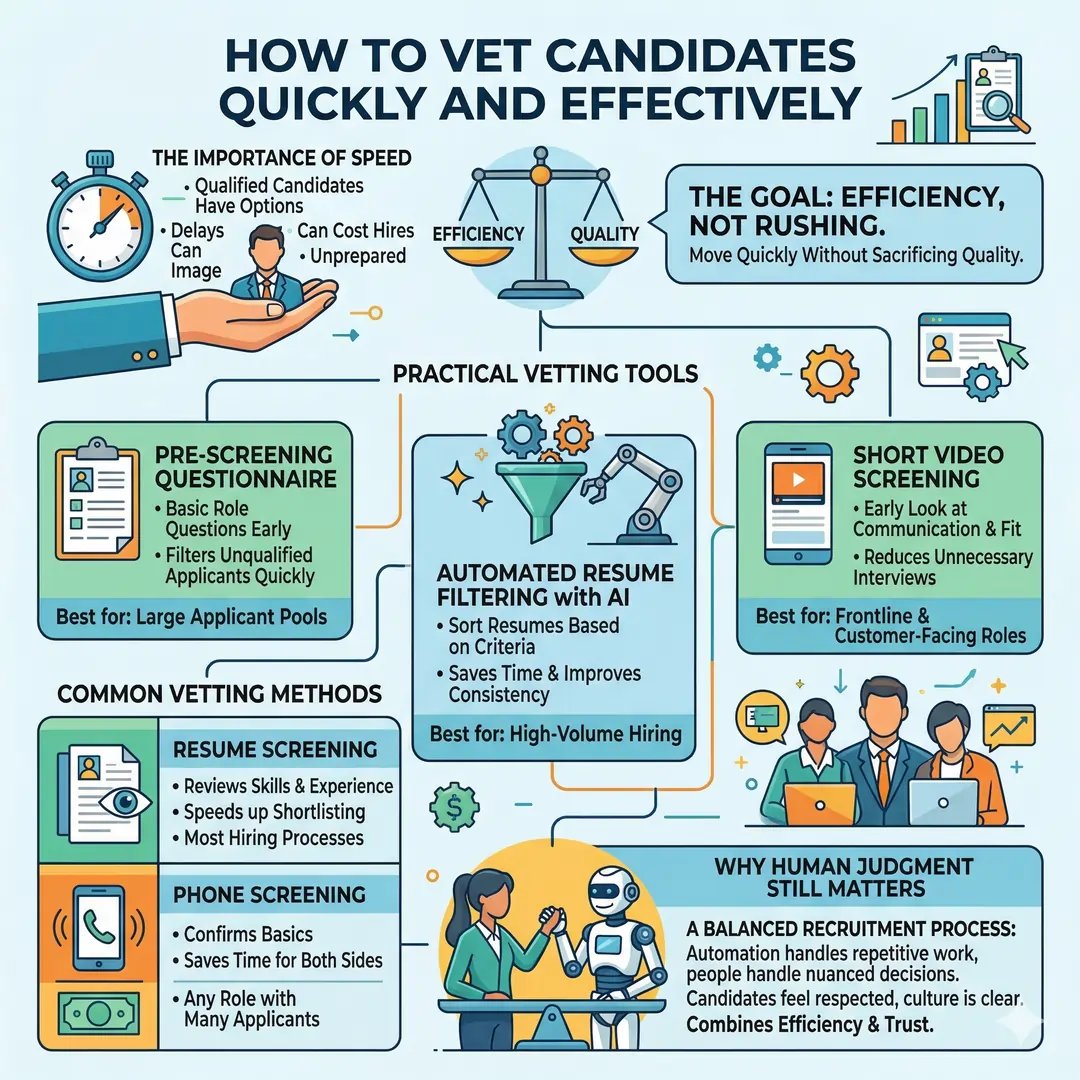
One of the most important messages in the source material is that speed matters. Qualified candidates often compare several offers at once, and delays can cost a business the person it wants to hire. A slow hiring process can make even a strong employer look unprepared. The source material recommends completing vetting quickly while still being thorough.
The goal is not to rush. The goal is to move efficiently without sacrificing quality.
Practical Vetting Tools
The source material highlights several time-saving tactics that employers can use:
- Pre-screening questionnaires
- Automated resume filtering with AI
- Short video screens before interviews
These tools help reduce the time spent reviewing candidates who are clearly not a match. That leaves more time for serious contenders and better conversations later in the process.
Table: Common Vetting Methods
| Method | What It Does | Benefit | Best For |
|---|---|---|---|
| Pre-screening questionnaire | Asks basic role-related questions early | Filters unqualified applicants quickly | Large applicant pools |
| Resume screening | Reviews skills and experience | Speeds up shortlisting | Most hiring processes |
| AI resume filtering | Sorts resumes based on criteria | Saves time and improves consistency | High-volume hiring |
| Video screening | Offers an early look at communication and fit | Reduces unnecessary interviews | Frontline and customer-facing roles |
| Phone screening | Confirms basics before formal interviews | Saves time for both sides | Any role with many applicants |
Why Human Judgment Still Matters
Technology can make hiring faster, but it should not remove the human side of recruitment. The source material points out that some candidates may try to manipulate AI screening systems, which is one reason human review remains important. It also explains that maintaining a human connection helps employers show company culture more clearly.
That balance is important. The best hiring process is usually one where:
- Automation handles repetitive work
- People handle nuanced decisions
- Candidates feel respected throughout the process
This combination improves both efficiency and trust.
The Importance of a Human Touch in Hiring
Hiring is more than a technical process. It is also a relationship-building process. Candidates are evaluating the employer just as much as the employer is evaluating them. A human touch can make a real difference in how the company is perceived.
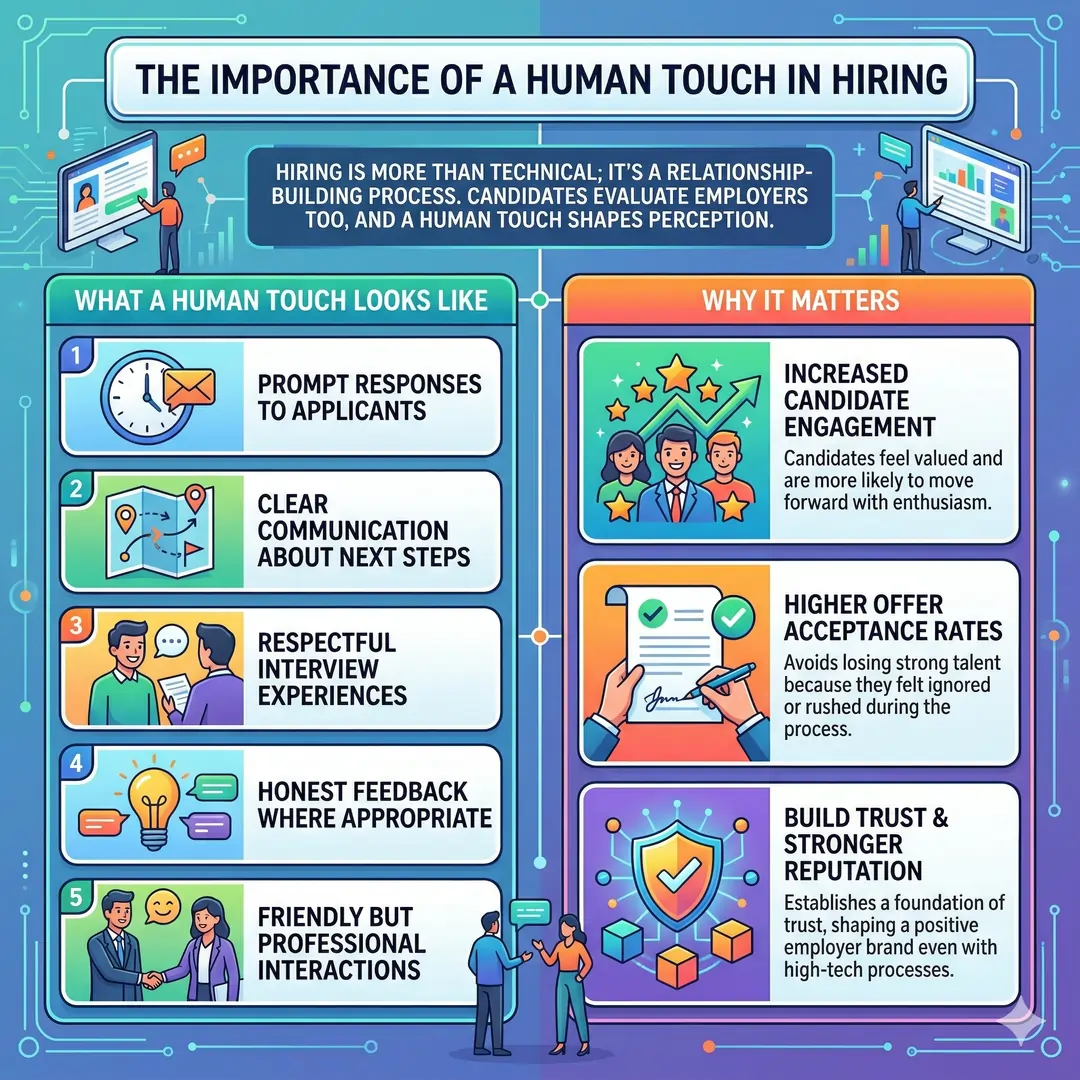
What a Human Touch Looks Like
- Prompt responses to applicants
- Clear communication about next steps
- Respectful interview experiences
- Honest feedback where appropriate
- Friendly but professional interactions
Why It Matters
A candidate who feels ignored or rushed is less likely to accept an offer. A candidate who feels valued is more likely to move forward with enthusiasm. Even in a technology-heavy hiring process, a human connection still builds trust.
Improving the Interview Stage
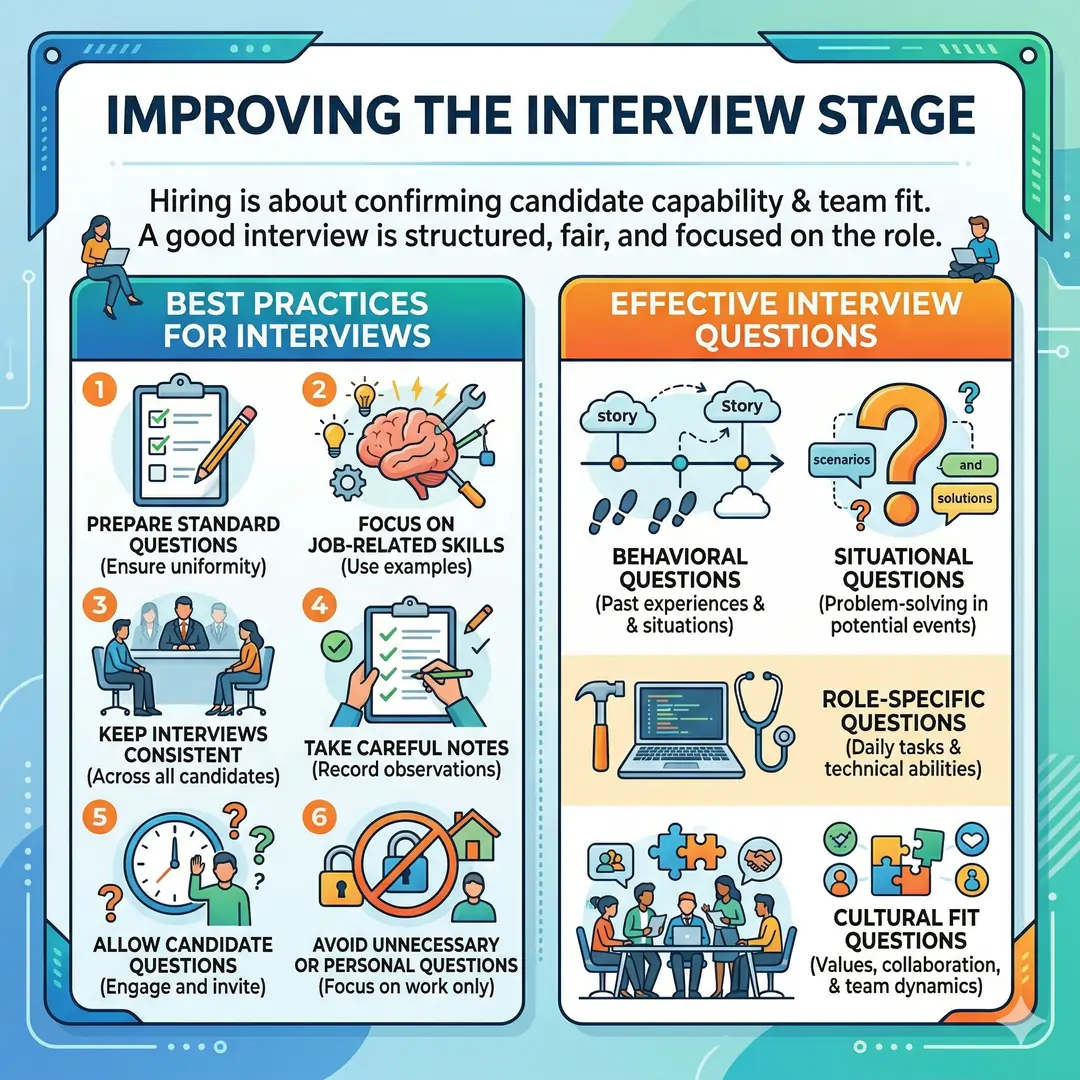
Interviews should help confirm whether the candidate can do the job and whether they fit the team. A good interview process is structured, fair, and focused on the actual role.
Best Practices for Interviews
- Prepare a standard set of questions
- Focus on job-related skills and examples
- Keep interviews consistent across candidates
- Take notes carefully
- Leave time for candidate questions
- Avoid unnecessary or overly personal questions
Types of Interview Questions That Work Well
- Behavioral questions about past experience
- Situational questions about problem-solving
- Role-specific questions tied to daily tasks
- Cultural fit questions that focus on values and collaboration
Table: Interview Styles
| Interview Type | What It Measures | When to Use It |
|---|---|---|
| Structured interview | Consistency across all candidates | Fair comparison |
| Behavioral interview | Past behavior and decision-making | Predicting future performance |
| Technical interview | Job-specific knowledge | Specialized roles |
| Video interview | Communication and convenience | Early screening |
| Panel interview | Broader perspective from multiple interviewers | Important final-stage hiring |
Making a Competitive Offer
After the right candidate is found, the next step is making an offer that is attractive and fair. A strong candidate may be considering more than one opportunity, so the offer needs to stand out for the right reasons.
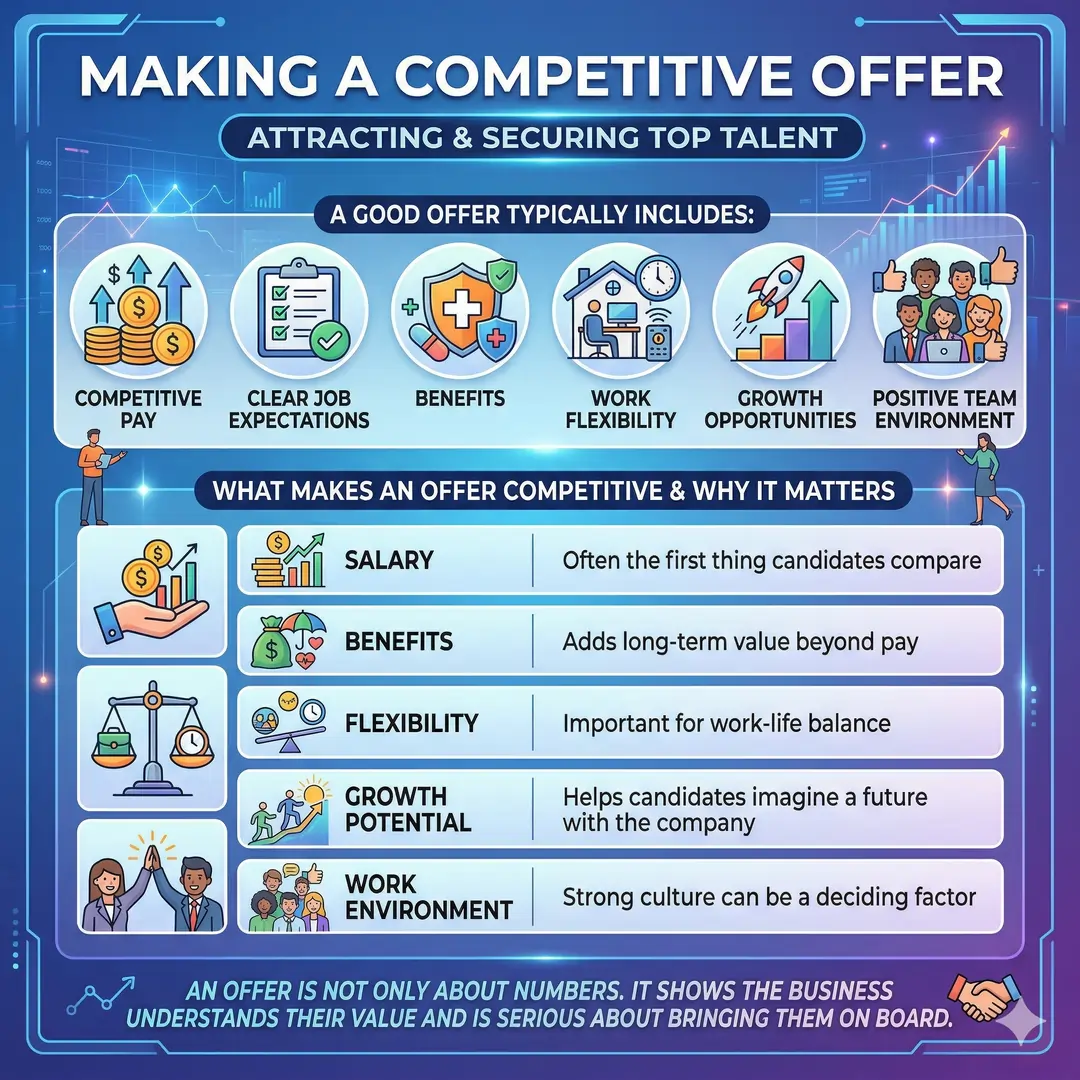
A good offer usually includes:
- Competitive pay
- Clear job expectations
- Benefits
- Work flexibility
- Growth opportunities
- A positive team environment
Table: What Makes an Offer Competitive
| Offer Element | Why It Matters |
|---|---|
| Salary | Often the first thing candidates compare |
| Benefits | Adds long-term value beyond pay |
| Flexibility | Important for work-life balance |
| Growth potential | Helps candidates imagine a future with the company |
| Work environment | Strong culture can be a deciding factor |
An offer is not only about numbers. It is about showing the candidate that the business understands their value and is serious about bringing them on board.
Common Hiring Mistakes to Avoid
Even experienced employers make avoidable hiring mistakes. Being aware of them can help improve results.
Mistakes That Can Slow Hiring Down
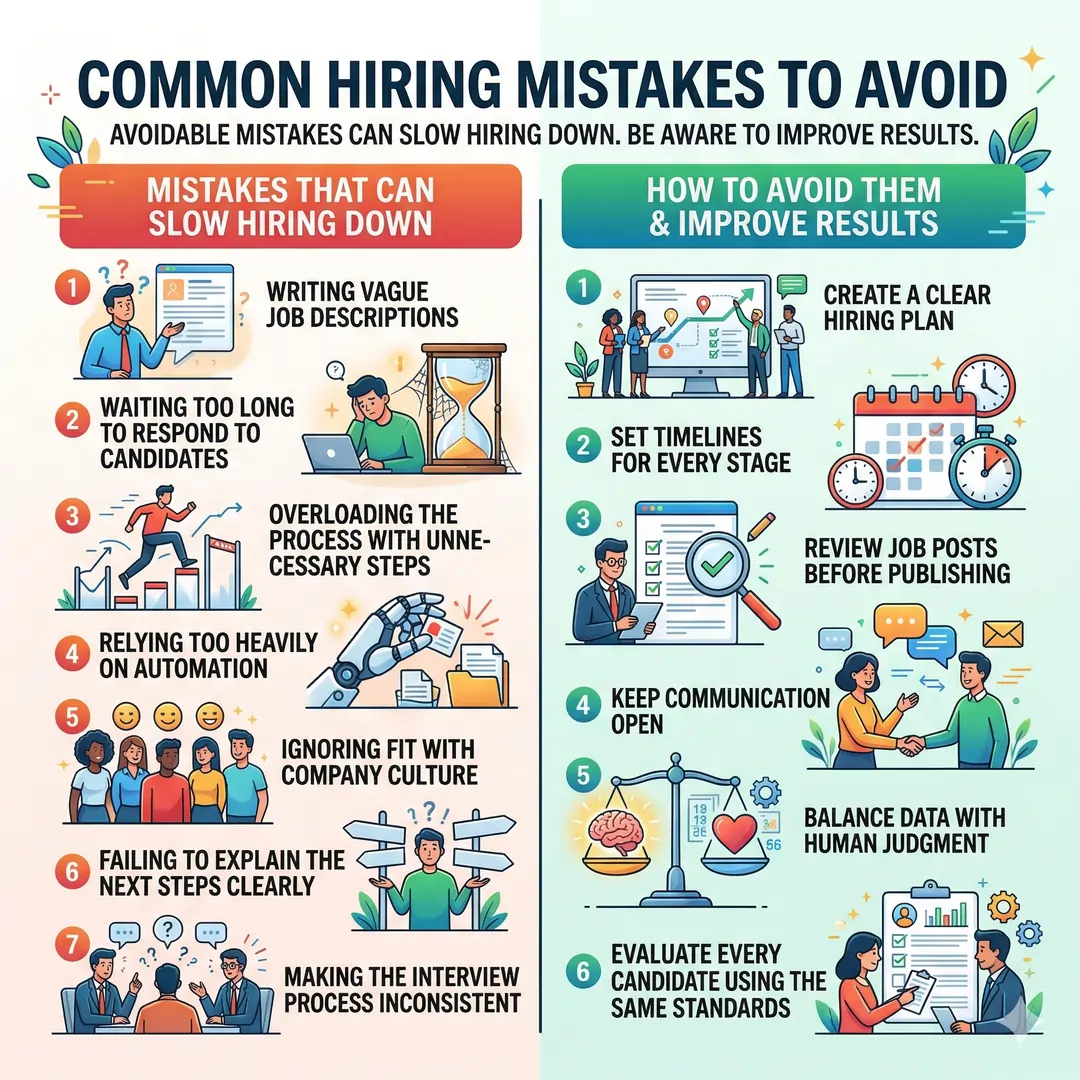
- Writing vague job descriptions
- Waiting too long to respond to candidates
- Overloading the process with unnecessary steps
- Relying too heavily on automation
- Ignoring fit with company culture
- Failing to explain the next steps clearly
- Making the interview process inconsistent
How to Avoid Them
- Create a clear hiring plan
- Set timelines for every stage
- Review job posts before publishing
- Keep communication open
- Balance data with human judgment
- Evaluate every candidate using the same standards
A Practical Hiring Framework for Small and Mid-Sized Businesses
Many smaller businesses do not have large HR teams. That is why they need a simple process that can be repeated consistently.
Table: A Step-by-Step Hiring Framework
| Step | Action | Goal |
|---|---|---|
| 1. Define the role | Decide exactly what the business needs | Avoid confusion later |
| 2. Choose a platform | Select a hiring tool with the right reach and features | Find qualified applicants faster |
| 3. Write the job post | Create a clear and honest description | Attract the right people |
| 4. Publish and promote | Share the role in the right places | Increase visibility |
| 5. Pre-screen applicants | Use questionnaires or resume filters | Save time early |
| 6. Interview top candidates | Assess skills and fit | Narrow the field |
| 7. Make an offer | Present a strong and fair package | Secure the best candidate |
| 8. Onboard carefully | Help the new hire get started | Improve retention |
Examples of Good Hiring Thinking in Action
Sometimes hiring becomes easier when we look at it in real-world terms.
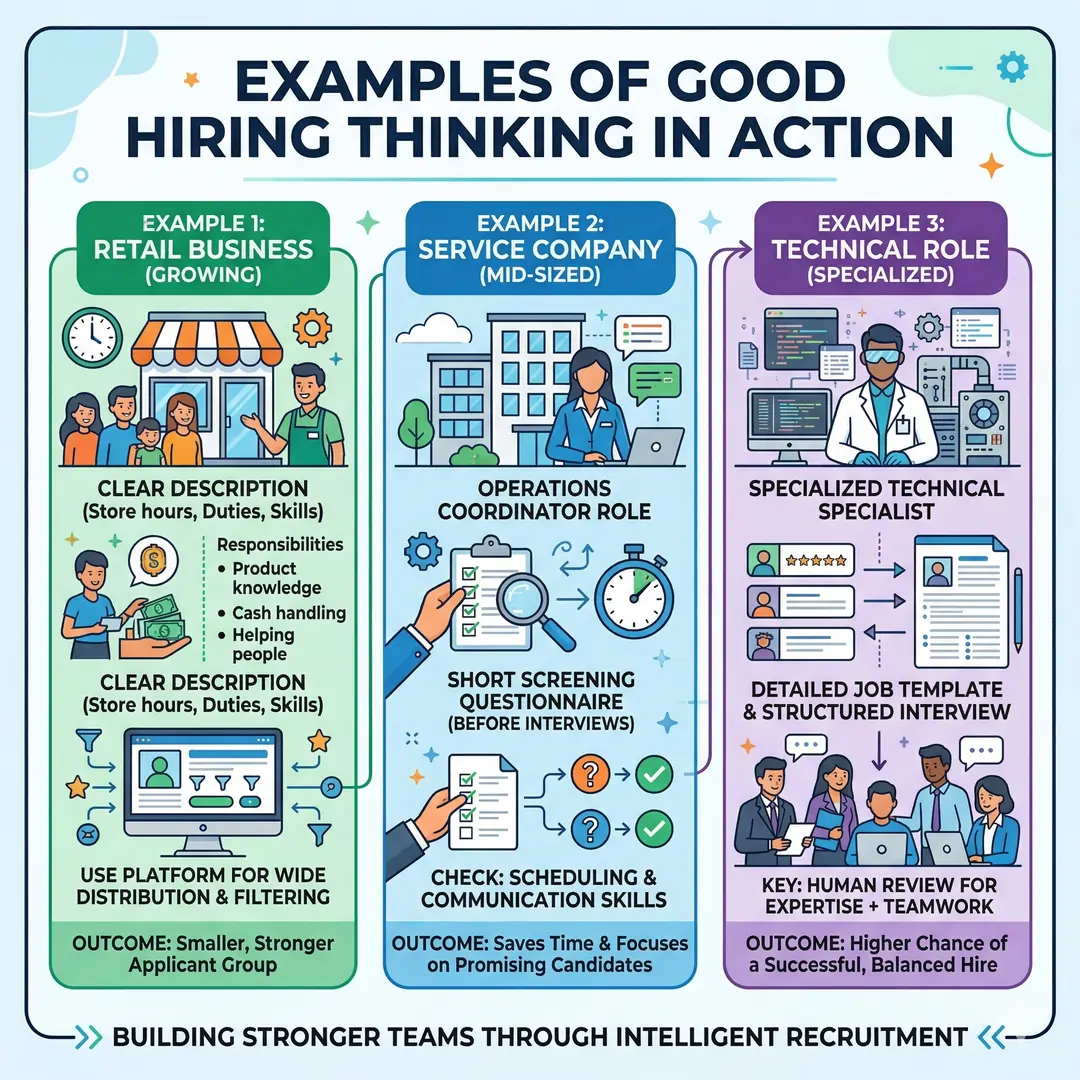
Example 1: A growing retail business
A small retail store wants to hire a customer support associate. Instead of posting a vague message, it writes a clear description showing store hours, responsibilities, and the skills needed for handling customers. It uses a platform that can distribute the role widely and filter applicants by availability. The result is a smaller but stronger group of applicants.
Example 2: A mid-sized service company
A service company needs an operations coordinator. It uses a short screening questionnaire to check scheduling experience and communication skills before interviews. This saves time and helps managers focus only on promising candidates.
Example 3: A specialized technical role
A business looking for a specialist in a technical field uses a detailed job template and a structured interview. It keeps human review in the process because the role requires both expertise and teamwork. That balance improves the chance of a successful hire.
Final Thoughts
Hiring the right employees takes planning, clarity, and patience. It is not enough to simply post a job and wait. Businesses need to think carefully about where they post roles, how they write job descriptions, how they screen applicants, and how quickly they move when they find a strong candidate. The source material makes the case clearly: the right platform, a strong job description, and efficient vetting can make a major difference in hiring success. It also shows that while AI and automation are helpful, a human touch still matters deeply in the process.
For businesses of any size, but especially small and mid-sized ones, hiring should be treated as a strategic priority. A thoughtful process can improve the quality of hires, reduce wasted time, and create a stronger team for the future. The best companies are not just those that hire quickly. They are the ones who hire wisely.
Key Citations And Article References
- Recruitment Strategies and Best Practices (SHRM)
- Effective Hiring Strategies for Employers (Indeed Hiring Guide)
- How to Hire the Right People (Harvard Business Review)
- Why Hiring the Right Talent Matters (Gallup Workplace Insights)
- Recruitment and Selection Factsheet (CIPD)
- The Future of Recruitment Technology (Forbes HR Council)
- Top Online Recruitment Tools for Businesses (Business News Daily)
- Online Job Search Basics for Employers (Investopedia)
- Best Recruitment Software Platforms (TechRadar Guide)
- Top Recruiting Software Solutions (ZDNet Review)
- How AI is Transforming Hiring (McKinsey Insights)
- AI in Recruitment Explained (IBM Technology Guide)
- Global Human Capital Trends Report (Deloitte)
- AI and the Future of Hiring (World Economic Forum)
- Future of Work and Workforce Trends (PwC Report)
- How to Write a Job Description (Indeed Employer Guide)
- Step-by-Step Job Description Writing Guide (SHRM)
- Free Job Description Templates (Betterteam)
- How to Create Effective Job Descriptions (CareerBuilder)
- Writing Great Job Descriptions (Monster Hiring Guide)
- Interviewing Best Practices for Employers (SHRM Toolkit)
- Structured Hiring and Interview Techniques (Harvard Business Review)
- Pre-Employment Screening Guide (Indeed Hiring Resources)
- Interviewing Best Practices for Employers (Glassdoor Guide)
- Selection Methods and Hiring Decisions (CIPD Guide)
Frequently Asked Questions (FAQs)
FAQ 1: What is the best way to find employees for a small business?
The best way to find employees for a small business is to use a clear hiring process that starts with a well-defined role, continues with a strong job description, and ends with fast but careful screening. Small businesses usually do not have the luxury of wasting time on poor-fit applicants, so the hiring method should be simple, focused, and consistent. The source article emphasizes that businesses often improve results when they begin by choosing the right hiring platform, because a good platform can increase reach, support candidate matching, and reduce time-to-hire.
A smart approach usually combines technology and human judgment. A platform can help you publish the role, sort candidates, and identify people with the right background, but the final decision should still involve a real person who understands the business culture and day-to-day work. This balance is especially important for small businesses, where each hire can have a major impact on productivity, morale, and customer experience.
In practical terms, small businesses should focus on three things:
- A specific job description that explains the role clearly
- A hiring platform with enough reach to attract qualified candidates
- A simple screening process that quickly removes obvious mismatches
If the process is too broad, too slow, or too vague, the business may attract many applicants but few strong ones. If it is too narrow, it may miss talented people who would have been a great fit.
FAQ 2: What should a strong job description include?
A strong job description should give candidates a clear picture of what the role involves, what kind of person the company is looking for, and what the candidate can expect in return. It should be specific without being overloaded with unnecessary detail. A good job description does not just attract more applicants. It attracts better applicants.
| Job Description Element | What It Should Include | Why It Matters |
|---|---|---|
| Job title | A clear and accurate title | Helps candidates understand the role quickly |
| Main responsibilities | Daily tasks and expected outcomes | Sets realistic expectations |
| Required qualifications | Must-have skills or experience | Filters unqualified applicants |
| Preferred qualifications | Helpful but not essential skills | Broadens the talent pool without lowering standards |
| Compensation | Salary range or pay transparency when possible | Builds trust and improves candidate interest |
| Company culture | Values, team style, and working environment | Helps candidates judge fit |
A well-written job description should also avoid bias, unclear language, and exaggerated expectations. For example, instead of saying “must be a rockstar who can do everything,” a better version would explain the actual tasks, goals, and work environment. That makes the posting more professional and easier for both people and search engines to understand.
It is also wise to update job descriptions regularly. As roles change over time, the language should reflect the current needs of the company. A description that is too old or too generic may attract the wrong applicants, while a fresh and precise one makes the hiring process much easier.
FAQ 3: How can businesses screen candidates quickly without losing quality?
Businesses can screen candidates quickly by using a structured process that removes obvious mismatches early while still leaving room for human review. The article explains that speed matters because strong candidates may be considering several offers at once, and delays can cause businesses to lose top talent.
A strong screening process often includes pre-screening questionnaires, resume filtering, and short video screens before formal interviews. These tools help employers focus their time on people who are more likely to succeed in the role. At the same time, human review remains important because not every good candidate fits neatly into an automated system.
A simple and effective screening flow may look like this:
- Review resumes for basic qualifications
- Use a short questionnaire to confirm availability, experience, or role-specific skills
- Conduct a brief video or phone screen
- Invite only the strongest candidates to a full interview
This approach saves time and keeps the process organized. It also improves the candidate experience because applicants get faster responses and a clearer process. The key is not to rush, but to screen intelligently. A fast process that ignores quality can create problems later, while a fast process that is also thoughtful can lead to better hires.
FAQ 4: How should employers balance AI hiring tools with human judgment?
Employers should use AI as a support tool, not a full replacement for human decision-making. AI can be very helpful for tasks like matching candidates to job requirements, organizing resumes, and speeding up repetitive parts of recruitment. The source article highlights that AI-powered hiring tools can improve efficiency and help employers find candidates more effectively.
Still, human judgment is essential because hiring is not only about matching keywords. It is also about communication, problem-solving, team fit, and long-term potential. A candidate may not look perfect on paper, but could still be an excellent hire in real life. That is why businesses should review AI results carefully rather than relying on them blindly.
| AI Can Help With | Humans Should Handle |
|---|---|
| Sorting resumes | Final hiring decisions |
| Matching job requirements | Assessing culture fit |
| Scheduling or early screening | Interpreting communication style |
| Identifying patterns in hiring data | Judging leadership potential and adaptability |
This balance is especially useful when hiring for roles that require both technical skill and interpersonal ability. AI can make hiring faster, but people make it wiser. The best approach is a hybrid one where technology reduces manual work, and humans preserve fairness, context, and relationship building.
FAQ 5: What is the most effective way to attract high-quality candidates?
The most effective way to attract high-quality candidates is to combine clarity, reach, and trust. Candidates are more likely to apply when a business presents the role clearly, explains the value of the opportunity, and makes the hiring process feel professional and respectful. The article shows that companies can improve hiring results when they choose the right platform, write strong job descriptions, and keep the process moving efficiently.
A strong attraction strategy often includes more than one channel. Employers should not depend on a single source of applicants. Instead, they should use a mix of job postings, referrals, career pages, and professional outreach when appropriate. The important thing is to make the job easy to find and easy to understand.
Here are a few practical ways to increase candidate quality:
- Write a specific and honest job description
- Share the role in places where your ideal candidates already look
- Highlight growth opportunities, not just duties
- Include compensation details when possible
- Keep communication fast and respectful
- Show the company’s culture and values clearly
Businesses that look organized, responsive, and transparent usually attract better applicants than businesses that appear vague or slow. Good candidates often compare several employers at once, so the hiring experience itself becomes part of the employer brand. A clear process sends the message that the company is serious, reliable, and worth joining.
If you’d like, I can turn these into a more polished blog FAQ section with SEO meta-title style formatting and even stronger keyword placement.
FAQ 6: How long does it typically take to hire the right employee?
The time it takes to hire the right employee can vary depending on the role, industry, and hiring process, but research shows that the average hiring process can take several weeks to over a month. This delay often happens because employers need to review applications, conduct interviews, and compare candidates carefully. In many cases, the longest part of the process is screening resumes and shortlisting candidates, especially when there are hundreds of applications for a single role.
However, speed has become a major competitive advantage in modern hiring. Companies that take too long to respond risk losing strong candidates to faster competitors. This is why many organizations now use AI-powered screening tools and structured hiring workflows to reduce delays without lowering quality. These tools help employers quickly identify suitable candidates while keeping the process organized.
At the same time, it is important not to confuse speed with rushing. A fast hiring process should still include careful evaluation, interviews, and human judgment. The goal is to eliminate unnecessary delays, not skip important steps. Businesses that strike this balance often see better hiring outcomes and stronger employee retention.
FAQ 7: What are the most effective methods for reducing hiring mistakes?
Reducing hiring mistakes requires a structured and consistent approach. Many hiring errors happen when decisions are based on incomplete information, unclear job expectations, or rushed judgments. By improving each stage of the hiring process, businesses can significantly reduce the risk of making a poor hire.
Some of the most effective methods include:
- Using structured interviews to ensure all candidates are evaluated fairly
- Defining clear job requirements before posting the role
- Separating required and preferred skills to avoid unrealistic expectations
- Using pre-screening tools to filter candidates early
- Involving multiple decision-makers to reduce bias
- Checking real-world skills through practical tasks or assessments
Another key factor is consistency. When every candidate goes through the same evaluation process, it becomes easier to compare them objectively. Research also shows that unstructured hiring decisions often lead to bias and inconsistency, while structured methods improve accuracy and fairness over time.
Finally, businesses should review past hiring decisions. Understanding what worked and what did not helps improve future hiring strategies and prevents repeating the same mistakes.
FAQ 8: What role does employer branding play in attracting employees?
Employer branding plays a powerful role in attracting high-quality candidates. It refers to how a company is perceived as a place to work, including its culture, values, reputation, and employee experience. A strong employer brand can make a business more appealing even if it is smaller or less well-known.
When candidates evaluate job opportunities, they often consider more than just salary. They look at factors such as:
- Work environment and company culture
- Opportunities for growth and learning
- Leadership style and communication
- Work-life balance and flexibility
A positive employer brand builds trust and encourages more qualified candidates to apply. It also improves employee retention, because people are more likely to stay in a workplace where they feel valued and supported.
On the other hand, a weak or unclear employer brand can make hiring more difficult. Candidates may hesitate to apply if they do not understand what the company stands for or what working there is like. This is why businesses should present themselves clearly in job descriptions, communication, and overall hiring experience.
FAQ 9: What are the advantages and limitations of using AI in recruitment?
AI has become an important part of modern recruitment because it can handle large volumes of data quickly and efficiently. Many companies now use AI for tasks such as resume screening, candidate matching, and interview scheduling. Studies show that a significant percentage of organizations already use AI in early hiring stages to improve efficiency and reduce manual workload.
Table: Advantages and Limitations of AI in Hiring
| Aspect | Advantages of AI | Limitations of AI |
|---|---|---|
| Speed | Processes thousands of applications quickly | May overlook unique or unconventional candidates |
| Consistency | Applies the same criteria to all applicants | Can repeat bias if trained on flawed data |
| Efficiency | Reduces manual workload for recruiters | Requires setup, monitoring, and updates |
| Accuracy | Identifies skill patterns and matches roles | May misinterpret context or soft skills |
| Scalability | Handles large hiring volumes easily | Not always suitable for small or specialized hiring |
AI works best when combined with human oversight. Experts recommend maintaining clear guidelines, regular audits, and human review to ensure fairness and accuracy in hiring decisions.
In simple terms, AI is a powerful tool, but it should support recruiters rather than replace them. The best hiring systems use technology for speed and humans for judgment.
FAQ 10: How can companies improve the candidate experience during hiring?
Improving the candidate experience is one of the most effective ways to attract and secure top talent. Candidates are more likely to accept job offers when they feel respected, informed, and valued throughout the hiring process.
A positive candidate experience is built through clear communication and a well-organized process. This includes:
- Responding to applications quickly
- Explaining the hiring steps clearly
- Providing updates during the process
- Conducting professional and respectful interviews
- Giving feedback when possible
Candidates often judge a company based on how they are treated during hiring. A slow or confusing process can create a negative impression, even if the company itself is strong. On the other hand, a smooth and respectful experience can strengthen the company’s reputation and make candidates more excited about the opportunity.
It is also important to maintain a human connection, even when using automated tools. While technology can improve efficiency, candidates still value interaction, transparency, and authenticity. A balanced approach that combines efficiency with personal engagement often leads to the best results.
Ultimately, companies that invest in a better candidate experience not only hire better employees but also build a stronger employer brand over time.
